
by P.E.A. Blair
Information and communications technology industries contribute up to 4% of the global carbon emissions currently driving anthropocene rapid climate change.[i] While Google claims to have reached carbon neutrality,[ii] this does not account for the accumulation of emissions in the supply chain and user end of their vast empire of software. What, then, can we make of eco-art that harnesses Google’s infrastructures to raise awareness of and facilitate access to the natural world? This is the case in the Internet of Nature[iii] devised by Sylvia Grace Borda and J. Keith Donnelly. Constructed with Google Street View photography and intersecting with the City of Dundee’s forest strategy plan,[iv] they present art tableaux of nature in the parklands of Dundee through which visitors are guided with text accompanying interactive Street View images situated within the parks.
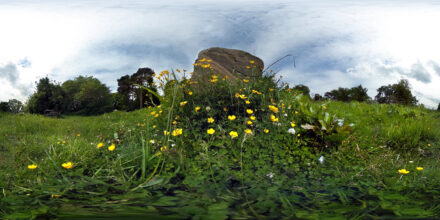
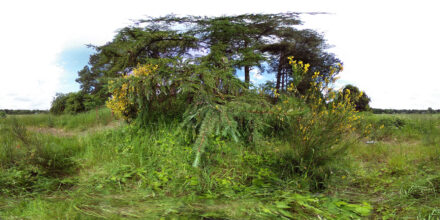
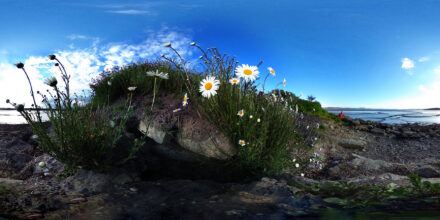
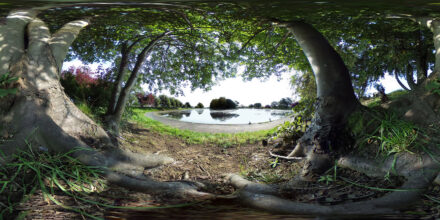
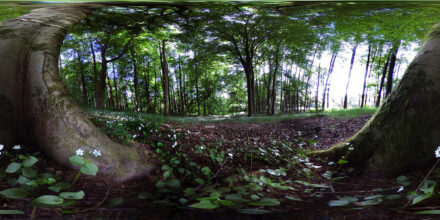
The Street View map program is made primarily by and for road vehicle users. Even when using it to plan a route as a pedestrian, the every-person avatar can usually only be dropped on roads amidst largely carbon and particulate-emitting traffic. Underpinning this is an assumption that users possess no hindrances to access or mobility. In the Dundee Internet of Nature, the motivations for and making of Street View images are disrupted and decentralized. The cameras are taken off-road to remote spots in Dundee’s green spaces. Visually, it is possible to pan and tilt 360° and zoom in and out from the series of fixed positions in the ways familiar to Street View users. For those who benefit from text descriptions, their accompanying paragraphs describe what the images show, and explain what species of flora feature and how their micro-ecosystems function.
This project has emerged in the year following strict pandemic lockdowns which acutely highlighted a widespread lack of access to parks in many urban places. Phase 1 of eased restrictions in Scotland began on 29 May 2020, and permitted up to one hour of local outdoor recreation.[v] This proved challenging for many underprivileged residents without gardens, green space or parks within accessible proximity to their homes. Others who were vulnerable and instructed to shield remained essentially imprisoned. With a rise of racist, anti-immigrant and misogynist sentiments dovetailing with the UK’s uncoupling from the European Union throughout this period, certain quarters of society doubled down on their occupation of outdoor space, meaning women and minority genders, ethnic minorities and some with mobility issues often had even less space or permission to traverse the outdoors. Without claiming to be a fix-all solution, the Internet of Nature finds a way to repatriate some of that inaccessible space linked to place.
Located on the east coast and north of the Firth of Tay which flows into the North Sea, Dundee is the fourth-largest city and has the second-largest population density in Scotland. The full Internet of Nature collection comprises over fifty 360° photographs uploaded in June and August 2021 depicting tableaux scenes in various parks and green spaces across the city, and more throughout Scotland, that have received over 70,000 views. While the virtual visiting experience equips users with ecological knowledge and scenes of nature, the images stay the capitalist agenda inherent in Google technologies by providing a reprieve from what Sybille Lammes points out as the visual bombardment of sites of consumerism trying to determine where users ought to stop off to eat, drink and shop on their real travels informed by their virtual routing.[vi] Instead, the Internet of Nature invites glimpses into a real/virtual world in which humans are not the protagonists and the activity does not produce (cyber)social identities for people. Instead, individual plants are centred and their stories told from their life-journeys, a by-product of which provides a way for humans to enjoy and learn about pockets of the natural world and the (g)local ecology on its own terms from its fixed-in-place perspective.
What we do not see but is implied by the low angles and fixed pivot point of the images is the necessary act of being in place undertaken by Connelly to produce the images. (Borda has been in Canada throughout, and has vast experience of this approach to photography from making her Farm Tableaux previously).[vii] This meant traversing off-street and off-path terrain to reach parts of the parks inhabited by plants with stories to tell and unusual (to us) viewpoints from which to see their relatively static lived world, reflected in the seemingly restrictive range in the pan and zoom functions. As Lammes argues, use of this kind of technology collapses any distinction between the idea of ‘maps as abstract and objectified, and the practice of going somewhere as a personal and subjective experience of space’.[viii] These images confront us with a subjective experience of organisms that are not going anywhere; they live out their lives and be where they are. This quite literally stops Google Street View in its tracks. Using a static camera lens’s ability to zoom derived from the animal ability to look into the distance or focus on what is close by, the Street View camera is no longer facilitating the human drive to travel and get somewhere. It is immobile and low down to enact the position of a flower, fern or sapling whose life journey happens in place, the space around which we are able to see.
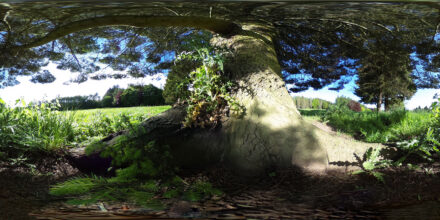
The low angle additionally subverts the usual high angle of a Street View camera typically mounted atop a specially modified car to facilitate the clearest 360° views as it moves and records. We see what we imagine plants would see if they could look, introducing us to a different embodied way of seeing, being in and experiencing green space and ecosystems at a time when recent circumstances have highlighted and exacerbated widespread issues with accessing such space in real life. Unlike the digital touring facilitated by Street View, the Internet of Nature is more of a gallery tour moving from image to image. While the pan, zoom and grab-to-swivel functions grant some interactivity, it is not possible to stray far from the rooted plant from whose point of view we examine the scene, inviting us to really look at this space in this moment. The lens and digital distortions are also reminders that what we interact with is a compressed rendering of wide open space in another place. While resisting an imposed lack of access, this virtual tour also has the potential to enhance real-life tours of these areas.
As this touring indicates, parks are primarily leisure spaces designed for humans and secondarily nature places for plants and animals to live, form cultures and thrive. The first stop on the Dundee tour at Camperdown Park inverts that. Picturing a native conifer, we learn that ‘debris nestled in the junction between this Scots pine tree trunk and its root system is now supporting an opportunistic thistle plant (The thistle is enjoying the tree canopy cover protecting it from wind and sheltering it from too much sun) While nearby around the tree’s root system a new sapling is starting to sprout. The presences of stinging nettles is a sign of their capacity to grow and rehabilitate poor acidic soils slowly to a more favourable pH. Indeed the pine needles from this tree would be too acidic or toxic for most plants to take root near it.’ The guide provides information concerning life in the immediate vicinity of the ground-level space at this tree, around which new life has found ways to self-regulate and harmonize through mutual benefits.
With humans largely confined to their domiciles, nature teemed in abandoned urban spaces. Birdsong replaced the hum of traffic and the air was abuzz with pollinators free to perform their labour with their pick of unkempt wildflowers so often considered to be weeds and are thus usually destroyed.[ix] Even if there were few recorded increases in wildlife populations, nature became more heard and seen during this ‘anthropause’. Nature’s resurgence in human-free spaces, however small, appear consistently in the wider gallery. The Scottish wild orchid, for example, features in an image at Turbine 115, one of the photographs taken at Scottish Power Renewable Whitelee Operations.[x] This flower was dying out due to our increasing reclamation of marshland, but re-emerged as the rains and land were left to go their own way in our absence.
Scotland is perhaps the UK region most attuned to climate science and what actions are needed to curb the climate and ecological crises. Indeed, Glasgow was chosen to host COP26 in November 2021. With North Sea Oil facing difficulties[xi] and the increasing capacity of renewable energies, an added subset of green industries and their need for human-free spaces, such areas are becoming established as places for nature in a way that parks typically are not. We may call these spaces wind-farms and solar-fields, but they are also home to growing cultures of flora protected from further human interference, indicating that to save ourselves we really ought to leave most other things well alone. The Internet of Nature allows us to do that while accessing the spaces through Street View photography. This shows the potential of de-centring the human and human modes of mobility: when we centre nature – even digitally – we all win.
[i] Charlotte Freitag, et al., ‘The real climate and transformative impact of ICT: A critique of estimates, trends, and regulations’, Patterns 2.9 (2021), p. 3 Link here. last accessed 15 October 2021.
[ii] ‘Operating on 24/7 Carbon-Free Energy by 2030’, Google Link here last accessed 15 October 2021.
[iii] ‘Dundee City’s own “Internet of Nature”’, Earth Art Studio Link here last accessed 15 October 2021.
[iv] ‘Strategic Forest Plan, Dundee City Woodlands 2015–2025’, Link here last accessed 15 October 2021.
[v] ‘Lockdown begins to ease in Phase 1’, Scottish Government (2020) Link here last accessed 15 October 2021.
[vi] Sybille Lammes, ‘Digital Cartographies as Playful Practices’, in Contemporary Culture: New Directions in Art and Humanities Research ed. by Judith Thissen, Robert Zwijnenberg and Kitty Zijlmans (Amsterdam University Press, 2013), pp. 93–100 (p. 97) Link here last accessed 15 October 2021.
[vii] Sylvia Grace Borda, ‘Farm Tableaux: Project Synopsis’ Link here last accessed 15 October 2021.
[viii] Lammes, p. 96.
[ix] ‘Nature: liberated by lockdown?’, Natural History Museum (2020) Link here last accessed 15 October 2021.
[x] Borda Donnelly COP26, ‘Turbine 115’, Google Street View (2021) Link here last accessed 15 October 2021.
[xi] Jillian Ambrose, ‘North Sea oil was battered by Covid, but now faces much deadlier waves’, The Guardian (29 August 2021) Link here last accessed 15 October 2021.
Further links
Full Internet of Nature online collection
____________
Paula Blair makes the Audiovisual Cultures podcast and holds a PhD in Film and Visual Studies from Queen’s University Belfast. Visit Paula’s links here.