“Everything goes in and nothing comes out.“ is how the store The Black Hole was once described, where founder and owner Ed Grothus sold second-hand technical equipment.
Spanish artist Janire Najera’s photographic series, named after Grothus’ shop located in New Mexico (USA), provides a personal narrative, but also serves as a physical and political document of the past – that also looks forward, towards the future.
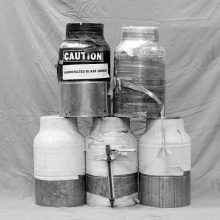
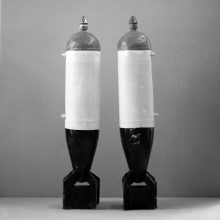
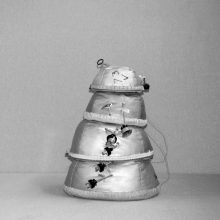
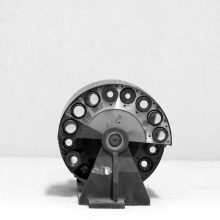
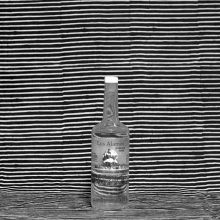
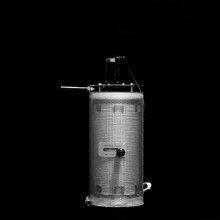
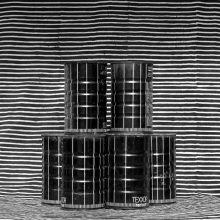
For the series, Najera selected and positioned a number of unidentified scientific objects and electronic equipment in front of the camera. Presented in black and white, most of the artefacts invite curiosity over their function and material. Without any context in terms of scale or size, the mysterious instruments puzzle at first glance. Labeled ‘caution’ or ‘restricted data’, or with their labels taped over, some of the items appear anonymous or somehow forbidden, their uses unknown. Yet, other scientific objects are relatively familiar: analysers, casings, seismographs, glass bottles and models of bombs or rockets. Shot with a long exposure, the images have a realness and sharpness to them, which contradicts their otherwise ambiguous appearance.
The true identity of these objects begins at Los Alamos National Laboratory, where Grothus began working in 1949; this is the largest science and technology research institution in the world, strategically situated in the remote mountains around Los Alamos. During the Second World War, the development of the first atomic bombs was overseen there by Robert J. Oppenheimer, under the code name ‘Manhattan Project’. At the lab, obsolete equipment was frequently exchanged with more up to date technology. While still working there, Grothus founded the Los Alamos Sales Company, later known as The Black Hole. Here, he accumulated the non-radioactive scientific equipment discarded by the laboratory and sold these items to the general public.
Characterised as a hard worker by his children, Grothus disliked waste and keenly collected everything – a habit developed while growing up during the Great Depression. During the Vietnam War, Grothus became disillusioned with his government’s involvement and joined the anti-war and nuclear disarmament movement. ‘Atomic Ed’ as he was called, left his job at the laboratory in 1969 and focused solely on the store. In the following four decades, Grothus established a “base to campaign for nuclear disarmament“ and founded the ‘First Church of High Technology’ holding a ‘Critical Mass’ on Sundays. Activists, artists and the public found their way to Atomic Ed, and he would continuously expand the store in order to raise awareness of the danger of radioactive waste and the nuclear threat.
2013 marked the 70th anniversary of the laboratory at Los Alamos, and even today, it is a place of military concealment and national security. The lab includes a facility for genetic research and, most importantly, the ‘Stockpile Stewardship’, a US program of reliability testing and maintenance of US nuclear weapons. Trespassing the local surrounding area is impossible, since it is either radioactively contaminated or blocked for security purposes.
After Ed Grothus’ death in 2009, his family arranged for the closing down of The Black Hole, per his request. During the final liquidation sale in 2012, Najera photographed Atomic Ed’s inventory and made portraits of people purchasing them. The colour portraits – as opposed to the artefacts in b/w – were taken against a silver backdrop. This shiny mylar material, which the artist discovered in the store, emphasises the mechanical, futuristic atmosphere of the shop. People hold up, wear their purchased items and Cold War relics, as if they were pieces of treasure. There is a woman who has proudly purchased a whole trolley piled up with records, while others hold a computer, bulbs and unmarked boxes. Literally, the stock is in ‘good hands’; the intention of the final sale was to recycle and distribute the inventory amongst the community rather than impersonal profit making.
The exhibition The Black Hole at ffotogallery in Cardiff featured an interesting array of (physical) artifacts in display vitrines and documentation film from the sale weekend for visitors to see. Some of the unframed, square photographs were hung in grids – almost like an organised display of inventory. The clear, clean display of the images also references the isolated, sanitized environment of the laboratory and emphasises the complicated legacy of the nuclear threat in America and abroad. The captions are listed on a separate hand out, stating the item’s function and use, as well as the location where it was found in the store (for the sale, Ed’s son Tom arranged an idiosyncratic system for labelling locations in the shop referring to family pets or science contexts: for instance, ‘Oppie’, ‘Laika’ or ‘Bootsie’ section).
Through her work the artist establishes strong links between history, social movements and activism through a very clean, objective documentary style. Najera’s stated aim is to rethink “imagery that questions the histories and environments we belong to.” Her critical voice shines through with pairings such as the black binding of Nuclear Power Issues and Choices (1977), a pro-nuclear publication released during the Carter Administration and sponsored by the Ford Foundation, which lies next to a colourful wildlife book titled The Living World. With an eye for detail and patience in looking, Najera communicates an affection for craftsmanship and materiality of the objects from our recent past, also associating the issue of technology and decay.
Ambiguity through invisibility forms a central motif in her series – firstly, without appearing ever, the theme of Ed’s traces and legacy run through the series in the form of his nameplate or miniature US flags. Secondly, Najera did not photograph inside the lab, for obvious reasons of restrictions and denial of access to the interior worlds of top-secret science. We are forced to think about elitist and privileged forms of power and regulatory systems of influence, exclusion, security and finance. To some degree, the photographer and by extension the viewer (or visitor), take on the same role of a customer at The Black Hole. When looking at the mechanical devices captured in the images, one wonders about the sites that provide the stage for our everyday experiences, and are regulated by America’s political and military institutions.
Certain aspects of the photographs bring to mind Taryn Simon’s work, especially An American Index of the Hidden and Unfamiliar, while the clean, functional nature of the imagery recalls Christopher Williams’ work. However, neither the references to clean advertising photography nor Williams’ self-reflection on the medium itself forms Najera’s interest in her project. Instead, having worked extensively in the Southern US, the range of her work as a photographer is largely explained by her interest in showing “communities that have been displaced through changing social and economic climates.” Inspired by the cultural diversity of Native Americans, Spanish descendants, Mexicans and Americans, she focused on the Spanish cultural legacy in her project Moving forward, looking back (commissioned by the Spanish Embassy, publication forthcoming March 2015). Other projects include If We Look Back, documenting a road trip of the Old Spanish Trail through the car’s side mirror – thus looking both forward and back at the same time – while, in her words, depicting “the contradictions you can find between the old and new and the rural and urban.”
Janire Najera’s work is a personal approach to a place, which cannot be photographed, that is bound to secrecy and power. She photographs what did come out, due to Grothus’s persistence – and his present spirit and humour. It is not hard to imagine the fun he had distributing bottles of “Sparkling Water from Los Alamos“, showing a mushroom cloud on the label, or cans of “Organic Plutonium” (apparently Ed sent one to the White House, which was answered by a personal visit from the secret service). The artist successfully makes tribute to Grothus and his legacy through objective documentation and closely observed portrayals of the community around Los Alamos. As Ed reminded us, it is difficult if not impossible to get near the lab itself, since contaminated material is disposed in an underground fill, again, “Everything goes in and nothing comes out.“
– text by Eva Eicker
__________
Text co-commissioned by Ffotogallery and Photomonitor as part of Wish You Were Here 2014 – Ffotogallery’s season of exhibitions and events foregrounding early career photography and critical writing.
Ffotogallery is the national development agency for photography and lens-based media in Wales. www.ffotogallery.org
For further viewing: www.janirenajera.com