
An essay by David Barro
__________
Karina Beltrán’s works make their way across the face of privacy, of memory, of origin, on a kind of voyage through different moments which are condensed as scenes or landscape, almost as if a temporal reality conjugated in a discontinuous, nomadic universe. Think, for instance, of a curved time capable of turning every little detail into floating debris, like the remains of a shipwreck. But a timeless shipwreck where images float and drift as if they possessed several lives or lived in several times at once. For in Beltrán‟s works everything is expanded and poetised.
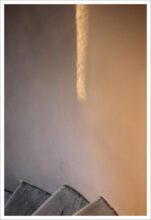
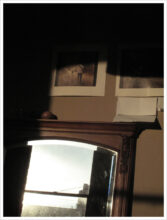
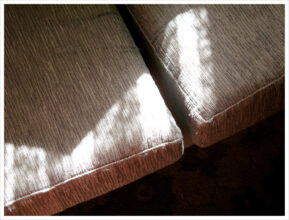
Beltrán’s gaze is inquisitive, one that skips over already charted horizons. As a result, her photography is patiently conceived and begotten from waiting, from an encounter surfacing from a tense observation able to unveil to us barely noticeable details of our surrounding reality. Perhaps this is why she lends so much importance to light, an element with the power to reveal spaces but also to bend and distort them with plays of chiaroscuro. This obsession also impinges on certain details when it comes to showing the photographs in the exhibition space, whether in poetical fragmentations or in compositions seeking out the splits and folds of the place.
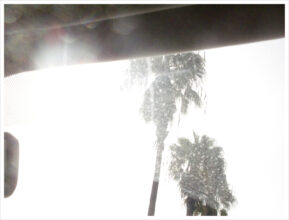
The resonance of light within the image is expressed in a particular way that mitigates the motif, as if the intention were to compose brief haikus whose silence can be heard even before the words. The vibrant unreality of light—whether natural or artificial—turns every detail into a threshold, taking on an essence, as if the identity of what is photographed, and the very act of photographing, were blinded and everything were leading us back to the origin, towards the beginning, the prior moment.
José Ángel Valente once said that the artist makes him or herself by emptying the self, which means that the very first thing created is nothingness. In the work of Karina Beltrán, this nothingness, insofar as a place of internalised matter, is translated into silence, into a slow experience letting life express itself. The rest is consummated with our motion, with the human need to discover and to try out the new.
This reminds me of a poem by Luis Cernuda urging us to move forward without turning back, defending truthfulness to life as the end of the journey, the opposite direction to settling for an easier destination. Some years ago, I used the poem to open an essay on Bernard Plossu, who still travelled by train as if he were shunning the aseptic in order to search for sensations, for the tense gazes that reveal his passion for cinematographic atmospheres and for poetry as a fragment of an incomplete, diffuse reality. At the time I spoke of photography as an impossibility, as a mute music; of a dense, albeit not overburdened photography. Exactly the same can be said for Karina Beltrán’s work, where it seems as if the time of exposure were the time of life, where all the places compose an endless source of events and betray a nomadic quality, a distillation of experience which is the by-product of a providential exercise in the poetry of frailness, of memories as an intersection on the verge of being erased.
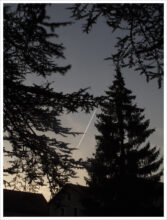
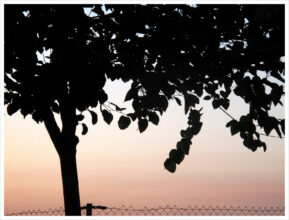
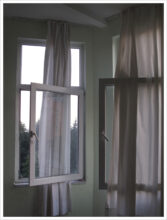
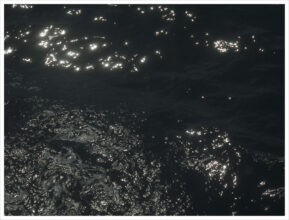
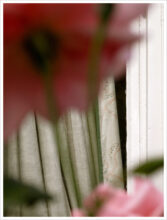
All the above can be seen in her Constelaciones, where a series of small and medium format photographs taken in various cities and places such as Istanbul, New York, London, Madrid, Gran Canaria, Lanzarote or Tenerife, add up to a sort of private, enigmatic diary. A life in flight. Taken individually, the atmosphere in the images presented by Karina Beltrán is the outcome of a tense, lingering gaze. As a whole, the feeling is closer to turmoil, to turbulence, to a convulsed beauty, probably because in that spiral, in that movement and on that journey which we need to fine tune in order to delineate our own imagined story, the fleeting becomes even more manifest, the crack widens and the light breaks through and strikes against the memory.
In these constellations it is impossible to perceive just one story. The experience is much more elusive, extreme, overwhelming. Like the people in the images, we as beholders find ourselves in some kind of passageway, be it a door, a window, a shirt, a back. Everything leads us to the other side. Everything opens up. Hence the profusion of skies and seas.
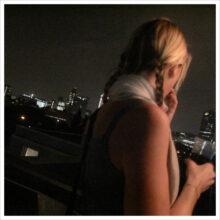
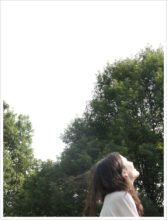
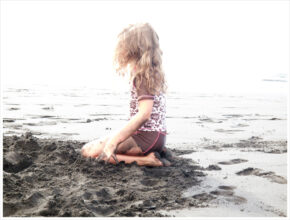
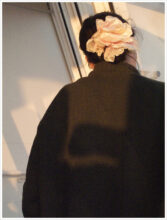
These constellations are full of people with their backs to the viewer, as if looking for the indeterminacy of solitude. A nostalgia for detachment. We could well think of Friedrich and his minute travellers in the immensity. Yet here it is time and the abyss that are immense. Even when open, the landscape is impenetrable, inaccessible. Similarly to Romanticism, imagination is the magical medium. Karina Beltrán does not photograph the scene but what she sees in it. For the artist contemplates contemplation, which begins to operate like an abstraction, like romantic nostalgia. The same happens when the scene becomes darker and the sfumatto is blinded with black, leading to obscurity and shadows.
Edmund Burke had this to say: “In nature, dark, confused, uncertain images have a greater power on the fancy to form the grander passions, than those which are more clear and determinate.” But if we are talking about anything here it is a dispossession of sorts, of a split between what the artist wants us to see and what we actually see. A nostalgic landscape suggesting micro events and understated experiences which, like the stars, have the power to dazzle everything with their fleeting brightness.
The collection of images presented by Karina Beltrán is a kind of ergograph or body writing. Similarly to painting, colour branches out into labyrinthine paths to live a life of its own. As if chance were drawing its own map from the cracks, from a split identity. We could speak of liquid and of water as a key element in one of her constellations. All this allows Beltrán to build a space of the invisible, like in the writing of the dream. Energy is condensed and everything is revealed, even though the contours and frames toy with the elusive. As spectators, we open our eyes to this disorder without—as Samuel Beckett pointed out— needing to understand, just letting the truth in.
I look at these photos again, and think of a sentence by Alejandra Pizarnik: “I cannot speak with my voice, but with my voices.” These are the other voices Karina Beltrán distils in events and infinitesimal scripts. Like Pizarnik, close to the maudit poets, to divisions and splits, in this work there is something of romantic surrealism: the unsayable, brevity, the lack of responses and alternatives to raised fissures, to a certain self-possessed existential anxiety, to silence. The space of the estrangement from the simple is not far from the wound in the first-person singular confessed by Pizarnik, where the „self‟ becomes a phantasmagorical entity. It would be like that dream similar to a second life that opens Nerval’s Aurélia: “Here began for me what I shall call the overflowing of dream into real life. From that moment, everything took on at times a dual aspect—without my reasoning ever lacking logic, nor my memory losing the slightest details of what was happening to me. it was just that my actions, to all appearances mad, were subject to what human reason would call illusion.”
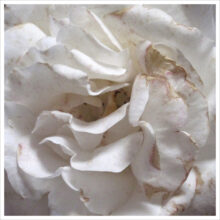
In other words, a celebration of the ephemeral, a beauty plummeting into the void, taking on meaning and form in the tragedy of loss, of what has been lived. Borges wrote about it in Los Conjurados, “I know I have lost too many things to count and that such losses are now what is mine.” In this case, we are speaking about a work that has been built from the emotional, from an intimate relationship with life. That is why everything in it seems to be left floating. But, above all, in Beltrán we notice a way of seeing the world in painterly terms, looking for colour and texture, with the composition continuously remitting us to art history, and naturally, using light as an element to create atmospheres. We ought to bear in mind that her photographic images are the by-product of her earlier painting vocation, and also of her command of watercolour techniques, from which she borrows glazes and transparencies. But also that her gaze adopts the immediacy of photography to capture the spontaneous, without posing the figures as in some works from previous series.
In Karina Beltrán’s images, time seem to have been frozen. It is almost as if feeling had been condensed and as if loss acquired a symbolic nature, in its evasive and fleeting condition. Everything leads to echoes of places, to emotional charges, to gravitations which we are unable to decide whether they are real or imaginary. As if the forces inherent in them were closed and their past were just palpitating. Something we perceive in her series El hilo de los días, where the moment seems to be floating, awaiting to be trapped in a brief instant. As if it were about living in dispossession, in flight or in loss. Like someone keeping a secret.
I think of Bertolucci‟s Last Tango in Paris, where a story made out of personal ghosts is silently woven out of three wrecked lives, a story in which the eventual winner will be the implacable fate of ruin. Two of those characters are drastically different from each other. The third one—the Henri Sauvage building in rue Vavin, Paris—even more so, for it stands for a host of previous lives, an aura of sorts that instead of unveiling names or stories, reveals only the yearning for life. Like in that event, Beltrán clings on to those stories that evaporate like steam on a wall, to broken memories pointing to a past without revealing it, drawing a world of doubts. In that regard, she becomes part of a kind of poetics of frailty, capable of making us lose a sense of the real, as if those images were spectral properties of memory.
Karina Beltrán does not look for the spectacular. On the contrary, her universe is of a simple order. But, whereas it is true that the image is taken in an instant, it is equally true that it takes shape after being slowly pursued, as a pause or a wait. Hence its density, a signature of someone who paints by working with the defects of the image. To engage with them, Beltrán’s images demand our involvement. In that way, she travels through the hidden and dark side of the visible, somehow violating that intimacy with an explosion of diffuse, distorted light. Stolen images, bathed in a melancholic halo that is the product of her longing to capture that image that reflects reality, that is never the image of the real, but its transversal gaze, that instant of a present floating in memory. That is why her photography is painting and drawing as well as photography per se.
For that reason, it is interesting to see her presenting us with a series titled Polaroids, where drawing replaces photography. These are small format drawings, made with colour pencils and threads. Little architectures where light continues to be at the fore, even if they are interiors. Though the human figure is missing, it is suggested through a number of elements, telling us that the interiors were once inhabited and, in that sense, the witnesses of either happy
or harrowing, exciting or painful moments.
From a painterly viewpoint they are attractive images, with several different exposure times, for they first take inspiration from photos taken with a mobile phone and are then drawn and sewn with threads that stand out chromatically to create yet another abstract time. It is as if the images had no beginning and no end, a conflict addressed by John Berger, who establishes a difference between photography—a document of the past—and painting—a prophecy received from the past about what the spectator sees when standing in front of the painting at that moment. The visual image as the commentary of an absence, as a shadow of what is being described. “Visual images, based on appearances, always speak of disappearance (…) Stories, poetry, music belong to time and play within it. The static visual image denies time within itself (…) because painting is static, it has the power to establish a visually „palpable‟ harmony (…) A musical composition, since it uses time, is obliged to have a beginning and an end. A painting only has a beginning and an end in so far as it is a physical object: within its imagery, there is neither beginning nor end.”
For Karina Beltrán works on the limit, on the sidelines of disciplines, and at the same time, on the margins of reality. That would explain why these drawings have the time of intimate, secret things. Just as when her photography blurs the limits of the form. Now she uses interiors to look for painting as remains; if the wall fills up with colour, the threads multiply; when coming closer to the wall what dominates is the area of colour, the dissolution of space. It is, on the other hand, about tattooing the paper, of allowing memory to leave its mark. For in her Polaroids, which might be heralding the closing of a circle in her return to painting, there is, as always, a certain solitude. In this case, a solitude of places that end up by operating like non-places, as a reality filtered by an eminently pictorial way of looking. But also as a call for attention, as a decoy. Like when the intimate nature of a small plant with flowers is usurped by placing it as a powerful image on a billboard. It is the lure of the minimal, of the abridged, of the apparently insignificant. Placed in the public space, the image turns the passer-by into the accomplice of an enigmatic intensity demanding a pause, an interrogation about the reason for that image, for that mystery. But what lies behind that scenario, that intention? Without a doubt, the lingering of a poem that takes its time, that insists, that brings us to a halt.
Everything may perhaps be the by-product of a flight, and it is possible that what Beltrán is telling us is that life could vanish like a wisp of smoke. As such, the interesting feature of the artist‟s discontinuous poetics of frailness is it power to fake the image, to extinguish what had apparently been resolved and lock it at an unsolvable crossroad. Lacan shrewdly summed it up in his Seminar on “The Purloined Letter”: “what is hidden is never but what is not in its place [manque à sa place].” And in Beltrán’s works, those shadows are, more than anything else, vibrations of light.
For the true image will always remain hidden, mysterious.
David Barro
__________
For further viewing:
Constelaciones by Karina Beltrán
La imagen como un hilo de humo essay by David Barro (original, Spanish)
with thanks to Karina Beltrán and David Barro