
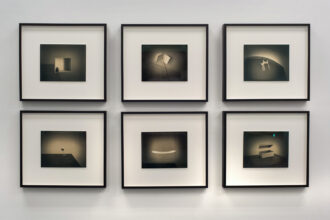
How can a series entitled ‘Gravity’ feel so weightless? Much greater than conveying the articulation of mass, Max Kellenberger’s works seem instead to render the interminable flux and fluidity of things in relation to one another. In the stead of weight, a precise and fragile ineffability of lightness is evinced, and what we are shown is the indefinable continuum where things meet and causality is alchemically rendered essence, where the question of the “how” disappears in the endless beauty of the universe’s “why”.
There is in all of Kellenberger’s work a meditative and reverent devotion to photography’s capacity for mechanical precision and its articulation within the picture plane, a formal rigor which clearly being so deeply considered reveals a sense of order and harmony which transcends line or form per se. Line and composition seem used in the service of the beauty and grandeur of order. As a Bach concerto undoubtedly achieves a sense more transcendent than the simple sum of notes and instruments, or a landscape evokes an inspiration to beauty greater than a collection of grasses, mountains and light, so Kellenberger’s compositions declare a visual harmony which resonates as a symphonic whole, the sum of which is greater than its parts. And therein is established a peaceful, unified framework from which he elicits a narrative.
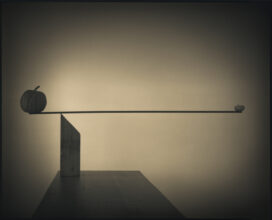
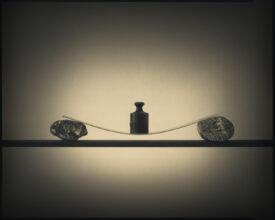
In ‘Gravity’, Kellenberger uses the precision of photography to capture both the infinite lyricism of the possibility for ever-evolving specificity and the empyreal dignity of these relationships one to another, mirroring how the mathematical precision of gravitational relationships in the universe conveys a magnificence greater than the sum of its mechanics. In one image, Kellenberger crafts a singular moment in which two squashes are poised in dialogue with one another on a minute fulcrum of exactness; only within that singular spatiotemporal configuration can they balance one another and live on the same line in space and time. The image becomes a ringing declaration of the divine accuracy of the universe.
Though born of mass, gravity is nothing without bodies in relation to one another, without time and space to measure this relationship, without relativity. Photography is, as is gravity, inextricably linked to space and time. An endlessly relative formal record of time and space, photography is perhaps the ideal medium to visually describe gravity. Both are formulas relaying the relative nature of time and space as they are defined by things. Kellenberger uses the temporal and formal precision of photography to toy playfully with these relationships and stir from them their essence.
In gravity, as in photography, contrast between things serves to underscore their individual properties, to elucidate their definition. Each image Kellenberger has made describes a carefully selected relationship of things one to another. Further, each image demonstrates a certain precariousness of spatial or temporal relationship within which there is perfect studied alignment of the use of conceptual contrast — weight to lightness, order to whimsy, line to arc, motion to motionlessness, frozen to fluid motion, the seen to the unseen. Kellenberger poises everything so as to evoke a single point, in time, in space, in relationship, such that the infinitely singular nature of those relationships themselves become clearer.
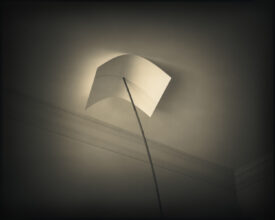
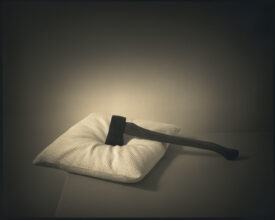
These relationships are further narratively enriched by the playfulness of his conceptual choices. When does axe ever meet pillow? Yet how much more clearly we now understand heavy, sharp and hard to light, smooth and soft by means of axe to pillow. Skillfully employing photography’s unique ability to capture individuated space and time, Kellenberger pictures for us a simple scenario where stick meets sheet of paper on ceiling, the fine plane of the paper gracefully arching a wilt downward, yielding to the distinct brutality of the stick’s single point, emphasizing for us that only in this way, at this point, in this delicate moment, can this happen. Our focus through Kellenberger’s lens is resolved and narrowed to a pinpoint of extreme clarity, the image’s great simplicity, like the wisdom of innocence, somehow conveying the meaning behind the larger workings of the universe.
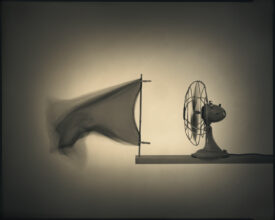
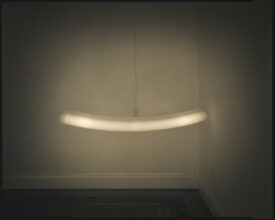
Each one describes an aspect of gravitational relationship in precise yet poetic focus: a swinging bulb whose pendulous arc captured over the long exposure of time figures mass and distance and illuminates the bending of light around mass; a weight neatly depressing a board between two rocks succinctly illustrating the idea of weight itself by means of arc to line, the heavy hard line of the board supporting the experiment contrasting the fragile arc of the weighted moment above it.
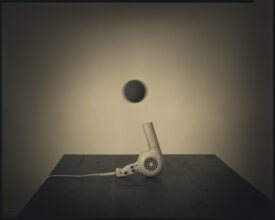
And then there are those sweetly joyous, playful examples, wherein Kellenberger exhibits an experimenting childlike curiosity as if he is trying to take gravity apart and put it back together again in order to understand it. An improbably balanced hair dryer keeps a spinning ball in balance just above it, lightheartedly layering the conceptual narrative of gravity, balance on balance to precarious on precarious, certainty to uncertainty.
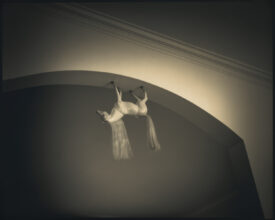
A child’s toy horse posed strolling upside down on an archway, mane dripped succinctly above (or beneath it), as if to say how majestically silly we are, spinning round this earth, unaware we are always in some way upside down.
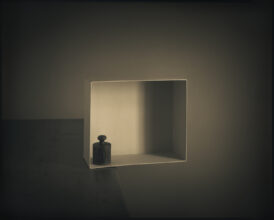
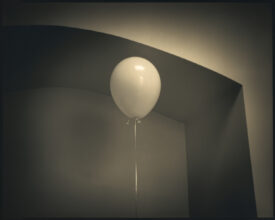
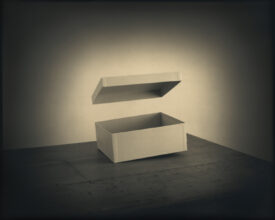
Or the beautiful refinement of a balloon the contents of whose lightness is held in check by the pressure of its container and the solid mass it attempts to transcend, which though thwarted, remains lightness all the same and even more for its seeming confinement.
Employing the delicacy of lightness to render the inevitably compressive nature of mass, Kellenberger toys with it as binding, and serves to illustrate its infinitely nuanced, relational nature. Lighthearted, yet deeply serene, Kellenberger’s work reveals order as transcending individual elements to express essence, science and art as harmonious grandeur.
These photographs are beautiful because the certainty of gravity is articulated with such delicacy that some almost seem to suggest the dissolution of the force, which in the end perhaps best defines its relative essence. Conceptually, they tread a fine line between the idea of weight and lightness, between gravity or attractive pull and floating away. So fine a point is put on the precise nature of the objects’ relationships, one to the other, that a certain fragility begins to appear, as if to emphasize the tenuousness of assigning certain definition at any point at all — or better, suggesting infinitely varied meaning. It is as if Kellenberger is visually narrating the symphonic majesty of the ordered universe; and what is most beautiful about the photographs is that they begin to express what gravity’s mathematical equations suggest and which quantum mechanics is only beginning to discover, how time may become timeless, weight become weightless, and space, indeterminate – all dependent on infinitely varying modes of observation.
Each photograph visually describes the beauty of individuals’ bringing out the unique qualities in each other, for each quality reveals the necessity of the other in order to define its existence, and in their reflexive relation to one another express a sort of infinite singularity in which a new universe is unfolded every moment. The capturing of these individual space-times unfurls more time in the mind of the viewer, a secondary realm, a time inherent to the unique reality of the image itself, sending ripples of continuous narrative and meaning emanating from the seemingly static nature of the “frozen” image.
Perhaps photography has a gravity of its own in that it bends time to its will with the weight of its meaning. If so, Kellenberger’s experiments in visually depicting gravity go to proof of this theorem.
Essay by Christin Paige Minnotte
——
About the artist:
Max Kellenberger (b. 1956, Switzerland) is an artist living and working in San Francisco. His work has been shown and published internationally; recent exhibitions include a two-person show at Rick Wester Fine Art in New York and two solo shows at Corden|Potts Gallery in San Francisco. His photographs are in numerous private collections, including those of Joaquim Paiva, Graham Nash, and Elton John. maxkellenberger.com @maxkellenberger9
About the author:
Christin Paige Minnotte is an artist working in photography, video, installation and performance. Her work is centered around mankind’s relationship to nature. She has a BA in Languages and Literature from Bard College (2001) and a BFA in Photography (2010) from the San Francisco Art Institute. christinpaigeminnotte.com