Walking is one of the most basic human functions in life – one foot in front of the other for perpetual motion, moving the body from one place to the next. But more than its basic function, it becomes a vehicle for experience, a way to navigate the world. In our childhood development, learning to walk becomes a landmark moment, from being mostly static beings to having the ability to explore.
Human nature is innately curious, we have a tendency to want to explore and discover the world, from the unknown of the deepest jungles to the sublime of the highest mountains. Walking allows us to transverse these unknown spaces, photography allows us to document and share these experiences with a wider audience.
This desire to explore reveals itself within the photographic act. Walking and taking images are deeply entwined, from the earliest landscape photographers carting a large format camera and mobile darkroom to the highest view, to Henri Cartier-Bresson’s flaneur on the street, walking the city for hours. This navigation of the immediate landscape becomes the basic premise to experience and capture these events. In order to find a subject, the photographer has to explore the terrain, to look, to think and then to capture. As important as walking is stillness, which mimics the photographic aim of taking a static representation of a continuous event. Through this play of movement and stillness, thoughts and themes are allowed to emerge from the visual chaos of the world.
Past its utilitarian purpose, walking enables the process of thought; as we pace, our minds can begin to wander. As Rebecca Solnit stated “walking ideally is a state in which the mind, body and the world are aligned, as though they were three characters in a conversation with each other.” (Solnit, R. 2001: 5) The rhythms of walking echo the rhythm of thinking, freeing up mental space; the visual activity encountered on a walk can trigger new thoughts and clarify previously disconnected ideas.
There is a rich association between walking and philosophy, with philosophers such as Aristotle, Immanuel Kant, Jean-Jacques Rousseau and Henry David Thoreau all employing it as a tool for thought. There is something about movement that encourages ideas to emerge. In the two solo shows of Michal Iwanowski and Paul Gaffney presently at Ffotogallery, these ideas are able to manifest themselves in the photographic images created within the landscape.
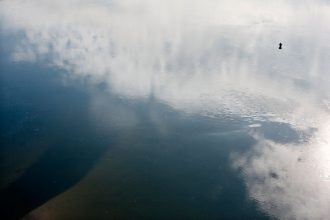
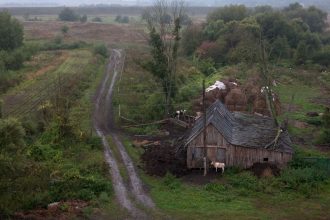
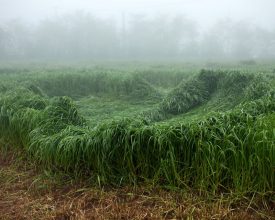
Michal Iwanowski’s project Clear of People retraced the epic journey taken by his grandfather and his brother as they escaped from a war prison in Kaluga, Russia. Crossing over 2,200 kilometres on their way to Poland, they walked by night, attempting to stay inconspicuous as they navigated the harsh terrain. Iwanowski’s journey has remained true to his ancestor’s aims, attempting to stay clear of people as he presents the landscape through the eyes of the fugitive.
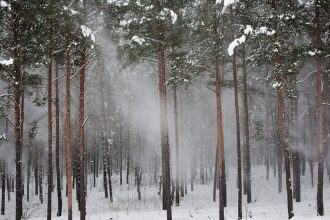
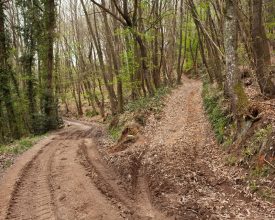
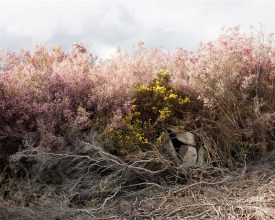
Paul Gaffney walked a distance of 3,500 kilometres across Southern Europe, to create the body of work We Make the Path by Walking. Depicting unknown landscapes, the images come with no destination, map co-ordinates or information; instead Gaffney has created ambiguous spaces for reflection which capture the contemplative experience of nature.
Both artists use photography as a narrative tool; for Iwanowski, photography acts as the device to re-tell this chapter from his family history. The long walk away from the Russian war prison taken by Iwanowski’s grandfather and his brother represents a specific moment in time, deeply rooted within the historical events of its era. Seen in context of the events of 1945, the personal and political history is deeply embedded within the landscape. In Clear of People, the landscape depicted holds this history and becomes the stage to re-imagine this event. Devoid of people, the landscapes show the harsh reality of what Iwanowski’s ancestors must have endured on their journey. Bleak, often inhospitable landscapes form the backdrop for this story of hope and survival. The photographs give a shape to this private memory and act as homage to Iwanowski’s grandfather and his brother.
The landscapes in Gaffney’s We Make the Path by Walking reflect a form of meditation and personal transformation. There is a subtle lyricism to the images here; quiet and contemplative, they suggest something of the past and stand in as a personal document of the distance travelled, and the mental state induced along the way. The path stands in as a metaphor, not only of this journey but also of personal choices. This is hinted at in the title We Make the Path by Walking suggesting a sense of complicity in the path we choose in life. The images often present a crossroad, the viewer can become seduced by a series of possibilities and uncertain outcomes, but unlike the walker, we can only choose one path, constantly moving forward. There are recurring motifs throughout the work such as man made structures in the landscape, obscured horizons and paths leading into the distance. These motifs become part of an uncertain narrative, they are left to intrigue and open to variable interpretations. Gaffney doesn’t enforce meaning into the images, but gives the viewer space for personal consideration.
The two bodies of work explore very different themes, but are grounded in the physical process of experiencing the landscape on foot. With the rise of motorised travel and increasing expanse of roads and motorways, the joy of walking is often lost in our accelerated culture. These images present the landscape in a way that would be missed when driving past, glimpsed through a train or car window. Both Iwanowski and Gaffney’s work connect with a sense of history, allowing the viewer to reconnect with the land in a way modern life doesn’t allow. The narrative of walking pervades the images and their sense of place, encouraging you to slow down, stop and look.
Michal Iwanowski Clear of People and Paul Gaffney We Make the Path by Walking exhibitions continue at Ffotogallery continue until 8 March, 2014.