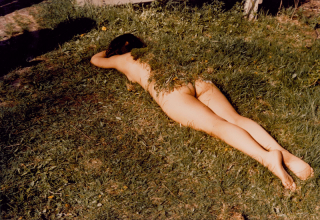
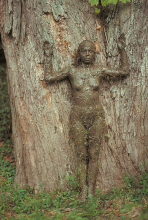

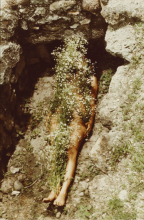


Cuban-born artist, Ana Mendieta (1948-1985), is best known for her Silueta series, for which she created imprints of her body in nature, leaving, as the title suggests, a silhouette or a trace. At the outset, Mendieta used her own body placed in the landscape to make her mark. As she progressed, however, she created – largely for practical reasons – a template by lying on a piece of foam board and having her outline traced and then cut out. She would then take this cut-out with her into the landscape and use it to either trace her outline in the earth, imprint her image on a surface, or sometimes to directly stand in for her body. Between 1973-1980, Mendieta created over 100 Silueta in a variety of materials, including earth, wood, grass, flowers, leaves, moss, algae, mushrooms, pebbles, fire, ice and stone.
Mendieta created her Silueta works in the absence of an audience, apart from her tutor and lover, Hans Breder, who would usually accompany her with his video camera. Given the ephemeral nature of the Silueta themselves, the photographs, Super-8 films and 35mm slides are all that remain, and, indeed, all that even contemporary audiences would have seen. For her first key solo exhibition, held at the Corroboree Gallery of New Concepts, University of Iowa, in 1977, Mendieta presented 27 small-scale colour photographs, unframed and mounted on board, of her works made over the previous two years.
In her personal writings, Mendieta explains:
‘In galleries and museums the earth-body sculptures come to the viewers by way of photos, because the work necessarily always stays in situ. Because of this and due to the impermanence of the sculptures the photographs become a very vital part of my work.’[i]
In fact, in an interview with Dr Joan Marter, she contends that her works are both ‘body earthwork and photo.’[ii]
It is a matter of debate, however, as to whether this definition of Mendieta’s work ought to include all photographs and slides (with more than 100 silhouettes, there are thousands of slides in her archive), all estate prints (photographs printed after her death), only lifetime prints, or only those explicitly paired with sculptures by Mendieta herself. From each complete reel of film – and she would usually use one per work – she would select just the one print to crop and render as the photographic counterpart to the ephemeral event. Her chosen images were usually shot from directly above or in front and always tightly cropped, not showing anything much of the landscape, focusing instead on the trace of her body. This makes it hard for the viewer to glean any sense of scale or proportion, a property which Mendieta described as ‘magical’. [iii]
In the late 1970s, Mendieta moved from colour to black and white, simultaneously increasing the size of her prints to near on life-size. Whilst the larger format enhances the detail, the switch to monochrome gave Mendieta more control over what she was sharing with the viewer. By presenting her works in this medium, she very much directed and orchestrated the impression imparted.
Alongside photographs, Mendieta also made Super-8 films of her Silueta, and, with over 80 films to her name, was more prolific than any other artist in the 1970s. Interpretations of Mendieta’s work often pivot on her deliberate corporeal absence as a comment on the position of women in society and the art world, by both putting herself forward as subject, but simultaneously removing herself from the male gaze. As author Susan Best notes, taking the films into consideration as well alters this longstanding interpretation of the Silueta, largely based on the photographic archive alone, since, although Mendieta is almost always absent in the photographs, a number of the films show the process of creation of the silhouettes, and thus often also a spell of the artist’s being present.[iv] Corazón de Roca con Sangre (Rock Heart with Blood) (1975), for example, shows her pouring red pigment over a heart set in the chest area of an ash silhouette, before lying on top, face-down. This film instead highlights Mendieta’s desire to unite her body with nature: ‘Through my earth-body sculptures I become one with the earth […] I become an extension of nature and nature becomes an extension of my body.’[v]
Some films, however, do show the artist’s body slipping from presence to absence, and others, as Collette Chattopadhyay notes, capture ‘the dissolution and erasure of her own sculptural efforts’[vi] as, for example, the silhouettes are washed away by the tide, or burn themselves out. This changing of state, crossing from presence to absence, portrays a temporality not captured in a still photograph.
That is not to say that a photograph cannot represent the passing of time, however. A photograph necessarily refers to a moment distinct from the one in which the image is seen. The use of photography therefore enables Mendieta to give further temporal elaboration to the disappearance of a moment, as already recorded in the disintegration of her figures themselves.[vii] As Chattopadhyay phrases it: ‘While her sculptures intone ephemeral and eternal conceptions of time, her photos freeze specific moments of time, which in turn lend her temporal sculptures a chronological validation and context that might otherwise be denied.’[viii]
Susan Sontag writes that a photograph is ‘not only an image (as a painting is an image), an interpretation of the real; it is also a trace, something directly stenciled off the real, like a footprint or a death mask.’[ix] Likewise, Mendieta’s Silueta are created as traces in nature or the landscape. In themselves, they indicate ‘a lacuna, an evacuated presence,’[x] and through their preservation in photographic format, Mendieta creates a double displacement of the Silueta from the body: the photographs become traces of traces of the body.[xi]
[i] A. Mendieta, ‘Personal Writings’ in G. Moure (ed.), Ana Mendieta (Barcelona: Ediciones Polígrafa, 1996) pp.167-222, p.186
[ii] From an interview between Mendieta and Dr. Joan Marter, New York, 1 February 1985, conducted prior to a College Art Association Conference, cited in O. Viso, ‘The Memory of History’ in O. Viso (ed.), Ana Mendieta : Earth Body, Sculpture and Performance, 1972-1985 (Washington, D.C.: Hirshhorn Museum and Sculpture Garden, Smithsonian Institute, 2004) pp.35-136, p.70. [My emphasis.]
[iii] S. Rosenthal, ‘Ana Mendieta: Traces’ in S. Rosenthal (ed.), Ana Mendieta: Traces. exh. cat. (London: Hayward Publishing, 2013), pp.9-19, p. 15
[iv] S. Best, ‘The Serial Spaces of Ana Mendieta’, Art History, 30, 1 (2007) pp.57-82, p.61
[v] C. Eshleman (ed.), Sulfur 22 (Michigan: Ypsilanti, 1988), p.71
[vi] C. Chattopadhyay, ‘Ana Mendieta’s Sphere of Influence’, Sculpture. 18, 5 (1999) pp.34-41, p.36
[vii] Best (2007), p.74
[viii] Chattopadhyay (1999), p.37
[ix] S. Sontag, On Photography (New York: Doubleday, 1990), p.154
[x] C. Butler and L-G. Mark (eds.), WACK!: Art and the Feminist Revolution (Los Angeles: Museum of Contemporary Art; Cambridge, Mass.: MIT Press, 2007), p.344
[xi] Best (2007), p.65
———-
Notes:
All images at right are courtesy Galerie Lelong New York and Paris, and Alison Jacques Gallery, London.
Ana Mendieta: Traces continues at the Hayward Gallery, Southbank Centre until 15 December 2013