
Photographers Rosy Martin (b1955) and Jo Spence (1934-92) met in 1983 when attending a series of co-counselling training courses. Working together during an exchange counselling session, they conceived of the idea of role-playing and photographing aspects of their identities that had been either hidden or denied. Spence explains:
‘Traditionally, the portrait is typified by the notion that people can be represented by showing aspects of their ‘character’. We understand the portrait differently. Instead of fixity, to us it represents a range of possibilities which can be brought into play at will, examined, questioned, accepted, transformed, discarded. Drawing on techniques learned from co-counselling, psycho-drama and the reframing technique borrowed from neuro-linguistic programming therapy, we began to work together to give ourselves and each other permission to display ‘new’ visual selves to the camera.’ (Martin and Spence, 1986:172)
They went on to develop this methodology, giving it the name ‘re-enactment phototherapy’ (Martin, 2009:40). ‘Photographs,’ Martin notes, ‘offer up the possibilities of a slippery surface of meanings and potential narratives for the viewer,’ (Martin, 2009:35) while, in terms of the possibilities of therapeutic performativity, the 19th-century empiricist philosopher Edmund Burke had already observed: ‘On mimicking the looks and gestures of the angry, or placid, or frightened, or daring men, I have involuntarily found my mind turned to that passion, whose appearance I endeavoured to imitate.’ (Burke, 1837:60) The key to making this method therapeutic, then, is to re-enact a transformation, or to find and engage a nurturing part of the self to challenge the punishing inner critic. By performing this re-enactment, it comes to be real. As Martin explains: ‘Re-enactment phototherapy is about making visible process, change and transformation, by going to the source of an issue or an old trauma, re-enacting it and making a new ending; a new possibility; a new way of being, visible.’ (Martin, 2009:41)
Having been in therapy for three-quarters of my life, working in the arts sector, and having recently been discharged from yet another inpatient stay on a psych ward, I was curious to know more about Martin’s and Spence’s method, and so when I saw that Martin was holding a two-day phototherapy workshop at the Centre for British Photography, London, this April, I knew I had to sign up. After a very early start, to get down to Westminster from Hertfordshire, I arrived at the centre unsure of what to expect. We were a small group of 12 participants, and Martin made it clear from the start that it would be very hard work, not to mention exhausting. After talking a little about the methodology, and reiterating how, in just two (long!) days, we couldn’t expect more than an introduction, we got started with a warm-up exercise. As Martin explains:
‘I use a selection of found old family album photographs, alongside some documentary images, which share the anecdotal captured moment aesthetic of domestic photography. I lay these out and invite the client to choose one that they are drawn to, quickly, without intellectualising their choice. Clients are invited to tell a story using their chosen photograph as a starting point, by entering the space of the image, identifying with one of the individuals in the photograph, speaking from the first person, thereby inhabiting the imaginary space offered up.’ (Martin, 2009:38-39)
While demonstrating the narrative potential of photographs, found images have the advantage of being anonymous and decontextualised.
We were then thrown in at the deep end and asked to pair up for the main re-enactment task. In preparation for session one, we had been asked to bring along five or six photographs from our own family album, which felt significant. In our pairs, we now presented and talked about these, in turn, with our partner in the ‘therapist’ role, actively listening but not interrupting. Following this, and over the week between our two sessions, we liaised with our partner to construct an idea of what aspect we wanted to work on, what the transformation might be, how this could be re-enacted, and what props and clothing might be required. Having gone along with no expectations, serendipity intervened, as I found myself partnering someone who, like myself, has long been ‘a citizen of the kingdom of the sick’ (1.). As I wrote in my text to accompany my final sequence of images:
… we both live with chronic illnesses, both have spent inordinate amounts of time in hospital, both missed out on our formative teenage years, and both understand what it feels like, as no one on the outside looking in, even those who might have journeyed it all with us, ever will.
I think I always knew illness would play a part in the work I did in the workshop, but I would never have thought I would take my transformation as far as I did, and that was wholly down to this partnering.
As I further wrote:
My body and I have been at war since I turned 13. I went from being a happy, independent child, to a teenager, and then adult, whose medical story could fill volumes. The first battle was with glandular pain, chronic fatigue, and joint paralysis, which, although having me prescribed part-time school and countless analgesics, never resolved itself with a satisfactory diagnosis – this was my first of countless experiences of being unseen and unheard – neither believed nor even listened to; neither by family nor by doctors. Highlights of the three decades since then include two battles with cancer; treatments pursued regardless of my screams of pain (which, when the doctors finally realised for themselves the trauma they were wreaking on my body – not to mention my mind – led to rapid changes of regimen, banishment to an isolation room, and surviving only thanks to the IV I was hooked up to, which provided medication, blood, fluids, and food); progressive late effects of these treatments, multiplying rapidly, meaning I am unable to live as full a life as I would like, to carry out a regular job, or, basically, to make any plans, along with the knowledge, with 99.9% certainty, that I have the joys of further cancers and heart and lung problems to come; and then the myriad mental-health battles, including anorexia, with five long inpatient admissions, nasogastric torture, years of barely existing, loss of memory, loss of friends, loss of my career; anxiety; personality disorder; trauma; and, although this is not really an illness, and casts a somewhat different light on my belief that I am simply broken and wrong, (very-)late-diagnosed autism.
Rereading this now, what stands out to me is not the plethora of diagnoses, but the simple statements: ‘My body and I have been at war,’ and ‘This was my first of countless experiences of being unseen and unheard’. Autopathographer Alice Hattrick interprets the savage self-estrangement, saying: ‘The violence – the battle – is the experience of illness, not the illness itself. It is what seems to happen between body and mind.’ (2021:76) Or, as history professor Joanna Bourke observes: ‘Pain alienates sufferers from themselves. There is a disconnection between “me” and “my body-in-pain”. What is this “thing” and why is it betraying “me”?’ (2014:29). Add to that the medicalised objectification of the body, and the pressure to ‘conform’ to the ‘sick role’, and it is not surprising that there is an ‘institutionalised reconstruction of a person’s social self-identity, characterised not by individuality, choice or control, but by depersonalisation and powerlessness.’ (Evans, 2005:39) Therefore, key to my transformation – as indeed to that of most other participants – would be to reclaim agency and make myself seen and heard. As psychiatrist Judith Herman puts it: ‘The first principle of recovery is the empowerment of the survivor. She must be the author of her own recovery.’ (1992:133) Having remained a passive patient throughout my cancer experiences, letting the doctors do to me as they wished, I eventually learned, in my battles with anorexia, that no matter how desperately ill you become, no intervention in and of itself can save you – you have to accept responsibility and, albeit with essential support, ‘do’ recovery for – and of – yourself.
Fittingly, albeit terrifyingly, our warm-up exercise on day two comprised learning to direct and ask for what we want. In the vein of seeking to reclaim agency, and so as to avoid the objectifying ‘violation’ by the photographer, described by writer and activist Susan Sontag as ‘seeing them as they never see themselves … having knowledge of them they can never have,’ (1977/1979:14) the ‘therapeutic gaze’ is something quite unique. Martin explains: ‘Unlike the traditional power relationship in portrait photography, the photographer/therapist’s gaze does not attempt to control, nor objectify the other. The client, as sitter/director, determines how s/he wants to be represented. It is the photographer/therapist’s task to enable this to happen.’ (Martin, 2009:42) The outcome is very much a collaboration in which the photographer/therapist’s role might be analogised to that of a ghost writer.
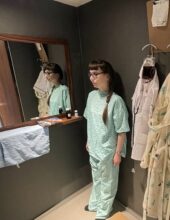
It was now time for the main event – our re-enactments. By this point, I had a vague storyboard in mind, for which I had brought along a suitcase full of props, and which my partner, I believe, understood. My written description of the first couple of scenes is as follows:
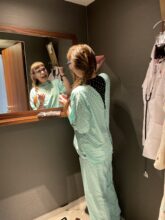
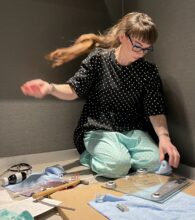
The photographic sequence begins with me in isolation in hospital: hospital pyjamas on, tubes in my nose, blood transfusion bag [filled with red wine!] hanging behind me, medicines and syringes on the shelf. At first I am passive, but then I become angry – angry at the doctors for not listening to me, angry at everyone else who doesn’t see me (hence the mirror), angry at myself for being so unfixable. I throw my journal (I am a writer, and my journal was my life throughout many of my sickest years) hard against the mirror, rejecting myself and all that I have become.
Surprisingly, I found it incredibly difficult to enact my anger – and my anger is usually real rage. My anger is what terrifies me most – and it is hard to carry on when terrified of yourself. I frequently cannot reach any alternative emotion: there is either nothingness or rage. It offers some solace, at least, to know I am not alone in this. Among many others, the professor and philosopher Havi Carel writes about her experience of living with a chronic illness, describing a ‘bitterness’ which is ‘verboten’ (2008), and the pressures of being manoeuvred into being courageous and uncomplaining; Hattrick describes the feeling of shame in ‘living a sick life, an internal experience that is measured and judged by others who say, “You look well”… if illness is a source of shame, and perhaps even its expression, then that feeling needs to be attended to, not counteracted with pride.’ (2021:61) So what was really important, when seeking a transformation, was to not fall back on the toxic positivity of emphasising my strength and bravery – qualities I know I possess, but which I frequently wish I didn’t have to. What began as a throw-away comment during my planning session with my partner ended up becoming what I knew I absolutely had to do – namely:
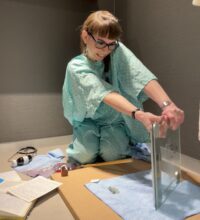
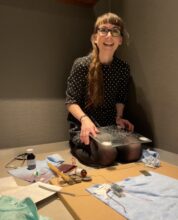
… turn[ing] the anger (inasmuch as I can muster it) against that which is keeping me trapped – represented here by my scales, but, really, control in all its shapeshifting forms. I pick up my hammer and … This is something that I NEVER, EVER thought I would be able to do …
And, as it turned out, I almost couldn’t! No matter how hard I swung my hammer, they simply refused to shatter:
My hammer crashes down on to the scales, and the resounding din is deafening … but they will not smash. What looks like glass, clearly is some super-reinforced material. Now I panic, because what would it mean to not be able to break them now? I’d surely be fated to battle on and on and on … I tear at the metal bars on the underside of the scales, and, somehow, driven by adrenaline, bend them and, in so doing, pull apart the mechanism, snap the plastic, shatter the digital display screen, rip out the wires …
As Martin observes: ‘Upon careful reflection afterward, it is often the seemingly chance occurrences or ideas that hold the psychic weight’ (2001). The metaphor of the battle to recover being so much harder than anyone might think certainly rings true, as does knowing that that plexiglass platform, although no longer part of a functioning whole, is still there, always latent – a lesson I learned through my most recent relapse.
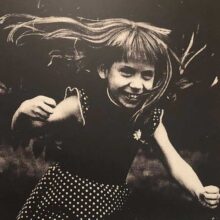
To complete my transformation, I intended to rediscover and accept my inner child – part of that banished, ‘unfixable’ self. I had in mind a family-album photograph of myself at four years old, taken upon arrival at my uncle’s house in Australia to discover he had a swimming pool in his yard. Wearing a polka-dot dress, I am leaping in the air, hair flying, with a huge smile. I have multiple copies of this photo around my house to remind myself to try to be kind to this girl. So, as I continue to destruct the scales, I tear off my hospital pyjamas to reveal a polka-dot dress underneath, and I let my hair loose, shaking it out of its plait, until, as I say with an impish grin, in a short live clip my partner also took: ‘Well, that’s well and truly broken!’
I should say, at this point, that Martin and Spence were, of course, developing their methodology before the advent of digital photography. Martin explained to us the importance of the ‘deferral’ inherent to analogue photography: ‘The trust, even surrender that asking the other to make images of you, required on behalf of the client is important. Frequently checking back and reviewing during the process, as one now can with a digital camera, interrupts the flow, the happening in the moment.’ (2009:35) As a compromise, my partner took mostly live photographs (using her phone), but we didn’t stop or look through them until afterwards. It was important to me, however, to fully document the event, to make it real, as I have great difficulty holding on to memories and believing in an experience without significant reinforcement from others or unequivocal evidence.
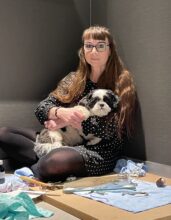
I would have been more than happy to end my sequence there, since the destruction of my scales is insurmountable in terms of transformative value, but my support dog, Parsley, who had been miserably watching the events from the sidelines, desperate to come in and comfort me, finally hurtled into my lap and began licking me all over. The final shot thus became one of him and me sitting together amid the medical detritus, staring defiantly into the lens. I wrote:
[Parsley] came into my life two years ago, finally giving me purpose. He visited me on weekends throughout my last admission, and he was – and is – my motivation. He grounds me, helps me through my anxiety attacks, enables me to go out and about, and keeps me battling. The battles will never end, as long as I live, but, with him by my side, I will be a valiant soldier.
Once both my partner and I had completed our re-enactments, we sat down to look through our images and select our final few to share with the group. This part of the workshop was, for many, quite painful, and there were tears. But, in equal measure, there was a tangible lightness and sense of relief and freedom in the room, as the enormity of what we had all just done began to dawn. As Martin writes: ‘By making images of these feeling[s] working with Jo, I have been able to integrate my intellectual knowledge at a deeper, unconscious level, to transform it into an inner wisdom.’ (1986:174) Hearing others’ stories helped me realise quite how consequential the life events we had been dealing with were. In every case, our self-identities had been disrupted. Working with photography, we were able to ‘supply a visual metaphor for the divided and multiple self,’ ‘postur[e] and imposture,’ and ‘manufacture’ a new ‘truth’ (Rugg, 1997:1-6). Spence is not exaggerating when she says: ‘The point where image production in society intersects, through our snapshots, with personal memory is where a disruption can be caused, so that we never see ourselves in quite the same light again.’ (Martin and Spence, 1986:172) My point of intersection and disruption is not so much in the destruction of the scales, but, on reflection, the re-emergence of ‘little Anna’ (signified by the dress and the hair) and her integration into my present, through the cuddling with Parsley. It is not that she was – or is – in any way the representation of an underlyingly ‘true self’, or ‘essential identity’, to which I can return; she is – or was (note the order of these parenthetical tense alternatives) – an exiled part, which needs to be accepted and listened to (2.).
I am a writer, and, prior to my last relapse, I had begun compiling my memoirs, yet while I get something out of sharing my self-reflective writing with others and hearing how it helps them, the writing process, in itself, is never hugely transformational for me. While literary theorist Paul de Man – along with other postmodern theorists – argues that autobiography is indistinguishable from fiction, and that, in the same way that photography may ‘manufacture a truth,’ ‘the autobiographical project may itself produce and determine the life, ’ (1979:920) it is also the case that ‘the danger looms large that the power of self-agency will be lost in the midst of arguing that the self is constructed solely through language. The trick, then, is to … resist being made into nothing more than a body by reintegrating body and language through the power of subjecthood and referentiality.’ (Rugg, 1997:16) And this can be achieved through recourse to the visual. As theorist Roland Barthes claims, that which is depicted in a photograph has been there (1981:76). With our ‘re-enactments’, the very linguistic term also implies this. Thus, as language professor Linda Haverty Rugg argues:
‘On the one hand, photographs disrupt the singularity of the autobiographical pact by pointing to a plurality of selves; not only this image but this one, this one, and that one are the author. On the other hand, photographs in an autobiographical context also insist on something material, the embodied subject, the unification (to recall the autobiographical pact) of author, name, and body.’ (1997:13)
Thus, while any autobiographical act, whether textual or photographic, necessarily begins with a disassociation (the self’s observation of the self as other), the photographs produced in a phototherapy session not only effectively represent this disassociation, but also offer a possibility of reconciliation and reintegration. In this sense, Rugg continues, they act as ‘hyper-icons’ (3.); not merely, as proposed by Barthes, analogues of reality, but also analogues of memory, and consequently analogues of thought (Barthes, 1977:17). The photos we makethrough re-enactment become memories just as readily as ‘real’ events do.
Martin emphasises the point that phototherapy is about the process of construction and creation, not the final image(s) themselves (2009:43). Nevertheless, these images act as visual reminders, which ‘provide a mapping of the session, and the possibility to reconstruct and recall it’ (ibid. 46). For someone with memory loss, like me, this is vital. As Martin notes, ‘aspects of what happened within the session can so easily slip back into the unconscious and be repressed again’ (ibid.).
Beyond the danger of language taking away agency, I find it can often be too academic: I have frequently been told I am producing the perfect therapeutic answers and analyses, but that they are meaningless, because I cannot apply them to myself – they are ‘just an academic exercise’. Furthermore, some aspects of the sick identity simply lack vernacular linguistic expression. As Virginia Woolf bemoans:
‘English, which can express the thoughts of Hamlet and the tragedy of Lear, has no words for the shiver and the headache … The merest schoolgirl, when she falls in love, has Shakespeare and Keats to speak her mind for her; but let a sufferer try to describe a pain in his head to a doctor and language at once runs dry.’ (2012:6-7)
American essayist Elaine Scarry goes so far as to argue that pain’s resistance to language is not simply one of its incidental attributes but is essential to what it is (1985:4-6). Hence why visual therapy – and perhaps in particular phototherapy – is such a valuable methodology for working with trauma and pain. Thanks to the warm-up exercises, my happy partnering, and the safe space created by Martin, the Centre for British Photography, and the group, I certainly achieved something more meaningful and symbolic than I ever could have dreamed, and I am sure it will be something I refer back to in good times and in bad. It seems the old adage holds true: ‘Seeing is believing’.
__________
(1.) Everyone who is born holds dual citizenship, in the kingdom of the well and in the kingdom of the sick. Although we all prefer to use the good passport, sooner or later each of us is obliged, at least for a spell, to identify ourselves as citizens of that other place.’ (Sontag, 1991 cited in Carr, 2018:34).
(2.) Parts work is a way of thinking that has roots in many schools of thought: Gestalt Therapy, Internal Family Systems, Voice Dialogue, and Jungian Archetypal work. cf. www.psychologytoday.com/gb/blog/making-the-whole-beautiful/202202/how-parts-work-helps-us-get-know-ourselves and integrativepsych.co/new-blog/what-is-parts-work-therapy-ifs, accessed 16 June 2023.
(3.) Hyper-icon’ is a term borrowed from WJT Mitchell, WJT. (1986) Iconology: Image, Text, Ideology, University of Chicago Press, cited in Rugg, 1997:25.
__________
Barthes, R. (1981) Camera Lucida, trans. Richard Howard. New York: Farrar, Straus and Giroux
Barthes, R. (1997) Image-Music-Text, trans. Stephen Heath, New York: Hill and Wang
Burke, E. (1837) The Works of the Right Hon. Edmund Burke cited in Bourke, J. (2014) The Story of Pain. From Prayer to Painkillers. Oxford: Oxford University Press
Carel, H. (2008) Illness: The Cry of the Flesh. Durham: Acumen
Carr, S. (2018) Portrait Therapy: Resolving Self-Identity Disruption in Clients with Life-Threatening and Chronic Illnesses. Jessica Kingsley Publishers
de Man, P. (1979) ‘Autobiography as De-Facement’ In: MLN (94:5) pp.919-930
Evans, K. (2005) ‘Body Image and the Construction of Identity’ In: Diane Waller, D. and Sibbett, C. (eds), Art Therapy and Cancer Care. London: Open University Press, pp38-49
Hattrick, A. (2021) Ill Feelings, London: Fitzcarraldo Editions
Herman, J. (1992) Trauma and Recovery: The Aftermath of Violence – from Domestic Abuse to Political Terror. Basic Books
Martin, R. and Spence, J. (1986) ‘Photo Therapy: New Portraits for Old’ In: Spence, J. Putting Myself in the Picture. A Political Personal and Photographic Autobiography. London: Camden Press, pp172-193
Martin, R. (2001) ‘The Performative Body: phototherapy and re-enactment’ In: Afterimage. Nov-Dec. www.rosymartin.info/performative_body.html, accessed 15 June 2023
Martin, R. (2009) ‘Inhabiting the image: photography, therapy and re-enactment phototherapy’ In: European Journal of Psychotherapy, Counselling & Health, (11:1), March, pp35-49
Rugg, L. H. (1997) Picturing Ourselves: photography and autobiography. Chicago: The University of Chicago Press
Scarry, E. (1985) The Body in Pain: The Making and Unmaking of the World. Oxford: Oxford University Press
Sontag, S. (1977/1979) On Photography, London: Penguin
Sontag, S. (1991) Illness as Metaphor and AIDS and its Metaphors. London: Penguin
Woolf, V. (2012) On Being Ill, Middletown: Paris Press
__________
Anna McNay is an independent writer, editor and curator. She contributes regularly to a number of art and photography journals, including Studio International, Art Quarterly and The Flux Review. Her areas of particular interest are representations of gender, sexuality, the body and the mind.