Traces, whether they be lines and symbols on maps, the silhouettes of industrial monuments, or the marks left by a stylus on a printmaker’s plate, are all fuel to ignite the flame of vision that energises the work of David George.
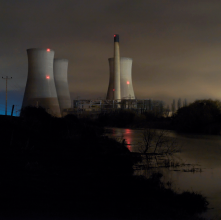
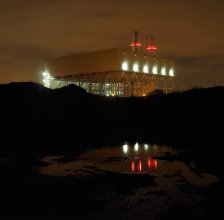
In his photographic series, Enclosures, Badlands and Borders, pulses of metal and concrete jut from the landscape. Chimneys, cooling towers, industrial plants and sheds boldly punctuate the sky, calibrating the distances across the picture planes, while feeding our desires and habits with the energy and products they demand, but which we ourselves can’t provide. One day these industrial icons might well be archaeological finds: fine lattice-works of iron oxide stains and strata of the pale crumbs of perished concrete, patterning the earth, energy sacrificed to time, symptoms of a long-dead culture, hieroglyphic denotations of spent desire and greed. How does this idea tie-in with the raison d’etre of David George’s images? How do we celebrate something that the majority decry or simply ignore, yet that remains symptomatic of and indeed a signifier of our civilisation?
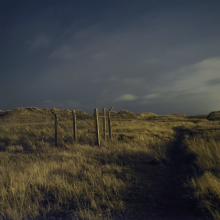
The gruff aesthetic of our industrial infrastructure has been referenced many times before, for instance the work of Bernd & Hilla Becher took this genre a certain distance along the spectrum of contemporary photography, but they were perhaps a little more exclusive, a little more precious about what they photographed and then again, they were fully engaged with that postmodernist trope of serial imagery. The antithesis of the social documentary or the neo-romantic landscape, George’s images, while having a certain intrinsic beauty, are nonetheless edgy, discomforting, challenging our parameters for what is culturally significant – what matters to us. The fact that the images from this series evince a certain aesthetic finesse, that they are pleasing to the eye, is immaterial; this is something that George’s imagery conjures almost subconsciously. What is of importance here is the conviction through which he has arrived at the decisions to depict these scenes. These sites offer the negative ontology of those frontier landscape images of the ‘Wild West’ by such pioneering American photographers as Timothy O’Sullivan, William Henry Jackson or Carleton Watkins. Their pioneering work depicted the natural wilderness of the 19th Century North American frontier , the ‘Wild West’; in contrast, George depicts an unnatural, synthetic wilderness spawned by the industrial age, but which has comparable extremes of scale, a similar raw-edged feel, the same sense of remoteness that distances and yet at the same time, fascinates the eye. George’s is a different frontier, sometimes the ‘Wildish North-East’, sometimes the ‘Wildish South-East’. Those frontiers between modified landscapes and imposed industrial infrastructures that are the non-places in our landscape, non-places that, for that very reason evade the tourist brochures.
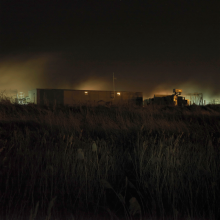
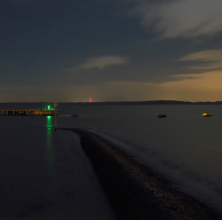
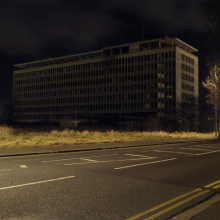
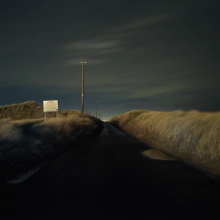
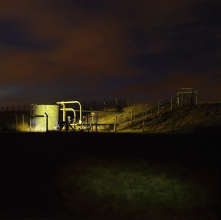
Through his use of available light, the night-time images that George has executed have a subtle, constrained, range of colours where acid greens, mustard yellows, ochres and siennas dominate, a damped-down suite of colours whose visual pianissimo has the effect of pacifying these images with their chromatic quietude and imbuing them with an aesthetic that would grace any tourist brochure.
In my early days of cinema-going I was always eager to work out which film technology had been used and always came to the conclusion that I far preferred the tones of ‘Eastman Colour’ to those of ‘Technicolor’, less garish, less colour-saturated, less synthetic. Then when it came to 35mm film, ironically, I preferred green-rich ‘Fuji-colour’ to red-rich ‘Kodacolor’, for similar reasons. The upshot of all this is that I find those colour tones that David George achieves in this series, totally sublime. As subjective as this might seem, it is, nevertheless, this fact that give George’s images their unique mien, their stylistic autograph. The luminance of flood-lighting, security lighting, aircraft warning lights, et al, neatly counterbalances, while pushing back, the dark areas of barren and bleak wasteland that threaten to dominate the picture-planes of his images. This is a delicate balance, however with the abeyance of the stygian gloom, never totally submitting to the eeriness of those sinister industrial hulks.
All this precludes, however, the presence of any formulaic, contrived composition, self-reflexive proportion or calculated pictorial dynamic. The viewer, although distanced from these scenes by their scale is nevertheless drawn in by the visual impact that results from that totally intuitive empathy guiding George’s framing of these scenes – where feeling has ousted analysis, where his heart has ruled his head. This intuition is of that same gifted skill that informed the eye of Andrei Tarkovsky the celebrated Russian film-maker. And there is something distinctly cinematic in the mien of George’s images, in fact if somebody had told me that these were stills from a heretofore undocumented Tarkovsky film, I would easily have been easily duped.
The power of these images is not derived simply through the sheer starkness that they portray but also through the lack of human scale here, we are confronted by industrial monoliths that, through their brute presence, repel the viewer’s eye. We find our gaze deflected towards the peripheral details that might offer some solace, some visual relief from the daunting structures that seem to orchestrate their own assertive and aggressive pictorial presence in these scenes. And yet, these same structures, that with their air of arrogance dominate those skylines, are ultimately doomed, despite their apparent impregnability they will ultimately crumble before the march of technological progress, superseded, they will become obsolete, fall into decay and ultimately face demolition. George’s hints at this in his images imbue then with a sense of poignancy – phantoms on the verge of becoming ghosts. Will they be remembered, not necessarily fondly, but with a certain enigmatic nostalgia?
With his images in the Enclosures, Badlands and Borders series, George is offering hooks on which we might hang our memories of these places, their significance will change with the passage of time but here he is offering their physical existence a degree of perpetuity. Unlike those scenes of industrial carnage wrought upon the landscape that typify Ed Burtynsky’s photographs of ‘Manufactured Landscapes’, in his series of images George shows these industrial hulks as mollified, merging, through age and maturity, with their altered but mellowing landscapes – these are alien presences that have nevertheless settled into and made themselves comfortable within their milieu, their sting has been drawn, their poison milked, their sublime-edge blunted.
So, despite their bulk, their apparent intransigence, the longer we look at these structures in his images, the more we realise that George is suggesting that our familiarity with these sites has softened them. They have become inclusive rather than intrusive and, given the subtle, redemptive play of light around these sites, George’s photographs might even encourage in the viewer that nostalgic response mooted earlier. Maybe that Romantic genre of the ‘Picturesque’ is, after all, being replayed, updated and upgraded here.
For more information www.davidgeorge.eu