We invited Dr Matt Johnston to draw from his critical framework for encounters with the contemporary photobook to discuss how this can be applied to diverse photographic publications. In his essay Seeing things differently, he walks us through these ideas in relation to two recently published books.
__________
In the post-millennium, conversations regarding the photobook were predominantly production-centred and legitimising in nature. The photobook as an art object. Now, with the aim of consecration widely regarded as being met (Chéroux, 2021:4), attention seems to be turning towards the power of photographic relationships with the page to ‘catalyse real change’ (Cataldo, 2023:10). As reception, relevance and sustainability begin to enter the general hum of the photobook ecology, it is useful to ask how our existing approaches to discussing the photobook support adjusted aspirations. Does an emphasis on publication obfuscate the work of publishing? Are competitions, awards and reviews able to do justice to the communicative potential of the medium? How else can we know the photobook?
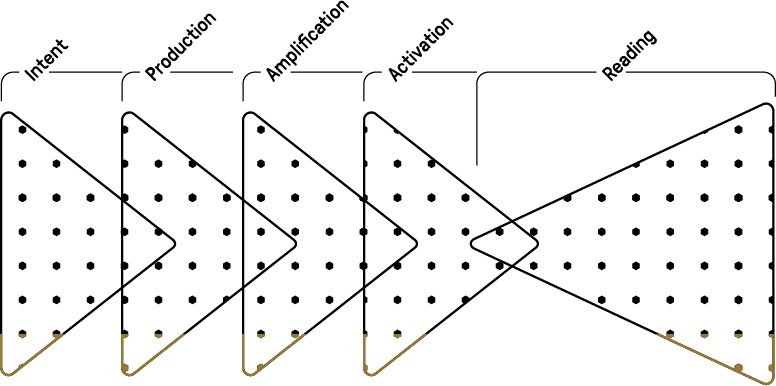
In 2021 I produced a critical framework for encounters with the contemporary photobook. It was designed to account for the various (and frequently hidden) acts involved in publishing in which the publication itself is only one component and far from an ending. The framework’s five stages — beginning with a purpose of publishing — are informed by those prior. So that the intent of translating work form the private to potential-public dictates choices in production. Then, the form of the book arrived at will necessitate the maker(s) to increase awareness and reach via acts of amplification [1] before the work is helped to engage and facilitate readers in activation. Finally, the unpredictable nature of reading that stretches from initial knowledge of the work through concentrated encounters and on to shelf-life and re-reading.
Application of the framework can be total or partial. Employed by makers or readers. Used in isolation or alongside established critical approaches. Intended to reveal rather than resolve, its use when approaching a photobook as a reviewer is to bring to the fore topics which might otherwise go unnoticed or else slip into the realm of perceived insignificance. Price, purpose, availability, accessibility of visual language. Topics which must be evaluated, as Fouad Asfour asserts, in relation to ‘which audiences the publications are trying to reach’ (2021:98).
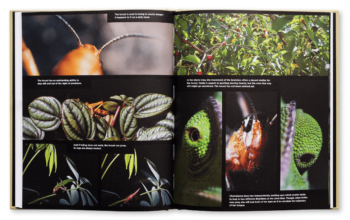
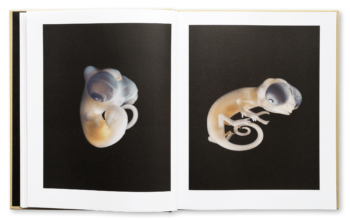
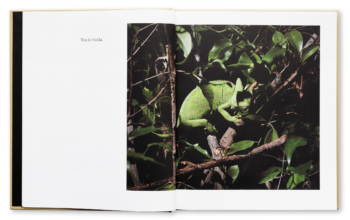
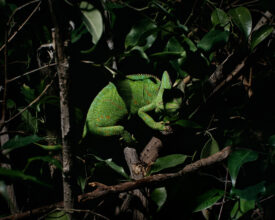
Hulda & Lilli by Maija Tammi (Kult Books, 2023) wears the clothes of so many contemporary works — a muted, matte cover debossed with title — but it quickly deviates to adopt elements of the picture book with large text narrating and anthropomorphising accompanying images. Conceived as an ‘inventive human experiment’ aiming to ‘draw out an emotional reaction’ and probe our feelings, we follow Hulda (a chameleon) and Lilli (a locust) from outer pages towards the centre. Depending on the way the book is picked up, the reader will experience one life before the other. This anchoring bias, the baggage of our sentiments towards species which may be deemed more worthy, interesting, or cute, and the power of narrative influence are the crux of Tammi’s work here [2].
As the stories of Hulda and Lilli come together, a design shift takes place and we enter a series of busy, utilitarian spreads akin to biology text-books or natural history volumes. Then, at the centre of the book two fold-outs reveal four interviews which frame the work in separate, but related, contexts (from biology to the neurological workings of empathy). An example of activating the work, these texts provide resources which enhance and extend a reading. It is quite possible to get much from this book without engaging with these texts, but their inclusion for many will aid assimilation of Tammi’s work into scenarios far removed from the locust/chameleon world of Hulda & Lilli. Not only do they provide another layer to the work but they are in themselves layered — taking responsibility for simple explanations of key terms and ideas before working towards more nuanced conversations.
Combined with accessible visual language that the work adopts, this responsibility for the reader’s route into the work’s themes generates interesting questions in applying the framework more completely. The book appears to speak to a broader public than is typical of the medium yet resides in an established physical form (costing €35 and with a print run of 300 copies) which sets up amplification acts that must account for a limited audience — likely those already residing in the ecology of the photobook or art book [3]. There is thus a tension between several facets of the books production. This is not to say there is an issue with Hulda & Lilli. But if we consider how scale, printing and binding impact audience and readership as a public and not only an experience, we might imagine other, supplementary, ways in which to realise this reading experiment in new situations.
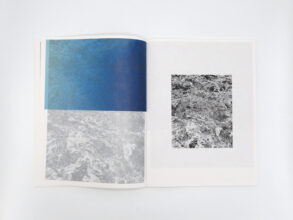
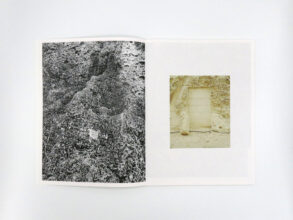
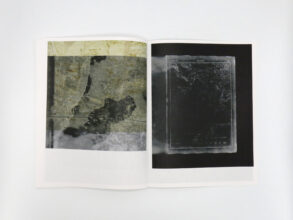
Nihilartikel by Izabela Pluta (Perimeter Editions, 2022) takes its title from the German word used to describe the ‘practice of inserting intentional errors, falsities or fictitious entries into reference texts… for the purpose of later identifying plagiaries’ . A paper town is perhaps the best known example. Magazine-like in size and sporting a semi-naked glued binding, Nihilartikel, evokes a slightly more contemporary aesthetic than Hulda & Lilli. Less formal. This is an atmosphere continued inside with only a short text which presents a set of definitions for unlabelled geological and geographic terms. Then, a series of visuals. Some are clearly photographs. Others seem to be scans, photographs of other photographs… maps [4]. Blues, greens and oranges are overlayed onto black and white. Images, colours and shapes stray to join others. It’s a structured assemblage.
There are clues and motifs which relate to the themes of the work (contested land, the fallacy of official record, the slipperiness of truth) but the reader is gifted little. At the back of the book, Ramona Heinlein’s essay The Uncertainty of Location comes closest to providing a way in for those who happen to arrive at the book with little prior knowledge. This text, dense in its presentation across a double spread isn’t as inviting as the interviews in Hulda & Lilli. Much like the images, it requires some work and ideally, some familiarity with a particular use of visual language.
A look at the events which accompanied the launch of the book — a signing and discussion at Perimeter books and an ‘in-conversation’ at the University of New South Wales Galleries — solidify the works position as somewhat esoteric. As acts of both amplification and activation (increasing awareness of the work and providing new understanding about its conception) they form a readership that is unlikely to be casual. In turn, the casual reader is unlikely to find Nihilartikel easy to relate to their experiences. Again, there is no insinuation of fault here. Instead an illustration of how, by considering accompanying events, resources and texts alongside the book itself, we can build a more complete picture of the potentials and problems of establishing publics for the photobook.
In their works, Tammi and Pluta call into question how narratives shape our ways of seeing and feeling the world. They raise the role of perspective and intent in the construction of knowledge and propose new ways to look, ‘even though it can be challenging’ (Tammi). With any adjustment to the way we look and speak of photobooks, a similar discomfort is expected. To talk about cost, to discuss relevance of the work to diverse readerships and to go beyond the book to investigate the events and messages of the meta-book are all a little uncomfortable. To engage with readers and their readings is almost scary. But these are only small forays into new discussions. A framework like my own might act as a companion for such excursions or may prompt more advanced strategies that encourage us to ask what it might mean to ‘publish the arts for a broader public’. This shift does not condemn those works that find homes and resonance in small, niche communities but recognises the potential of the medium to move from the cul-de-sac of the ‘cultural institution and the bespoke bookshop’ (Rzepecky, 2020:281). By asking questions of the way in which works are made public, as well as what is made public, it is possible that we may arrive at a more agile discourse. A discourse with focussed criticism able to celebrate and support a more adaptable and resilient medium.
[1] A term I borrow from Michael Bhaskar’s theory of publishing in The Content Machine (2013).
[2] As well as her wider work and exhibition The Empathy Machine.
[3] Evidenced by the number of reviews available of the book in photobook-specific spaces (Photo eye, C4 Journal, now Photomonitor). The publisher working to ensure the book is inserted into this environment.
[4] In fact Pluta uses ‘photographs gleaned from aerial drone footage and moving-image stills filmed underwater in Malta and Japan, and traditional darkroom prints made with out-of-print and otherwise obscure oceanic maps’.
__________
Asfour, F. ‘Why Talk about Artists’ Publishing Practices in Southern Africa’. In Decolonizing Art Book Fairs: Publishing Practices from the South(s): Workbook, edited by Yaiza Camps, Moritz Grünke, Pascale Obolo, Jean-Claude Awono, and Chayet Chienin, translated by Marcel Kemadjou Njanke, 96–102. Paris: Afrikadaa, 2021.
Bhaskar, M. The Content Machine: Towards a Theory of Publishing from the Printing Press to the Digital Network. London ; New York: Anthem Press, 2013.
Cataldo, A. ‘Foreword’. In Photography Bound: Reimagining Photobooks and Self-Publishing, edited by Antonio Cataldo and Adrià Julià, 6–12. Cinisello Balsamo, Milano: Silvana editoriale, 2023.
Chéroux, C. “Editor’s Note: The New Face of Photophilia.” The PhotoBook Review, vol. 20, Fall 2021, pp. 3–5.
Rzepecky, S. ‘Publishing as Public Space?’ In Dwelling in the Margins: Art Publishing in Aotearoa, edited by Katie Kerr, First edition., y, 279-284. New Zealand: GLORIA, 2020.
__________
Dr Matt Johnston is a Senior Lecturer at Coventry University.