By Jamila Prowse
COVID-19 transformed the way photographers work; overnight portrait photographers were without models, landscape photographers were without scenery. Instead of this shift limiting her artistry, photographer Ronan Mckenzie adapted to these new circumstances, deciding to turn the camera on herself. Despite being a practicing artist for five years, when Mckenzie was commissioned by Luncheon Magazine to take a series of self portraits in May 2020, she reflected to the publication that it was only the second time she had ever tried to photograph herself, and the first where her face is actually visible.
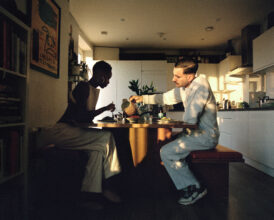
Our Table (2020) is the resulting series of images, which depict Mckenzie in intimate scenes at home with her partner, Diogo. Mckenzie, the director of a multifunctional creative space (HOME, London) and a curator in her own right, is familiar with evoking the domestic within an art setting. Yet, to invite a viewer into her kitchen partakes in another kind of vulnerability, far different than recreating the home within a gallery. The series is divided into three temporal scenes: breakfast, lunch and dinner. Passing time is denoted by the evolving light in the room and Ronan and Diogo’s attire. At breakfast the tones are muted, gentle, and in-keeping with a slow start to the day. There is an informality to Ronan and Diogo’s character as they sit across from each other at the dining table and drink out of mugs. For lunch, the couple both wear complimentary white outfits, and appear more animated, exchanging laughter over their meal. Finally, at dinner time the scene has been transformed; the entire room is caressed in the warm, inviting hue of dusk. Diogo pours Ronan a drink, Ronan moves to the same side as Diogo to try a mouthful of the food. We are generously invited into the personal exchanges of a relationship.
Each temporal exploration within the series includes three images, in which we observe Ronan and Diogo as they move effortlessly through the space. This movement is aligned with the preoccupation Mckenzie holds as an artist, with bodies in a state of flux. With the absence of models, turning the camera on a domestic scene, Mckenzie upholds her same penmanship as an artist. The simplicity and familiarity of capturing a quotidian scene around the kitchen table is reminiscent of Carrie Mae Weems’ seminal Kitchen Table Series, with Mckenzie giving a considered nod to the intergenerational influences on her contemporary practice. As the viewer, we become aware of how universally relatable the cyclical patterns of mealtimes are. In the passing of time, held in the same space which is ever-changing, we realise expansiveness can still exist within the confines of social isolation.
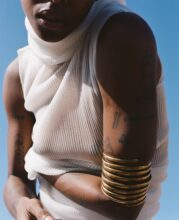
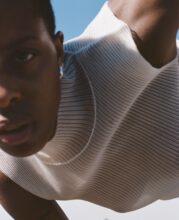
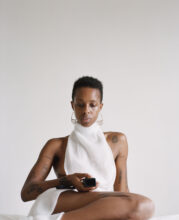
The limitless potentials of the self-portrait are visited once again by Mckenzie, in portraits for Vogue and Gerbase, in which the artist shape shifts using viewfinder snippets of her body. In one image for Gerbase, Mckenzie is close-up, her body partially obscured, once again framing movement using only her body. In another for Vogue, Mckenzie is completely visible, her legs curled up underneath her, her gaze focused down. In Mcknezie’s hand sits a visible camera remote, self-referencing the form of the self-portrait. These series act as portals into the artist’s early fascination with the possibilities of self portraiture; a consideration she further extends in 2021 through the curation of a group exhibition at HOME (supported by WePresent), ‘The Self Portrait’ (13th May – 27th June 2021), in which Mckenzie invites fourteen Black women photographers to share their own self-portraits. For many of the artists involved in the exhibition, this is the first time they have approached the medium, as is reflected by participating photographer Adama Jalloh: “Being someone that documents other people or places to maintain a memory or feeling of what was, I funnily enough excluded myself from that and realised that needed to shift. Photographing myself in front of a mirror was and still is challenging but it’s the starting point of me not running away from myself and the changes that come along with me.”
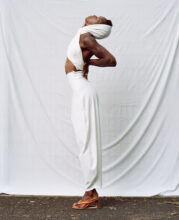
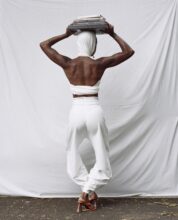
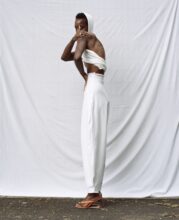
For the exhibition, Mckenzie returns to the form through a series of three portraits, (For Me This Time, 2020) situated side by side. The artist stands in front of the simple set of a white hanging sheet; the standalone backdrop communicates movement through the folds and waves of the fabric. Mckenzie expands the potentials of the human form by moving her body in new contortions, with defined lines that are analogous to strength. Within the central image, Mckenzie re-thinks the tradition of head carrying, with a pile of books balanced upon her head. The books signal Mckenzie as a student in the rich history of Black female photographers, which is further reflected in the curation of HOME itself which is filled with art books, fiction and historical literature relating to Black histories.
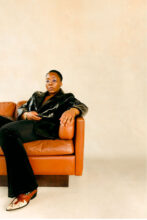
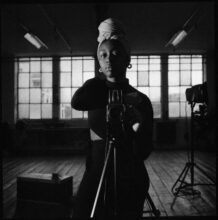
There is a continuation of the self-referencing of the self-portrait in Adama Jalloh and Christina Ebenezer’s images. In tone the works are very different. The muted cream plaster floor and wall of Ebenezer’s portrait creates the illusion that she is suspended in place. The tan leather of the sofa on which Ebenezer sits and her one cowboy boot in view, provide a flash of colour eluding to modernity. Whereas, Jalloh’s portrait is black and white, with the artist sharply in focus and centred in the frame. A slightly out of focus backdrop of what appears to be a photography studio, with large windows backlighting Jalloh and exposed floorboards, lends a grandiosity to the image. Parallels arise in Jalloh and Ebenezer’s gaze: chin slightly raised, eyes focused directly out at the viewer. Both artists appear defiant. Photographic equipment is left visible in both images – Jalloh’s large format, analogue camera on a tripod, and a lighting rig behind, Ebenezer’s self-timer remote in hand (which combined with the sofa is masked as a TV remote) – leading the viewer to the knowledge of how the images have been constructed by the artists. We are conscious of self-imaging being actively and purposefully engaged.
The individuality and range of the images in ‘The Self Portrait’ are a testament to not only how much can be done through self imaging, but also the expansive artistry of the contributors. Mckenzie and her collaborators’ overriding concern is what happens when the care a photographer usually reserves for their subjects is turned back upon themselves. How does this close form of looking change the ways we view ourselves? What is possible when we sit closely and consider the aspects of the self we wish to portray? As summarised by Mckenzie when speaking to Luncheon: “I’m so used to seeing and finding the beauty in others, but through this I’ve had to really find it in myself.”
__________
‘The Self Portrait’ is at HOME, London until 27th June 2021, supported by WePresent; it can also be viewed online here.
Jamila Prowse is an artist, writer and researcher who uses her experiences as a mixed race disabled person of Black parentage to understand and subvert barriers to working in the arts. Her research is preoccupied with oral testimony and the possibilities and limitations of complaint to protect art workers. Within her artistic practice, Jamila works across moving image and textiles to consider methodologies for visualising mixed race identity and the lived experience of disability. She is drawn to stitch making and patchwork as a tactile form of processing complex family histories and mapping disability journeys, and moving image as a site of self-archiving and autoethnography. Presently, Jamila is working on the first iteration of a series of three films, An Echo For My Father, tracing the history of her ancestry through her relationship with her late father Russell Herman, a South African jazz musician who passed away when Jamila was three. Jamila is part of an upcoming group show at Hordaland Kunstsenter, Norway (October 2021) and was studio residency artist at Gasworks from January to April 2021. She curated and hosted a series of podcasts for Lighthouse, Collective Imaginings, of conversations with art workers about their experiences of navigating the sector, was a recipient of a GRAIN writing bursary and Guest Editor of Photoworks Annual 26. As a writer, her reviews and essays have appeared in Frieze, Elephant Dazed, GRAIN, Art Work Magazine and Photoworks. jamilaprowse.com