-330x220.jpg)
-293x220.jpg)
-395x220.png)
-392x220.jpg)
-330x220.jpg)
-293x220.jpg)
-330x220.jpg)
-388x220.jpg)
-392x220.jpg)
-394x220.jpg)
-330x220.jpg)
-391x220.png)
-316x220.png)
-328x220.png)
-330x220.jpg)
-330x220.jpg)
-330x220.jpg)
-330x220.jpg)
-374x220.png)
I was sitting, fishing a fly out of my glass of wine, at a wood-paneled pub just south of London Bridge, with one of the senior darkroom technicians from the Royal College of Art. The smell of sulfur, vinegar, and wet fiber paper always seems to cling to her, a stubborn residue in an increasingly weightless world. As we watched the sun set through the leaves of a maple tree, we noted the dappled light on the ground as a natural camera obscura phenomenon, a concept we first learned about during a guest lecture at the RCA when we studied together. Those tiny gaps between the leaves act as pinholes, projecting thousands of distinct, overlapping shadowy images onto the pavement. In the midst of that soft, organic projection, she dropped a statistic that has disquieted my thoughts ever since: of the seventy-five-ish students currently enrolled in the MA Photography program, only about fifteen are printing images directly linked to the traditional “photographic”, and a mere ten are actually using the darkroom.
The rest? They are coding, designing interactive installations, building biometrically tracked sensory environments, and writing Python scripts. For anyone raised on the romanticism of the silver-halide print, this metric might read as an obituary. It suggests a wholesale abandonment of the indexical frame, the slow, chemistry-bound witness that has defined photography’s claim to truth for nearly two centuries. The artists have left the darkroom because the battleground has shifted, mirroring a broader, systemic unravelling of traditional artistic disciplines. In her essay Expanded Photography: Persistence of the Photographic, Lucy Soutter notes that philosopher Peter Osborne views this convergence of all art forms into a single, “generic” contemporary art category as an inevitable consequence of transglobal capitalism. Driven by neoliberal economic policies, this structural engine forces a profound transformation in creative practice, shifting “from a craft-based ontology of mediums to a post-conceptual and trans-categorical ontology of materialisations”.
When the world is documented by more than cameras and actively simulated, categorized, and policed by automated, algorithmic systems, this generic confluence of mediums becomes total, rendering still images a supplement. To understand where contemporary image-making in the United Kingdom is heading within this trans-categorical landscape, we will have a look at the work of Lila Rui Lan.
An RCA MA Photography graduate, Rui Lan’s practice is a direct response to this post-photographic landscape. Over the past few years, she has extensively expanded her medium from photography to interactive installation, carving out space to explore the increasingly entangled, uneasy relationship between the individual and the technology-embedded system. Her work operates in the cold shadow of the “synthetic eye,” an era defined by theorist Fred Ritchin, where computational vision does not merely record reality but synthesizes it, severing the camera’s traditional connection to physical presence. It is a world where, as Hito Steyerl famously argues, images have ceased to be passive representations and have instead become active, “operative” files, raw instructions used by autonomous systems to track, optimize, and control human behavior.
In Rui Lan’s hands, the camera is no longer a tool to look at the world; it is a mechanism to dissect how the digital infrastructure looks back at us. I first encountered Lila’s work in February 2025, in my role as program curator for Der Greif. I was helping facilitate a Guest Room edition curated by Joanna Zylinska, an artist, writer, and professor of media philosophy at King’s College London, alongside conceptual artist Yanai Toister. The prompt they posed to our community was deceptively simple yet radically destabilizing: “WHERE is the photographic image today? Is it in the eye? In the brain? In our memory? In a database?”
Zylinska’s own philosophy of “non-human photography” has long argued that the vast majority of images are now created by machines for other machines, entirely bypassing human perception. In a landscape of automated satellite feeds, facial recognition systems, and neural network dreamscapes, the traditional camera is merely a tiny, quaint subset of a much larger computational ecosystem. Lila’s submission to that Guest Room immediately stood out to me because it leans directly into the dissolution of the still frame through her project, Whirlpool.
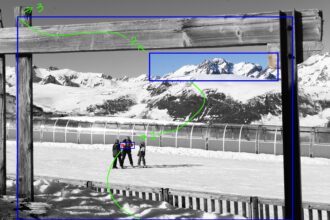
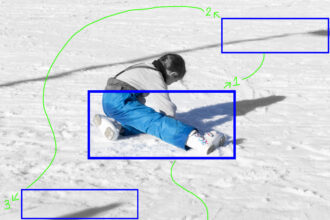
Rooted in large-scale photographs from her first visit to southern France, the work maps the fluid, dynamic transaction between her personal subjectivity and the surrounding world, examining the brief, unquantifiable interval that occurs between perceiving a new view and pressing the shutter, an act of structural affirmation that only takes place once attention has fully formed. Rather than presenting a passive landscape document, Lila overlays her prints with stark, diagrammatic green and blue bounding boxes and vectors, systematically charting the dynamic “whirlpools” of attention that dim everything else around them. By treating human vision and observation as a data-driven, calculated layout, she explicitly bridges the gap between the internal architecture of human perception and the cold formatting of machine vision, unfolding the frozen photographic moment to expose the raw sparks within.
When Lila transitioned to interactive installation, she carried this systemic perspective with her, treating the digital interface not as a neutral canvas, but as a site of human exploitation and algorithmic choreography. This critique of systemic transaction finds its most potent, unsettling expression in her major work, Laugh-out-loud (LOL), which was showcased at the Linz FMR 26 Media Art Festival in Austria, supported by Immersive Art UK. The piece is a sharp, dark parody of modern emotional labor. Its conceptual spark was born from an absurdly mundane digital friction: during an online residency, Lila noticed that to communicate spontaneous human warmth in meta-space, participants first had to consciously navigate their interface, pressing the “unmute” button just to let their laughter be heard. The irony of having to schedule and digitize a visceral human reflex stayed with her. She developed LOL to explore how human-AI symbiotic relationships are built on the requirement that humans conform to the rigid, operational logic of the machine.
[ Absence of Laughter ] ─► [ Host Fades & System Warnings ] ─► [ Algorithmic Glitch ] ─► [ System Shutdown ]
In its final presentation at the FMR festival, LOL bypassed the traditional gallery walls entirely, installed instead within a dark tunnel originally built by concentration camp labor and now reused as a pedestrian route to the Schlossmuseum Linz. There is no hyper-cheerful digital or physical room here; the historical site itself carries a heavy weight of forced compliance that profoundly reframes the work. A participant joins the game simply by tapping on the screen. From that moment, a single rule applies equally to both the human and the AI participant: they must laugh out loud. Within this space, both entities are considered equal parts of the system, dual entities that are thoroughly exploited and controlled by the designed architecture.
The interface settings deliberately build a simulated, high-stress vibe of competition between human and machine. Through a rigorous tracking matrix of timelines, warnings, countdowns, a laugh speed parameter, and a “laugh late” punishment that actively enforces extended time, the system gamifies human affect. Yet this competition is a bitter farce, because while the human operates under the psychological anxiety of performance, the AI is only filling a cold command, automatically matching audio triggers without an ounce of actual feeling. If the sensors record an ongoing absence of laughter, the digital host on the screen begins to fade, the system issues frantic warnings, glitches, and completely shuts down.
Here, Lila’s work intersects profoundly with Hito Steyerl’s philosophies on digital labor. In our current cultural moment, we are constantly told that AI is autonomous, a magic force operating in the cloud. Steyerl has spent years debunking this myth, showing that so-called artificial intelligence relies on massive, hidden infrastructures of human labor, microworkers who manually tag data, label images, and train vision algorithms. In LOL, Lila reveals that we have all become these microworkers. Our raw, emotional output is the fuel being mined to train the system. By staging joy as an industrial system demand, the work exposes how emotional labor has been gamified and how easily we begin to mirror the very systems we create. It forces us to ask: Can we still recognize the essential difference between humans and AI when our behavioral outputs have become completely indistinguishable?
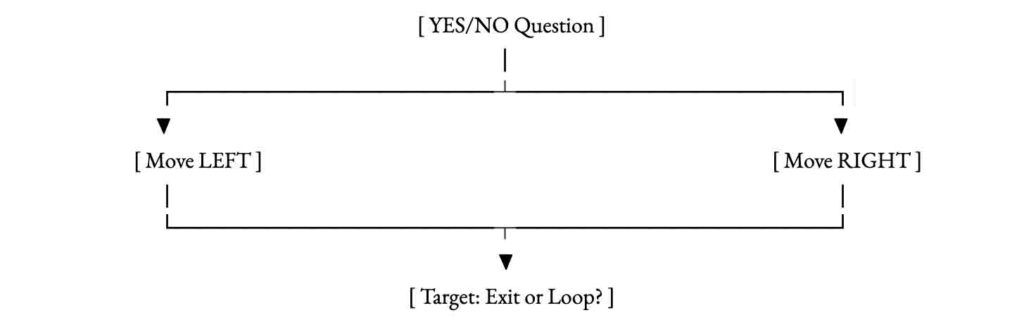
The tension of the binary trap between individual agency and systemic control is further explored in her interactive installations, Left or Right? (2025) and Kill Heroes (2024). In Left or Right?, a collaborative project with Natascha Christina Petersen, participants wear custom-built helmets that pose binary YES/NO questions about their lives as they navigate a physical space defined by towering columns. Every choice is recorded, compiling individual decisions into a collective pattern. At the threshold of the installation, participants face a critical choice: remain within the system’s loop, or step beyond it. Those who choose to exit are not rewarded with freedom; instead, they are met with a new barrage of questions probing why they chose to leave the known path.
The work serves as a chilling metaphor for our interaction with modern interfaces. From cookies to algorithmic recommendations, we are constantly forced into binary decisions. Even our attempts to opt out are immediately tracked, monetized, and folded back into the system’s dataset.
This critique of systemic manipulation is pushed to its extreme in Kill Heroes (2024), a project that functions through two distinct, evolutionary bodies. The work opens as a moving-image piece, presenting a simplified rendering of the disciplinary processes embedded in societal systems, while introducing the psychological possibility of destroying the conceptual “heroes” imposed upon us by these frameworks. This initial narrative phase aligns directly with Carl Jung’s process of individuation, mapping out a difficult trajectory toward psychological wholeness against the pressure of collective conformity. Following the moving image, the project expands into a physical installation that gamifies these rigid patterns of discipline into real-time, physical interactions, translating the work into an entirely embodied experience.
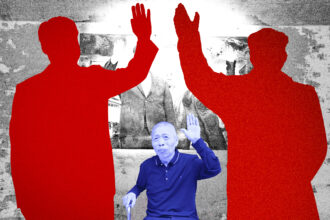
When a participant steps into this installation space, they are met with a warning regarding the system accessing their voice and image before the game activates, capturing a headshot for formal registration. Guided by a sequence of cold on-screen instructions, the user must perform a strict choreography of compliance by raising hands, opening mouths, and forming specific shapes until a target frequency is satisfied.
The true subversion of the work occurs at the precise moment the participant believes they are about to win the game, as the entire tone of the system shifts dramatically. The playful interface vanishes, replaced by a series of intense, silent, and accusing questions that flash across the screen, directly interrogating the participant’s motives for playing along at the cost of their own private biometric data. Finally, the participant is given a rare chance to question the architecture back, their recorded responses lingering in the machine for future players. Through this strategic evolution from screen to booth, Kill Heroes exposes how effortlessly we yield to surveillance capitalism, volunteering to behave in highly structured, predictable ways simply because our subjection has been gamified. It stands as a stark reminder of our lost autonomy in a modern society that relies on a deceptive promise of multiplicity to mask an oppressive, standardized singularity.
This terrifying subversion of the digital interface is not an isolated obsession. Recently, I traveled to Los Angeles as an RCA alumna to display my work and help recruit the next generation of students. It was there, in the courtyard of the Wilshire Ebell Theatre, recently featured in Hacks, that I had my first real, expansive conversations with James Coupe, who took over as the Head of the Photography MA programme in 2023. Having tutored Lila during her time at the institution, Coupe pushed her to dive deep into the volatile spaces where systems, art, and technology collide. It was within this rigorous dialogue that Lila completed a vital conceptual shift: a movement away from the traditional photographic pursuit of an isolated individuality toward a deeply relational one. This ideological turning point manifested directly in the structural evolution of Kill Heroes (2024), which migrated from a self-contained moving image work into a physical, interactive installation. Through this transition, the traditional beholder is explicitly reconsidered as an active participant who must interact with the system directly to trigger its parameters. Grounded in the cyberfeminist and media philosophies of Donna Haraway and Joanna Zylinska, her primary reference points for unpacking the messy realities of the human-AI symbiotic relationship, Lila’s environments refuse passive viewing.
One can trace a direct, urgent conceptual lineage here to Coupe’s own systems-based critiques. In Coupe’s 2019 installation, Exercises in Passivity, exhibited at the Jacob Lawrence Gallery in Seattle, viewers are confronted with a physical metal worker’s cage containing a screen. The monitor displays the multiple-choice personality test used by Cambridge Analytica to profile Facebook users, alongside psychometric evaluations used by global corporations to monitor potential and current employees. It is an artwork that, like the interactive iteration of Kill Heroes, literalizes the entrapment of the self within computational frameworks. In both spaces, the human subject is invited, or rather, coerced, into performing their interiority, whether through a biometric facial frequency or a psychological profile, solely to satisfy the insatiable hunger of a profiling engine. This is the pedigree of the contemporary RCA photography student: the camera is no longer a tool of passive looking, but a portal into systemic incarceration.
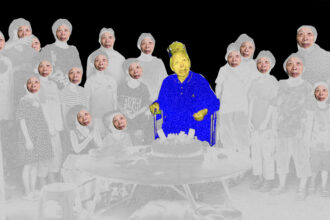
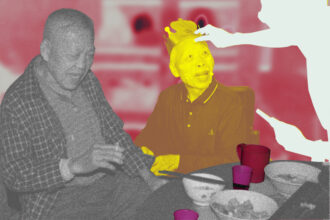
It would be a mistake, however, to view Lila’s practice as purely academic or cold. Beneath her systematic critiques lies a deep, quiet empathy for the human cost of these structures. We see this in her early photographic series, 84/Eighty-Four: Reunion (2023), which reconstructs memories of her grandfather’s eighty-fourth birthday based on photographs she took that day. Her grandfather, who had lost the use of his legs, sat in the middle of a rectangular entrance gate, waiting for relatives to arrive. When he blew out his candles, he wept. During the celebration, he leaned in and melancholically remarked to Lila: “Your father needs a son. Only a son can inherit the family’s glory.”
As Lila writes, at that moment, “the granddaughter was silenced forever, while the observer created a new layer through reterritorialization.” To process this patriarchal rejection, she cut, colored, and manipulated the images, isolating her grandfather’s figure in bright, artificial blues and yellows, while fading the surrounding family members into ghostly grey silhouettes. By manually interventionist editing, she exposed the invisible social structures of gender, inheritance, and familial expectation that governed that room.
[ Traditional Image of Family ] ─► [ Manual Intervention / Cut ] ─► [ Reterritorialized Silhouette ]
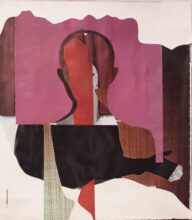
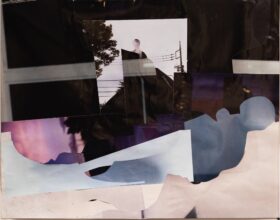
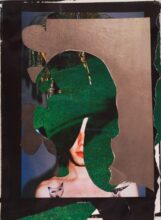
This is the same impulse that drives Shaping Shapes: Drifting in the Irreversibility (2025), where she cuts physical subjects out of magazines and newspapers, discarding them so that the overlooked, empty backgrounds take center stage. In both works, Lila is wrestling with what is central and what is peripheral, what is given voice and what is silenced. Whether she is cutting up a paper magazine or writing Python scripts to capture the biometric data of a gallery visitor, her target remains the same: the invisible systems that seek to standardize, classify, and erase our messy, complicated humanity.
Let us return once more to that London Bridge pub, and the darkroom technician’s (or was it my?) anxiety about the empty print trays. Where have the physical indexical traces of the photographic gone? Looking at Lila Rui Lan’s work, we can see that our anxiety is not entirely misplaced. It is tempting to declare that the decline of the physical silver print is a sign that photography is finally growing up. For over a century, photography was defined by the camera’s relationship to the physical world, a chemical recording of light bouncing off a body. In the age of the synthetic eye, the automated sensor, and deep learning, the image is no passive record; it is an active, operative agent. If contemporary artists continued to focus solely on the chemistry of the print, they would be ignoring the very software systems that are currently rewriting what it means to be human. Lila’s brilliant contribution to contemporary art is her refusal to let the image remain a static object on a wall, forcing us instead to confront the digital scaffolding that surrounds us. She takes the invisible, sterile logic of machine vision, biometric tracking, and data processing, and drags it into the physical space of the gallery, making it visceral, exhausting, and absurd. Her work shows us that to photograph today is to negotiate, resist, and somehow survive the technology-embedded systems that seek to turn our very laughter into labor.
Yet, we must tread carefully before celebrating this wholesale flight from the index. In their research on the automotive chip crisis, Alexander Ziegler and Eckhard Heidling document a parallel structural vulnerability, noting how an industry-wide rush toward hyper-digitized, “software-defined electric vehicles” left a multi-billion dollar manufacturing apparatus completely paralyzed when a single, minor microcontroller chip went missing. We see this exact systemic fragility playing out right now across our own discipline. The current global SD card shortage is directly linked to the insatiable, booming demand for AI data centers, which are currently consuming a significant majority of the world’s flash memory and NAND wafer supply. Silicon foundries have heavily reallocated their production lines away from consumer electronics, like cameras and standard SD cards, to manufacture high-margin enterprise-grade storage and memory for big tech AI infrastructure.
My father, who works as an engineer in the semiconductor field and holds regular Zoom calls at loud volume with his colleagues, expresses to me his relief that retirement will come before the system collapses in on itself. There is an exquisite, bitter irony here: photographers are quite literally running out of the raw physical materials required to capture light and make images because artificial intelligence is swallowing up the silicon required to build them. With consumer memory card prices more than doubling since the end of 2025, premium capacities facing severe stockouts, and legacy manufacturers suspending entire professional SD lineups due to this systemic reallocation of capacity, the physical act of shooting with a camera is being actively squeezed by the very infrastructure that Lila’s work dissects. Retail trade associations have already warned governments that this computational bottleneck will choke out consumer electronics well into 2027.
This presents a profound warning for the post-photographic age. In the same way that a modern vehicle stops functioning as a car when a computer chip fails, we should not forget that photography breaks down when we entirely sever its link to the act of seeing and the physical camera. If we reduce the image to a series of purely software-dependent interactive nodes, we create a practice that is highly sophisticated yet fundamentally fragile. When the server glitches, when the code breaks, or when the biometric tracking fails, what is left of the image? It is exciting and necessary to see this work in Lila’s practice; she uses the fragility of these interfaces as her very subject. As the darkrooms empty out, we must ask if we are trading a resilient, physical act of looking for a system that can be completely paralyzed by a single digital failure.
__________
Lila Rui Lan/蓝睿 (China) is a London-based multidisciplinary artist working across photography, moving image, and interactive installation. Her practice investigates the tensions between individuals and systems to imagine otherwise — systems that are relational where individuals, communities, nature, and technology are not in competition, but grow together, shaped by and toward one another. Her works transform social and algorithmic systems into participatory structures where people can physically explore and reimagine human relationships with each other and with technology. Two qualities define these works: their participatory nature, communicating through embodied experience, and their openness, the goal is for people to leave with questions, not answers.
As a recipient of the Immersive Art UK (Experiment) grant, her new project Laugh out loud ‘LOL’ was exhibited at Linz FMR 26 art festival in June 2026. Her recent projects include Left or Right? (with artist Natascha Christina Petersen), exhibited at O-day Festival (2025), and Kill Heroes, shown in NAE 2025 at New Art Exchange, Nottingham. Her work, Whirlpool, was featured in Der Greif (Guest Room curated by Joanna Zylinska & Yanai Toister) and exhibited in the Beijing Midsummer Art Season. In 2025, she completed an online residency with Loop Art Critique and was selected for the FM[Ai]R 26 residency. In 2024, she was featured in Photography+ (#25 Multiplicity, Photoworks UK) and exhibited at Glasgow Gallery of Photography, The eARTh Space (London), and Boomer Gallery (London). ruilanlila.com
Francesca Hummler is a German-American artist, educator, writer, and curator based between London and San Diego. She has been the Community Manager and Program Curator of Der Greif, a contemporary photography organization based in Munich, since 2022. In 2024, she spearheaded a symposium on AI in Photography in collaboration with FOAM Magazine, Photoworks, and The Photographers’ Gallery during Paris Photo 2024. Francesca graduated from the Royal College of Art with an MA in Photography with distinction in 2022. She has also worked as the Educational Delivery Manager and Photography Tutor at Photofusion in London, where she curated exhibitions and led community-focused photography programs, combining teaching, curriculum development, and career support for underrepresented groups.
An award-winning photographic artist, Francesca’s practice focuses on identity, drawing from her experience as the daughter of German immigrants in the United States. She explores the archive, familial intimacy, and generational trauma through a methodology inspired by photo-therapy. She has actively participated as a portfolio reviewer for FORMAT25, Photo-Match at Fotofestiwal Łódź, Shutter Hub YEARBOOK, UWE Bristol Photography BA Degree Show, and Offspring Photo Meet. She has also taught at ICASD, Vermont Center for Photography, Fotografie Forum Frankfurt (FFF), and lectured as a guest tutor at Paperdrop Lab and Fachhochschule Dortmund, University of Applied Sciences and Arts. She is currently working on curating a traveling show for the German Embassy in Washington. D.C. on German-American partnership. In Fall 2026, she will be joining the University of South Dakota as a Visiting Assistant Professor of Art in Photography. francescahummler.com
Bibliography
Coupe, James. Exercises in Passivity. Installation at Jacob Lawrence Gallery, Seattle, July 31 – August 24, 2019. (Reference for discussion on systemic labor, employee personality evaluations, and Cambridge Analytica profiling).
Jung, Carl. The Development of Personality. Translated by R.F.C. Hull, Princeton University Press, 1981. (Contextual resource for Kill Heroes and concepts of modern individuation).
“Memory Pressure Deepens: How Scarce Supply is Leading to Soaring Prices in 2026.” RedShark News, June 2026. (Contextual data on the global NAND flash market reallocation, skyrocketing camera media card pricing, and storage stockouts driven by AI infrastructure data centers).
Ritchin, Fred. After Photography. W. W. Norton & Company, 2009. (Investigating the rise of the “synthetic eye” and computational image synthesis).
Rui Lan, Lila. Lila Rui Lan: Artist Portfolio and Statements. https://ruilanlila.com.
Rui Lan, Lila. “Laugh-out-loud (LOL).” Interactive installation, showcased at Linz FMR 26 Media Art Festival, Linz, Austria, June 2026.
Steyerl, Hito. Duty Free Art: Art in the Age of Planetary Civil War. Verso Books, 2017. (Philosophical context on systemic labor and operative images).
Soutter, Lucy. “Expanded Photography: Persistence of the Photographic.” PhotoResearcher, no. 26, 2016, pp. 36–43. (Philosophical context on the erosion of mediums and generic contemporary art).
Ziegler, Alexander, and Eckhard Heidling. The Chip Crisis in the Automotive Industry: Challenges – Measures – Action Areas. Munich: ISF Munich, 2023. DOI: https://doi.org/10.36194/HyValue_Chip_Crisis_2023[cite: 3].
Zylinska, Joanna, and Yanai Toister, curators. “Guest Room: WHERE is the photographic image?” Der Greif, February 2025. https://dergreif.org/guest-room/joanna-zylinska-yanai-toister.