




__________
On first impression, these two books, both published in 2019, are very alike. Both consist of black-and-white pictures taken at the seafront in British coastal resorts. Both are authored by baby-boomer photographers who are well regarded in British photography circles. Both are traditional, elegant hardbacks bound in blue cloth. Both even have the same number of pages. And both have photographs tipped into their front covers, showing – superficially at least – remarkably similar scenes where people of varying age stand on a concrete platform, with the odd person on the beach beyond in front of the sea.
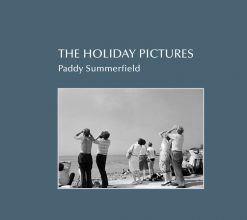
In Summerfield’s cover image, everyone is turned away from the photographer towards the sea. Even though we can’t see their expressions, these holidaymakers look awkward and uncomfortable in the summer sun, as if they have dressed for the office but found themselves at the beach. Whatever the out-of-shot object of their attention, it seems high, distant and unreachable. The overriding tone of the picture is uptight and tense.
By contrast, in Luskačová’s cover photograph we see most people’s faces. Although they also look out to sea, whatever they are looking at seems low down, close by and attainable. Although dressed similarly to the people in Summerfield’s picture, they seem more comfortable and relaxed. The warm and open mood is heightened by a girl in the centre of the frame and a baby in a pram who both smile – two more smiles than we’ll find in the whole of Summerfield’s book.
Here, judging a book by its cover – once we’ve studied it properly – is to be recommended. Because these two books are, in substance, chalk and cheese.
—
Opening the cover of each book, even before we consider the substance of their pictures, the formal differences between the two are instructive. With Luskačová, the pictures’ format is uninhibited and expansive: portrait images almost fill their entire page, and landscape photographs run freely across double spreads. In comparison, Summerfield’s book manifests a formal rigour: all the photographs without exception are landscape in orientation, each confined to the centre of a single page. And while Luskačová’s lens points in all directions, roaming to form a traditionally rounded, documentary view of the seaside, Summerfield’s camera is restricted to pointing towards the sea, as if frozen on a seized-up tripod. In a formal sense, then, all his pictures are the same. While on one level – with their constantly changing cast of characters and compositions – they are a consummate close cousin of street photography, on another level they are exemplary seaside typologies made with a contemporary-art rigidity akin to Hiroshi Sugimoto’s Seascapes or Thomas Joshua Cooper’s ocean photographs.
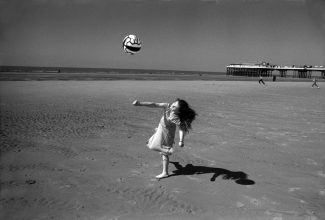
The people in Summerfield’s pictures are overwhelmingly awkward, such as his pasty women in swimming costumes who lie on giant mudflats, brilliant white in the sun, completely out of their element. But his subjects’ awkwardness is eclipsed by their alienation. Even in groups, his individuals tend to look alone in a crowd. A dozen people stand close to each other, but not one engages with another. They all stand together, alone. A girl plays ball on the beach on her own. A solitary man stands with his back to us taking a photograph of the sea and the beach. Could this lone figure suggest a proxy for Summerfield himself?
God features frequently in Summerfield’s book. An Adventist preacher warns with his sign. The Seaside Mission persuades with its music, but no-one’s listening. A nun, her back turned, walks away – it’s as if God has left the photographer on the bereft seafront which, with its concrete walls and wooden posts, looks more war fortress than holiday resort. A lone figure with a cane struggles along a cobbled path which stretches nowhere but into the sea: it might be sunny and fine, but it seems everyone is alone on a road to oblivion.
—
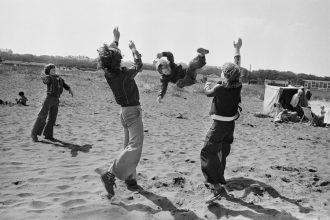
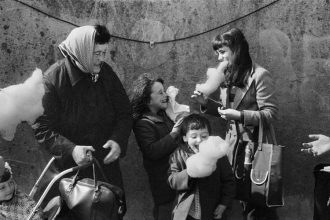
Luskačová’s subjects are a stark contrast. An elderly couple stand on wet sand in their Sunday best, but they look neither uptight nor uncomfortable as they smile down at a little boy in his shorts. Two boys may not have any beachwear, but they’ve nonchalantly adapted their city clothes by simply taking off their tops as they lark around to each other’s amusement. Family groups interact, play, and laugh. Together. Kids play ball with each other, pleasure on their faces. Boys sprint with dogs along the shoreline, big sisters cuddle little ones, brothers play fight each other, mothers and fathers tend to babies, and grandparents tend to grandchildren. Whether it shows playing with the dog, running away from the spray of the sea, cricket, football, or kids just throwing each other into the air, there is joy, laughter and fun in most of the photographs. If their subjects have worries and woes, they have left them at home and arrived carefree at the beach.
Luskačová’s work is in the more traditional subjective-documentary mode. She gives her subjects dignity, consistently showing them in a good light, and celebrates the joy that can be had at the seaside. You get an overpowering sense that she was in an upbeat, happy frame of mind when making these photographs, and that this positivity is reflected back at her by her subjects. Summerfield’s pictures, on the other hand, could be read as dark and introspective, and may say as much about the photographer’s own sense of alienation as they may comment on the people who are in them.
These two books have the same subject: people at leisure on the British seaside. They were both made by accomplished photographers similar in age using similar equipment and materials. But they could not be less alike. Luskačová’s presents a warm connection, whereas Summerfield’s suggests a frosty disconnection. But what they have in common is that both are skilfully executed self-portraits of sorts, potential expressions of the photographers’ inner selves.
A scepticism about the deeply artistic nature of photography is still widespread in Britain, as is the misapprehension that it is an objective medium where an apparatus takes an imprint of the world ‘as it is’. The patent differences between these two books easily dispel such specious notions. And make for compelling reading.
– reviewed for Photomonitor by Simon Bowcock
__________
For further viewing:
By the Sea by Markéta Luskačová is published by and available from RRB, Hardback, 134 pages, £60.00 retail
The Holiday Pictures by Paddy Summerfield is published by and available from Dewi Lewis, Hardback, 132 pages, £30.00 retail