The Cosmological Eye
The flat world of our city pavements, disregarded by most pedestrians, is revealed, under the intense scrutiny of Effie Paleologou, as significant terrain. A dull carpet of ill-fitting stone slabs, tarmac and fast-food detritus, becomes part of the curvature of the universe. The slightest scars – scratchings of heels, bicycle tracks, old blood, recent vomit, leaves embedded in cracks, rusty rivulets, ice damage – register a history that the questing photographer, a profound scientist of urban alienation, records and exposes.
One of Paleologou’s defining gifts is the ability to work from wherever life chooses to locate her. Or wherever, in mirror-image reversal, she chooses to locate her life. In the case of the Microcosms, 2014 series, the geographical limits Paleologou imposed on her project form an occult triangle, lines of force, attraction and repulsion, between three stations: Bethnal Green, Old Street, Liverpool Street. Each of these active hubs has a weighted back-story. A wartime disaster with panicked crowds crushed on the stairs. A nocturnal railway cathedral, supported by carbonized columns like an iron forest, where exiles like Joseph Merrick, the Elephant Man, returned to London. Or where Kindertransport trains delivered so many future orphans.
W.G. Sebald, arriving at Liverpool Street from Norwich, took to these same streets in quest of postcards and memory-prompts that he could absorb into the fastidiously designed pages of his documentary fiction. The German poet used photographs to authenticate events that never quite happened. Paleologou speaks about uncovering an ‘arbitrary cartography’, about mapping transience, points of arrival and departure. Travellers who remain ghosts, framed in the windows of night buses, given meaning only by the rigour of her compositions. She is walking with intent, hunting for incidents or materials capable of confirming her anonymity – and, at the same time, the only qualification that will permit her continued residence: the accumulation of recorded detail to shape a new map of an old place.
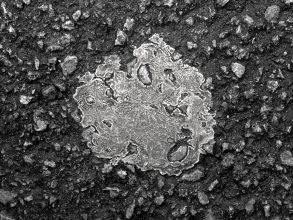
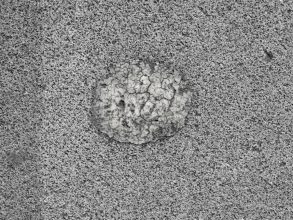
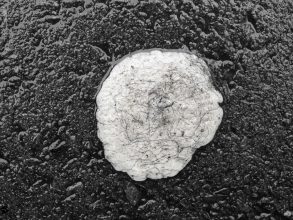
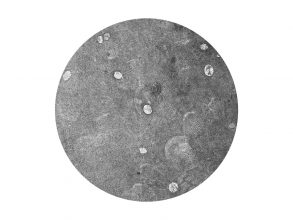
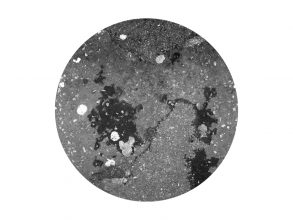
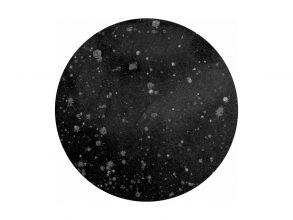
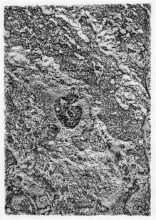
The cosmological prints based on that humblest and most intimate metropolitan pestilence, chewing gum, make a metaphorical connection, worthy of Bataille, between the bulging pregnancy of the splat on the pavement and the blood-veined eye of the observer. It was a brilliant notion: instead of cataloguing, in the traditional fashion of flanêur or surrealist dandy, shop windows, hats, shoes, dogs, advertisements, Paleologou kept her gaze on the unrolled mappa mundi of the pavement. A monochrome carpet of transience fouled by fossils of gum in patterns that invoked an early star map of the heavens. As above, so below. There was magic to this exercise. Repetition was part of its charm. From the black spots – in which so much could be read – we can imply a vast range of human intercourse. What could some forensic photographer ascertain from the tracings of gum spat out by chomping football managers like Sir Alex Ferguson? The red-nosed fury calculated by the distance the dead wad has been expelled from the restless jaws. The most expensively cultivated grass patches in Britain are littered with contours of gingivitic spearmint.
There is an undeceived sexual tenderness in this album of oral rejects. Dry mouths have been salved by the sugary-sweet coating around a capsule of rubber. The stain on the stone is the DNA of a passing stranger who is brought inside by the intimate processes of the darkroom. Paleologou compares gum-chewing to eating and kissing. But here is an oral transaction without nutritional value. Gum is anti-food. It mimics foreplay, nibble, suck, bite, but must not be swallowed. To swallow would be to choke. Gum is prophylactic, a shield against breath, taste, life.
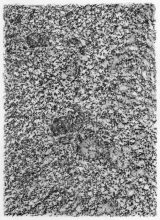
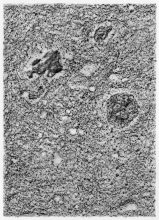
What is beautiful is the poetry of the restriction that Paleologou imposes on her quest. From her archaeological record of the density of gum-sightings, the photographer conjures up a narrative of passing crowds ‘forming random constellations as if in a parallel universe’. Photography is never enough. She kneels in the dirt, like a supplicant, a local historian making brass rubbings, to put paper over the sticky traces, to rub a pencil. This is a loving engagement with ‘viral colonies of debris’. It makes no difference if we are seeing these pinpricks as glimmers of million-year-old light from deep space, printed from a telescope, or a pulsing cell enlarged on a glass slide under a microscope. The fissures are geological.
The images are contemporary in their desperation to reanimate the city by recording its most disposable but enduring detritus. And pre-modern in the medieval philosophy of humours, metamorphosis, alchemy. The prints defy category and date of origin. They are Victorian: at the birth of photography, the death of fundamentalist Christianity, the beginnings of psychoanalysis.
It is not part of the official trajectory of the project, but the image trail leads straight to the memorial stone for William Blake in Bunhill Fields. Visitors, sitting on a bench under a drooping fig tree, contemplate the enormity of the poet’s surviving presence in London. And they spit out gum. The coins, placed every day in tribute on the lip of the gravestone, leave rusty traces. The stone is sculpted by exposure to weather, sunlight and acid rain. Paleologou sees her retrievals as part of a long tradition. A tradition of accidental collaboration between watchful artist, the undying ghosts of place, and the legions of ordinary citizens going about the business of survival. ‘I question not my Corporeal or Vegetative Eye,’ said Blake, ‘any more than I would Question a Window concerning Sight. I look thro’ it and not with it.’
– essay by Iain Sinclair, images by Effie Paleologou
__________
Effie Paleologou is a London-based visual artist , whose work has been exhibited nationally and internationally and is held in collections such as the Victoria and Albert Museum in London and the National Museum of Contemporary Art in Athens. Part of her series Mean City is currently on show in Victoria and Albert Museum as part of A History of Photography: Series and Sequences.
Iain Sinclair is an acclaimed British author and film-maker who lives between London and Hastings. Recent publications include London Overground and Black Apples of Gower. www.iainsinclair.org.uk