
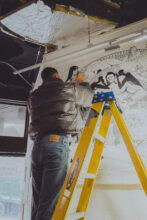

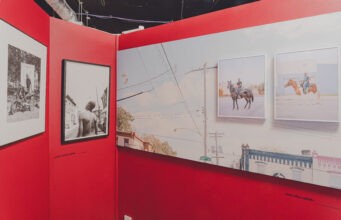


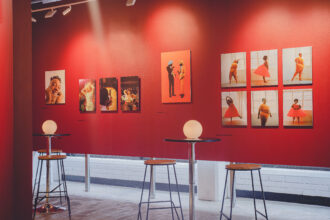

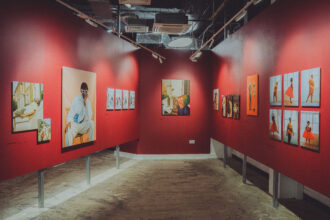
The recent exhibition, BLK BXY JOY was a joyous and celebratory depiction of Black contemporary art. Transforming Photofusion’s Brixton gallery with deep crimson walls, reminiscent of sultry jazz clubs, the space was filled with moving image works, painting and sculptures showcasing the work of 14 visual artists from the UK and internationally. The works are intimate, colourful and tender images portraying family, queerness and community. This was Destinie Paige’s curatorial debut, two years in the making and a striking testament to her shining talent and hard work.
The space itself invited conversations; accessible seating allowed you to get comfy, take your time with the work, watch the films. Take a moment and lose yourself in the artists’ vision, like the stunning series ‘Talia’ by Mariana Dos Santos Pires which embodies a cinematic beauty, drawing you into the space and inviting you to pause. Small, gently lit tables set a vibe – this is a place to spend time, a space to meet and talk to people.
As we emerge from the pandemic, arts spaces have an opportunity to ensure that they are working in a way that embraces their communities. Welcoming them back with open arms and committing to taking the time to really know them, care for them and support the making of more brilliant works like this. Catching up with Destinie over zoom, as I myself recover from Covid, we speak about her practice, her ambitions and her journey so far. She speaks passionately about “representing Black culture and femininity in all its vibrant colours…I want to tell the stories of people coming of age, that show a change or a progression”. This is clear in her own imagery and film-making, but also in her approach to curation.
When speaking to Destinie, she is quick to acknowledge those who supported her in making the exhibition happen. The artists, Sarah Fletcher, a long -term collaborator and designer, the team at Photofusion, her fellow youth programme members…the list is long. As we talk, I realise that it’s not just her humility that wants her to credit them, it’s a real dedication to the relationships that have got her here. These are people who have shaped her, provided a careful and nurturing space for her to grow and develop her ideas. “These are genuine people, people who have learnt their skills and want to share them with other people…these are the people that are inspirational to me. They might not be the people at the top of their careers but they are to me as they are the genuine people that were just there for me and that was that.”
The central person that Destinie celebrates is Photofusions’ Engagement Manager D Wiafe. Initially meeting Destinie through UAL’s Insights programme, D has been a ongoing source of support to her. Sharing his technical expertise, alongside hands on opportunities to apply these, he has forged a genuine connection not just with her, but with all the young people that he supports. Destinie speaks of her trust in him, “not to reject me if I got something wrong, but to take the time to explain, to guide me…he’s been so patient”. D came up through Photofusion’s engagement work himself once – testament to the long-standing work that they have done in Lambeth. But organisations can’t be the only places to take on responsibility for the next generation of artists and creatives – perhaps we could all be more proactive in supporting young people. Are there opportunities in your work where you could provide meaningful learnings to a young person? I’m not advocating for free labour and exploitative internships – I mean real sharing. A cup of coffee and a look over someone’s portfolio? A shadowing opportunity? Access to kit? Long-term mentoring can be just as meaningful to the mentor as it is impactful for the mentee.
There was a real sense of home in the exhibition, not just in the intimate works on show, though Ryan Prince’s work and Renee Osubu’s film Dear Philadelphia celebrate this beautifully. As Destinie speaks about Photofusion she tells me about how it was the first space that she could access the facilities that she needed to learn her craft. Whilst studying, it was hard for her to get into her university’s studio spaces due to the large number of students also needing the space, alongside complex systems to navigate. (We know that course numbers are continually increasing but this is not reflected in the space available.) “I live in Brixton Hill, so Photofusion was close enough that I could just come in when I didn’t want to be at home and use the space, to put in the work.” Photofusion were able to provide her with a space which she could come to, to try things out, to make mistakes – a creative home. This is something that takes time, it’s a long-term relationship which gave her space to grow.
Currently, arts organisations across the country are grappling with the new National Portfolio Organisations (NPO) funding round. This is in line with the 2020 Arts Council Policy, ‘Lets Create’, which shapes their funding priorities for the next 10 years. Organisations are now increasingly under more and more pressure to evidence the work that they do, with further expectations to do more; be better. Audience numbers, community engagement and diversity are the matrices which evidence their value for money and decide if they will get the much needed core funding to keep them going. The programmes developed within this often prioritise shorter term projects which get young people in the building. But how will these projects maintain the support that gave Destinie the space to grow into the artist that she is today? Can underfunded institutions build and nurture the close relationships needed to help young people not just access the arts but build sustainable careers?
To be candid, I know Destinie from my own time at Photofusion. I remember when she first proposed this show before I left, but this is not the same young person who came into the space four years ago. As we sit here reflecting on where she is today, Destinie is a confident artist, with a vision and the intention and the drive to make that vision happen. Her advice for other young people wanting to start out their careers: “You get out what you put in…find your people and grow by growing with them.”
Looking forward, I think we can all reflect on how we can be more proactive in supporting emerging artists, creating sharing economies and collaborative spaces in which artists are able to learn and develop together. When costs of living are skyrocketing, creative careers risk growing ever more unsustainable – let’s all take responsibility for ensuring that this doesn’t mean young talent doesn’t get the space to grow. Share your skills, open up your networks, provide access to kit, buy them a coffee and build relationships – maybe you’ll learn something yourself on the way.
__________
BLK BXY JOY was exhibited at Photofusion, London 3 February – 3 March 2022.
BLK BXY JOY, a collaborative exhibition by a young generation of POC artists who are redefining the picture of the Black experience, was curated by Destinie Paige, a London based filmmaker, photographer and set designer, who has been a long-term mentee in Photofusion’s mentoring programme (#madeatpf) and youth collective S2AU.
For this exhibition, Paige has drawn together fourteen emerging artists whose work celebrates new visions of black masculinity and femininity. Paige’s vision is to put a spotlight on unseen and under-represented artists who want to present a picture of the black experience that moves away from trauma. Artists: Terna Jogo / Karis Beaumont / Ryan Prince / Joshua Odulate / Joel Claudio / Prince Oke / Cian Oba-Smith / Skye Patterson-Mann / Renee Maria Osubu / Tolu Elusadé / Mariana Dos Santos Pires / Kemka Ajoku / PJ Harper / Nico Froehlich
With thanks to Becky Warnock for this essay.