

Solidity is neither in the heaven of ideas nor in the foundation of meaning, neither above nor below appearances, but at their joints (Merleau-Ponty. M 1968:116)
This text expands on the role of performativity in the work of London based photographer Tom Lovelace. As an overview of the bodies of work Black Marble 2016, Bollardo & In preparation No.11 2012, Cascade 2020 and Bathers 2021, the text proposes that the paradoxical pairings of body and object are akin to a fracture, which opens up what was otherwise concealed, revealing that which is hidden. Lovelace’s gestures initiate alternate configurations of the environment that surrounds us. As such, the works invites us to engage in that origination of ourselves through the photographic event.
When speaking about his work, Lovelace says he is interested in that point where the photograph breaks, where the everyday object fuses and amalgamates with the body, and thus reminding us that we are embodied beings. Phenomenologically, this origination is incessant. Often, we can overlook this embodiment, immersed not in a world of sensorial wonder and intrigue, but instead numbed by the imposed synchronicities of public space constructs, or by stealth, which forceable enlists us. Habits are formed, actions and gestures evolve. As Merleau-Ponty (2005) suggests, these gestures and habits become sedimentary in the body, as such our body relieves us of the necessity to think about them, far less be conscious of why we are doing them. However, this can be a catalyst for emancipation and renewal from those routines. In the seemingly graceful body-object propositions of Lovelace’s work, conventions of habit transgress, as does our grasp of what constitutes a photograph.
Cascade 2020 sits between being of the world and appearing as its objects. We see swaying sheets of unexposed photographic paper hung from a gallery ceiling, the public are invited to criss-cross in and out of this material, indeed in and out of recognition. The photograph is effectively realised by the viewers sensorial interaction with the material. The act of photography is performed, as we literally make the photo. For Merleau-Ponty, we exist both here, with a viewpoint, and inhabit all those things beyond us through that looking. As he (2005:445) tells us ’I make my reality and find myself only in the act’. In contact with an object or situation, its raw facticity unfolds in that instant. To take a photograph, we distance ourselves from the original object. Cascade is that shift from the limitations of seeing the world in front of us as in an image, to the boundless space of tactile being we sense all around us. Transformed into arenas of material play with the ubiquitous, this mobile materiality is, in its momentariness of being realised, where ‘the evidence of reality has never been as pressing as in the slip toward disappearance’ (Blanchot 1993:33). By this, we mean the transfigured everyday of Lovelace’s work are those moments of precariousness, the opening apart of the beings we are and the things we are not.
Exploring Black Marble, In preparation no.11, Cascade, Bollardo and Bathers surpasses the calculation and mastery of making which is traditionally associated with art and its functionality. Instead, this evolution from the making of static images, to the performed is where photography happens. Anthony Howell, in his book Anthology of performance, suggests that to perform is to begin from a position of ‘lack’, that is beginning with nothing. Where the painter has brushes and canvases, the sculptor their tools, Lovelace’s one liners bring to mind the genius of Erwin Wurms’ one-minute sculptures, they lack nothing. These forays haul a plethora of the most banal to centre stage, quite literally in the case of Bollardo. In doing so, that strife as Heidegger prevails between the exterior aesthetic that meets our eyes, and the being of the work we are invited to wrestle with that lies within. In these radical configurations of the everyday, we enter the photographs’ being. As such, we are aware of our being, our presentness, and the works ‘presentness’ with us.
In Locating that being, means considering performance and its relationship to site. Akin to ghost and host, Cathy Turner (2004) reminds us that in performance, we bring both something to a site in those actions and interventions, but also elevate the site itself through the interaction. In doing so, the work is co-created. This is apt in works such as Black Marble 2012. Black Marble is a series of 5 small scale black and white images that appear to document the shifting placement of a 1.5m diameter shiny jet-black ball. What we experience are fractures that contest formal hierarchies and disrupt social systems of the logical and formal. The photography is happening in the black ball, a fluctuating mobility between the world of appearances consumed by and in it, and the experience of our dealings with the phenomena outside it. In locating our place in the immediacy of the world and the viewpoint we start from, Black Marble is a marker of places. Whilst in doing this, it shows us everywhere except that point in space it marks. Instead, these works highlight both the instability inherent in the images of the world we are given, and our tactile experience of that world we instigate in response. As events, Heidegger called these clearings. In that experience of the artwork, an opening up happens disclosing those things in themselves previously concealed by the strata of knowledge, in effect truths.
Through Black Marble, Bollardo and In preparation No.11 we transcend the monotony of the world up till then in our way, and can instead be of the world, before words or explanation, in the realm of the pre-reflective. Merleau-Ponty called it raw facticity. For all the silky-smooth aesthetics, Black Marble 2016, and later Cascade 2020, are somewhat antagonistic, the photographs a result of that grating between the sensorial eye and logical mind. Indeed, Claire Bishop (2011) suggests that ‘without that antagonism, criticality and resistance to intelligibility, we ‘neutralise’ that performativity.
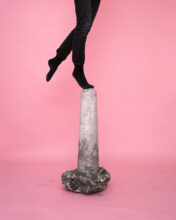
Bollardo 2011 see Lovelace in his soft pliable socked feet atop a hard anaemic concrete bollard adrift from a street, In preparation No.11 2012 well booted atop of metal braces recalling Rebecca Horn, in all these we see an adhoc actuality of daily life in all its teetering and precarity.
This meeting with the world of thingness, is an act of incorporation. The photographic emulsion, a bollard, metal braces, all testify to objects not as props, but as uncanny extensions incorporated by the perceiving body itself. Contrary to that visual world, in these tactile assemblages, we are very much at the threshold between a lived body sensing and the living body as world sensed at that point where ‘there is overlapping and encroachment, so that we must say things pass into us and we into things’ (Merleau-Ponty 1968:123).
In Bollardo 2012, Lovelace is with its bollardness and its bollardness with him, as the status of the banal is elevated through that incorporation by the body. More recently Bathers 2021-2022 exemplifies this point. The work is based upon a fascination for the Seurat painting The Bathers at Asnières 1884. It was painted in the so-called banqueting years of the Avant Garde. With the gritty onset of modernism, Paris was transformed with speed and energy in the blink of an eye. Seurat’s people seemed abandoned in the rush, marooned no less, a potpourri of automatons of the future and witnesses of their own obsolescence.
Lovelace’s Bathers comprises of 4 performers engaging with large sheets of exposed photographic paper strewn across the gallery floor. The resulting work both opens a paradoxical space of material presence in the form of a surface that consumes everything. What can be seen is a fullness of nothingness. Lovelace and his fellow performers meet the floor based photographic emulsion in intuitive and intimate silence. They peer at its light, they wait at the fringes of its blackness, delving into its mirror they long for something to emerge, yet the exposed paper has already consumed everything and keeps doing so. Bathers is an existential exercise in reconciling an inexhaustible depth of surface that is the photographic membrane, alongside a mutating corporeality. Performing Bodies and Bathers alike, they seek to prise out its secrets. Playing with these residual scraps and fragments, Lovelace’s Bathers proposes photography as a situation never wholly resolved nor entirely erased, indeed between thing and event. Lovelace and his performers examine this malaise, embrace it, and reorientate us continually in its presence of time and space. In doing so, Bathers enacts this very thingness, simultaneously revealing being while concealing it ever existed. Before appearance which clothes that being, we hear it, we touch it, we apprehend it and it us. In aligning these phenomenological standpoints, the role of habits both as constraints and emancipatory, the reappraisal of the everyday, and our engagement with the performativity of Lovelace’s work, is to suggest images are not made; but instead evolve a photographic clearing in this performative reciprocity of process and viewer. At this open, instantaneous and fluid duality of presentness and absence, our being is with the photographic being. Indeed, for Merleau-Ponty, there is no inside or outside. When we communicate with the world and let it express itself to us and through us, we are neither in that field of the intellect, nor in the echelons of the empirical, neither in the frame nor outside it, but instead moving around its ever-shifting joints.
__________
Arendt, H. (1958) The Human condition. Chicago: University of Chicago Press
Bishop, C. cited in Jackson, S. (2011) Social Works: Performing Art, Supporting Publics. London: Routledge
Blanchot. M. (1993) The One Who Was Standing Apart from Me (ed. Lydia Davis) New York: Barrytown Station Hill
Blanchot. M and Hanson. S. (1987) ‘Everyday Speech’ In: Yale French Studies 73, pg.16 www.jstor.org/stable/2930194. Accessed 20th October 2022
Merleau-Ponty. M. (2004) Phenomenology of Perception. London: Routledge
Merleau-Ponty, M. (1968) The Visible and The Invisible. Illinois: Northwestern University Press
Turner, C., D. (2004) ‘Palimpsest or Potential Space? Finding a Vocabulary for Site-Specific Performance’ In: New Theatre Quarterly 20(04): pp.373 – 390 Cambridge: Cambridge University Press
__________
Greig Burgoyne is artist and researcher. He primarily works in Europe in performance and installation. Indicative of the meeting of logic and the absurd, the resulting works reflect the paradoxes of space that seek to celebrating precarity and the visuality of the invisible. Recent solo projects in 2022/23 include Civitella Ranieri Foundation, Italy; Kunsthallen, Bochum; The Lowry, Manchester; Museum of Classical Art, Rome; Verein Für Aktuelle Kunst Rührgebiet, Oberhausen (VAKR) (with Monika Gryzmala); Spazio Mensa, Rome. Forthcoming projects include MLAC, Rome, ISM, The Hague and Ciclops Festival of Performance Art, Mallorca. His work features in “Performance Drawing – New practices since 1945’ published by Bloomsbury Books. Recent writing includes ‘The story of indigenousness and the ownership of history’ exhibition catalogue for Pera, flora and fauna at PORT for the 59th Venice Biennale, drawing the invisible UCM Madrid, and paradoxical drawing The Lowry Manchester.