__________
Street Music
Markéta Luskačová, whose photographs are on display at Tate Britain until 12 May, is from a long line of foreign photographers whose unique vision captured the British way of life. Like Edith Tudor-Hart, Bill Brandt and Dorothy Bohm, her photographs provide an almost anthropological record of working class society.
Born in 1944, Luskačová left Czechoslovakia in 1974. Although one of our most distinguished social documentarists she has still not achieved the recognition she deserves. The Tate exhibition covers three key series of her work – pictures of east London street markets and musicians (some of which were shown at the Whitechapel Gallery in 1991), families on Tyneside beaches and photographs of pilgrims in Slovakia.
It is the photographs of London taken between 1974 and 1990 which are the most compelling.
From the 1930’s to the end of the fifties, street markets played an important part in local economies devastated by the depression, war and rationing but by the seventies they had declined because of increased regulation and cheap supermarkets.
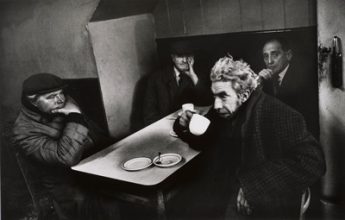
Luskačová caught this dying tradition with clarity and compassion, showing not just the traders and their customers but the café’s, pubs and small shops that survived in their wake. Flea markets were a form of people’s capitalism enabling people to sell their personal belongings and to buy essential items cheaply.
Despite being warned they were a ‘beginners subject’ Luskačová was attracted to the melting pot of the east end markets. Her son had just been born and she could push him around the streets and take photographs. The markets provided a Dickensian panorama of characters and she could take photographs without attracting too much attention.
Luskačová brilliantly captures the harsh, fragile lives of those she encountered. A group of homeless men burning pallets on a snowy day at Spitalfields market, two women smoking and selling their pitiful collection of junk on Cheshire Street, an old woman and child sitting on the kerb on Sclater Street with a grotesque clown propped up in the gutter. These are images that break your heart.
The markets that Luskačová photographed have all but disappeared. Lower Marsh, Leather Lane and Strutton Ground are full of foodie stalls, Spitalfields, Portobello Road and Petticoat Lane have been tarted up and tamed. Everything is licensed and controlled. The same is true of Luskačováa’s other main theme – street musicians.
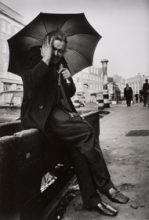
Like the street markets, the musicians were things that Luskačová never experienced in communist Czechoslovakia. She has said ‘they were often quite lonely men, yet the music lessened the loneliness of the street, the people in it, and my own lowliness.’ Here is a drunk singing on Brick Lane, a man with harmonica in front of Christ Church on Commercial Road, the busker Ginger with one of his home made instruments playing to a crowd on Cheshire Street.
Many of Luskačová’s photographs look as if they were taken in communist Eastern Europe. They are less dogmatic and political than the photographs of Tudor-Hart and grittier than the pictures of Dorothy Bohn and Evelyn Hofer. Luskačová has spoken about wanting to photograph those whose way of life might not last much longer. She has succeeded. The Czech verb ‘to photograph’ means to immortalize and that is what Luskačová has done with these photographs. This is how we were, back then. It just took a foreigner to show us.
– reviewed by David Ford
__________
Below: ‘Café, Bethnal Green Road, London’ 1979, later print. Tate © Markéta Luskačová