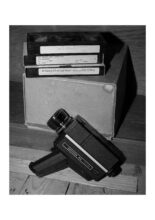

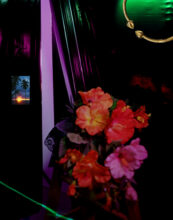



Now in its eighth year, and extended (to two weeks in its original location, and a travelling version at Impressions Gallery in Bradford until August), Co-founder and Artistic Director Vivienne Gamble’s Peckham 24 hosts a vital and fiercely contemporary look at the past. Co-curated with Emma Bowkett, Iona Fergusson, Fiona Rogers, and Raquel Villar-Pérez on the theme ‘Back to the Future’, Peckham 24 sees 22 photographers redress, re-imagine, and perform personal and collective histories. Works (some familiar from Arles, Foam, and Hapax, others new or even in-progress) are reconfigured and brought together to fill Copeland Gallery in such a way that, while the festival’s overarching concerns hold true, each space achieves something quite distinct in its excavation or piecing-together of archives, biographies, and memories.
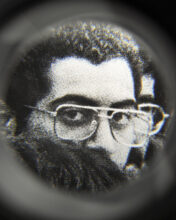
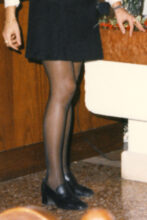
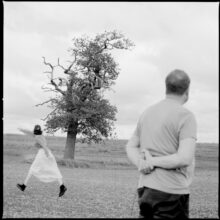
Emi O’Connell takes as her starting point her grandmother’s escape from one of Ireland’s Catholic ‘mother and baby homes’ in 1964. In sturdy boots, O’Connell trips and tumbles in her grandmother’s footsteps – careening out of frame across a row of prints punctuated by billowing statues printed on unhemmed fabric. Eleonora Agostini’s past is in her family’s restaurant, watching her mother serve and smile front of house, switching ‘backstage’ past the kitchen’s curtained doorway. That customer-facing smile is reproduced, postcard-sized, only to be part-obscured by a barefoot sole (compressed into a window-mount too small for its frame), above a row of life-sized legs in deportment performed for the camera / ‘client’, hung level with the floor – all is choreography. Amin Yousefi returns to photographs documenting the Islamic Revolution, scouring crowd scenes for individuals whose gaze – smiling, pensive, or mid-chant – met the camera’s. These faces, magnified in Yousefi’s loupe, are halftoned and vignetted – some meeting us in private, away from the crowd, others, including a child further enlarged to fill the wall, surrounded by raised hands.
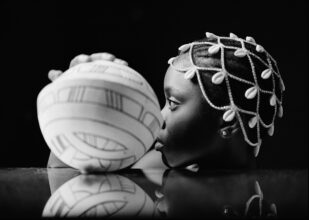
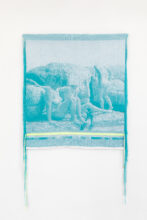
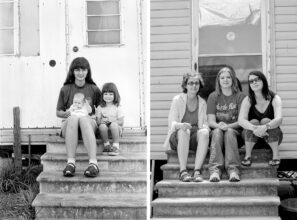
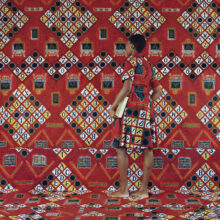
The four winners of this year’s V&A Parasol Foundation Prize for Women in Photography occupy a central space, a facing wall for each. All four also respond to histories – a connection neither forced nor coincidental, but a testament to a growing impulse to reconcile, revisit, or rework. Each also uses their own bodies as part of this process. Nancy Floyd’s 40 year, in-progress series of ‘environmental self-portraits’ shows the artist and the world around her change (it’s hard to imagine this not poignant to any viewer capable of aging). Aisha Olamide Seriki employs optical tricks from photography’s history in a series of rich monochrome images referencing Ori, the Yoruba concept of destiny. These are echoed in small, locket-sized prints, held in delicate frames and resting on bronze comb sculptures – objects, Seriki writes, which surpass ‘functionality to become a cultural symbol of empowerment, ritual, and self-care.’ Silvia Rosi extends her instantly recognisable exploration of her Togolese heritage with Teacher Don’t Teach Me Nonsense, both camouflaged-by and disrupting spaces clad with Dutch wax print fabric produced in the 1920s as part of colonialist efforts to erase Togolese languages like Mina. Mia Weiner’s fascinating hand-woven tapestries allude to representations of women in art history and mythology. Reclining on shorelines, their heads erased, these figures might be archetypes, anonymised, but their photographic realism, and Weiner’s direction complicates this.
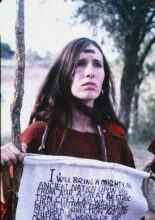
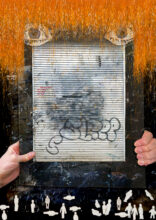
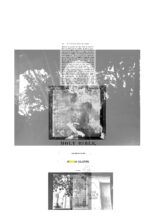
Documents (originals and reproductions) anchor several of the festival’s works, often in ways that demand viewers engage directly with the artifacts of devastating histories (the vitrine-held West Indian missionary ‘slave bibles’ – with references to freedom excised – in Jermaine Francis’ Once upon a Time; and the monumental enlargement of a Children of God step-by-step, allusion-filled, method for attracting recruits in Alba Zari’s Occult). Facsimiles of documents are sometimes physically layered: Egyptian movie posters form a backdrop for Lina Geoushy’s Trailblazers (self-portraits ‘as’ a series of activists, meticulously referencing the lighting and styling of period studio portraiture). Also layered: newly created materials – giving life to Laura Chen’s fictional detective in Being Framed – and recontextualised images – as with the grinning photographer in Odette England’s Woman Wearing Ring Shields Face from Flash.
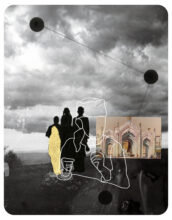
As an educator, for me part of Peckham 24’s gift is its radical variety. This is a showcase of what’s current and what’s next – something immediately felt in its embrace of unconventional methods of display. Where frames feature, they do so with purpose: folded, sharp, uncoated metal for Chen’s large print (with a ransom-note ‘cut them out and frame them’ line of text carrying double meaning in the centre); smooth oval-cornered dark wood for Bindi Vora’s Unravelling. Elsewhere photography is pinned, nailed, wallpapered, flapping on acetate – an incredible variety given the size of the show, and through which each work creates its own world. The festival makes a persuasive case for the reworking of the past to be an important movement in contemporary photographic practices.
__________
Peckham 24 ‘Back to the Future‘ was exhibited in London 17 – 26 May 2024
Work by Alba Zari, Amin Yousefi, Eleonora Agostini, Emi O’Connell, Jermaine Francis, Laura Chen, Odette England, and Tarrah Krajnak is on show at Impressions Gallery, Bradford Until 31st August 2024
Reviewed for Photomonitor by David Rule. David leads the final year of the Photography BA (Hons) course at the University for the Creative Arts, Farnham. He holds an MA in Fine Art from the Slade School of Fine Art, UCL. His practice involves photography and text and often takes the form of printed matter. He has founded and been a part of several small presses, including bookRoom at UCA, as part of the resurgence in self-publishing.