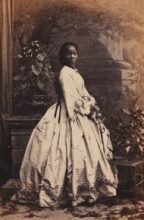
The Black Chronicles portrait photographs were discovered by Autograph (ABP)[1] in the Hulton Archive as part of the heritage lottery funded Missing Chapter research program. The photographs draw from a larger body of studio photographs, which collectively focus on redressing the absence of Black lives in Britain. The presentation of Black Chronicles in the National Portrait Gallery could be seen as a strategic move to raise the visibility of Black and Asian lives in Britain in the 19th and early 20th Century. Established in the mid-nineteen century with the aim of commemorating persons who contributed to British history[2], the NPG[3] has historically under represented people of colour.
The portrait photographs occupy the whole of gallery 33, which sits between the ground and first floor galleries. As one of only two routes available to reach the first floor galleries, it is almost impossible to ignore. Nine black and white carte-de-visite photographs, historically contact printed at 6x9cm have been enlarged to approximately 60x90cm. At almost life size, the details in the portraits are fascinating. The scratches and imperfections of time have left their mark on the negatives and have been left untouched as part of the photographs’ material biographies.
Quotes from the late cultural theorist Professor Stuart Hall locate the conversations around the photographs. The name of the sitter accompanies the author of the photograph. This succeeds in distancing the photographs from historical ethnographic photographs which reduce the sitter to an ethnographic type. Further text gives individual photographs a contextual biography and with it situational understanding.
In the centre of the gallery is an original carte-de-visite day book from the Camille Silvy archive, open on a page with portraits of a finely dressed Sarah Forbes Bonetta (1862). Bonetta, goddaughter to Queen Victoria, was born of royal Yoruba blood, captured and enslaved as a child. She was gifted to Queen Victoria, who arranged for her fostering and education. The Bonetta photographs exemplify the strength of the research, and succeed in complicating colonial narratives.
The additional intervention into the National Portrait archive to compliment the Hulton Archive studio portrait photographs are exhibited in galleries 23 and 31. They are more complex responses to Black Chronicles. Drawing from existing NPG archive material, the photographs and paintings selected use different registers to evidence historical Black and Asian contributions to British history. The inclusion of Angus McBean’s distinct black and white photographs of the Ballets Negres in gallery 31 are notable in their historical context. McBean’s photographs document the first black ballet company. The carte-de-viste photographs in gallery 23 are displayed as original photographs in a glass cabinet in the centre of the Expansion and Empire room. The individual sitters are identified by name, status and biography, the group portraits by racial type, status and having visited the House of Commons. Whilst these images stand testament to cultural diversity in the late 19th/early 20th century, the historical colonial connotations of the photographic exhibition strategies used in the Expansion and Empire gallery cannot be ignored.
Previously under-researched and overlooked Black Chronicles is an historically valuable resource that draws attention to prominent Black and Asian lives in the late nineteen and early twentieth century. Black Chronicles would benefit from further dissemination and publication of the photographs. #blackchronicles #BlackLivesMatter
– reviewed by Caroline Molloy
__________
Notes:
[1] Autograph ABP is a charity that works internationally in photography and film, cultural identity, race, representation and human rights.
[2] At the time, persons who contributed to British History were understood to be notable great warriors, statesmen, scientists and contributors to the arts and literature.
[3] National Portrait Gallery
___________
Black Chronicles. Photographic Portraits 1862-1948 is exhibited at the National Portrait Gallery, London, from May 18 – December 11 2016