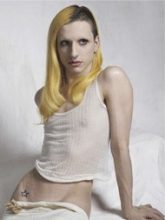
From a background as model and gallerist, Bettina Rheims (born Neuilly-sur-Seine, 1952) has forged a successful art-meets-fashion photographic career in a style often compared with Helmut Newton’s. She gained attention through relatively conventional portrayals of women before embarking on elaborate projects which push the boundaries of how sexual identities are depicted.
Rheims’ latest series, in conjunction with designer Jean Colonna and sound artist Frédéric Sanchez, originated as a follow-up to ‘Modern Lovers’ – her 1980’s exploration of transgender, which was shot at the height of the AIDS crisis. That plucked androgynous models from the street and shot them in black and white against studiously neutral grey backdrops. ‘Gender Studies’ started in worldwide social networking by seeking out people who felt they didn’t conform to society’s usual expectation of a binary opposition between the masculine and feminine.
Having discovered and Skyped with people who lived outside their prescribed gender roles, Rheims invited 27 of them into the studio. A lot of the subjects, says Rheims, ‘knew from childhood, that they were born in the wrong body’, and had decided to ‘correct the original mistake’. She found it hard to understand why women should want to become men, but what struck her as being completely new ‘were the ones who refused to choose between the two options, and had decided to live using both identities. Depending on the day, the mood…’ There’s an element of self-portraiture behind such comments, and Rheims herself has said that her work is partly about getting to know herself better, and that this project led her to muse on the male and female elements in her own make-up.
Rheims presents her young responents in artfully ripped clothing (trying, she’s said, ‘to keep a little mystery without dressing them up’ – though these are as dressy as rags can get). She also recorded their stories, and became fascinated by how the voice is harder to change than the body, how easily it slips back to a former mode at moments of emotion. Hamiltons shows 18 big prints of these in-betweeners, carefully posed to look calmly and inscrutably at – it seems – us, their eyes being level with ours. They’re accompanied by their voices on a 15 minute loop. Statements (eg ‘you can sculpt your own sexuality’ and ‘everything I do I do to make it a reality’) emerge ambiently in various languages but in snatches too short to pick up changes in timbre, and without any means of linking the words to individual images. This soon becomes a disembodied and somewhat generic background sound, which felt like a lost opportunity to connect more fully with individual stories. On the other hand, this matches the confusion of looking at the portraits: which characters were genetically born male, and which female? And which were born with both genital capabilities, and have refused to choose between their options?
Back, then, to the photographs. Whether it’s a strategic decision or simply the application of her signature style (and so broadly consistent with ‘Modern Lovers’), Rheims has ramped up what might have been down-to-earth documentation into an intensely aesthetic experience. Thus, there’s a double artificiality at work here. First, what may seem natural need not be accepted, as people can now implement their own understanding of their sexual identification. That’s a positive, but is it best served by the second artificiality, namely a style which imposes the photographer’s look and seems to elevate the subjects above the day to day – rather than showing them and their own clothing choices as part of the more grittily normal round? That plays to the danger that these people will emerge as being exhibited rather than understood. Their voices, and Rheims’ own evident investment in the project, may counter that. I was left wondering: uncertain, but fascinated – a not unsuitable place to be.