







Reviewed by Ricardo Reveron Blanco for Photomonitor
__________
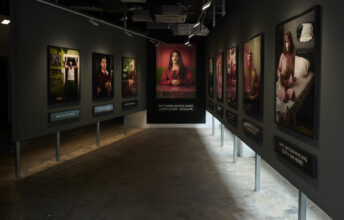
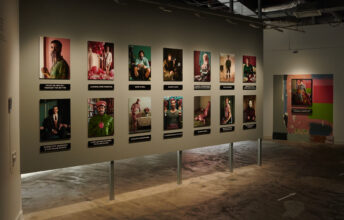
Hooking up culture has commodified and revolutionised the way bodies function in the internet age. At a swipe’s reach, anyone with phone access can consume, exchange and indulge in the oversaturation of the digitised sexualised body. BODY COPY, currently on show at Photofusion, in London, visualises how bodies, gestures and performances become aesthetic iterations for a capitalist driven society, and artist Mitchell Moreno (de)codes self-portraiture by capturing idealised versions of what men search for on same-sex hooking up apps. Satire, manufacture, and the grotesque are all products bought and sold within the parameters of this exhibition; which invite buyers into fetishising utopic images of idiosyncratic queer looks.
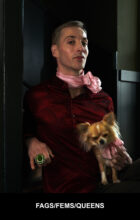
Working as stylist, set decorator, subject and photographer, the artist self-fashions themself into queer archetypes to explore the fragility of these constructions. These rigid categorisations become troubled identifying features, which are antithetical to queerness. Nonetheless, the broad definition that indexes the need for belonging to a scene is still based on an assumption of neo-feudal elitism, and reflects on the exclusiveness and discrete politics of queer identification and visualisation. This paradox becomes evident in how the queer experience is perceived socially: elevated in social status by what is most sought out for, but confined to a state of ignorance in its categorising system, extraniated from ethics and equality. Politically aware, but undesirable; interesting, but lonely, attractive, but toxic. These are the conditions to which we are accustomed.
Under the conspicuous umbrella of sexual discourse, problematic attitudes towards class, race and sexuality remain unspoken, and consequently mismanaged. These conversations are surfaced through Moreno’s approach, which by entering the comedic, allows these often neglected issues to enter public discourse. The series’ slapstick visual vocabulary is enforced through its pastel palette, theatricality and overtly staged mise-en-scene which collectively, become highly digestible to bystanders faced with queer iconography. The apps are profit driven by objectives of sex, romance and/or companionship, and in doing so, influence users to perform idealised manifestations of self-representation and consumption. Commerce has been intrinsically linked to how same-sex relationships have operated throughout history, even through coded language such as ‘trade’ meaning ‘gay for pay’ within queer circles. What digital hook-up culture has accomplished is present previously hidden and non-transactional areas of life into a browseable domain. Additionally, the series also escapes queerness and gains universality by representing how capitalism, compounded with new technology, heightens the ways in which the male gaze operates throughout all of society. Within these parameters, the gaze therefore becomes a site of value creation in ways that supersede just interpersonal interactions; ultimately enforcing capitalist mentality on a visceral level, through hyper-objectified sexual landscapes which are not limited to queer life.
“The series is consistently concerned with ideas of class stratification and how that is manifested in material culture.” – Mitchell Moreno
Physical attraction is not only what’s for sale here; class is marketed in these images too, whereby a low or high economic standing is fetishised by the observer. Displayed through photo-text portraits acting as pseudo ‘wanted’ posters, these fetishised classes are explicitly depicted through the texts taken directly from the app citing searches such as ‘free now for posh dom’ or ‘str8 chav tracks lad 4 same’. The series presents viewers with a myriad of characters adeptly performed and photographed by the artist Mitchell Moreno. Role-play and transformation become utensils in this process of the creation of gay semiotics.
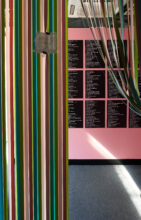
Akin to Hal Fisher’s 1970 photo series attempting to document queer semiotics, Moreno scours digital hookup ‘adverts’ archiving in the process modern queer tropes. As the artist claims in the exhibition text, seldom do these adverts question the cis-heteropatriarchy, as they consolidate problematic attitudes towards race, desirability standards and non-normative bodies. Ingeniously, Moreno uses satire to place these issues at the forefront of the work and engages with queer fragility and identity incongruence that pervades and exists unethically within sexual realms. Secluded upstairs, we find a compilation of black posters showcasing the ‘adverts’ that inspired the images taken by the artist. This small area, separated through a curtain and an ‘ADULTS ONLY’ handwritten note – reminiscent to the explicit content area you’d find in a porn shop – becomes a pseudo wank space, decorated by a used hand-shaped sofa and intermittent text notification alerts. This audio-visual section reflects on the internal addiction viewers have to conform to a consumerist enterprise, which like with pornographic content, ceases to be satiated as its consumption is fuelled by a never ending search for visual/experiential novelty.
The show is revolutionary as it forces viewers to be honest with themselves and not avoid asking each other the harsh question: to what extent do we neglect ethics when it comes to sexual discourse and engagement? Body Copy’s gay representation becomes a monoculture of queer narratives performed through clear-cut ‘categorisable’ tropes. These visual interactions amongst the service users and later the artist’s audience, reinforce a pseudo Diderot effect that tribalise and confirm the macro-capitalist and consumerist society that influence the way we self-identify, represent and gaze on each other. One advert reads: “a boy begging the internet to send me a sign” and Moreno cleverly uses semiotics to signal the effect the internet has on the way our bodies operate at a larger scale in our capitalist value system – a feat that only a percipient eye could visualise.
To tackle the opacity of these often invisible structures, Moreno ensures full transparency over the collected text, the visualisation of these idealised characters and the process of making the images which are made apparent through a showreel available for viewers to see the artist’s practice and rationale behind the series’ conception. Among the many formulations of how queer semiotics appear, we find the underlying principle of sexualisation and power dynamics among its characters, a principle which exarcebates the transactional and consumerist practice within this digital world. The repercussion: damaging the prospects for in-person socialisation and harming collective wellbeing within the communities involved in these visual relations.
__________
Exhibition details: 10th September – 15th October, at Photofusion 3Space International House, 6 Canterbury Cres, London SW9 7QD
Ricardo Reveron Blanco is a writer, curator and arts researcher. He is the co-founder of photography-based collective UnderExposed and is the Assistant Curator at Photoworks.
For further viewing: Mitchell Moreno’s website
All images © Mitchell Moreno