Carey Young has spent much of the past two decades exploring the corporate and legal worlds which, though they can have a significant impact on artists’ practice, rarely feature as their subject. Her 18 minute film ‘Palais de Justice’ shifts her focus from power in itself to its specifically patriarchal aspect. It is set in Brussels, in the imposing 19th century Palais de Justice, well suited to reinforcing the majesty of the law. There follow three main sections, running for something like 5, then 9, then 4 minutes.
First, we see a sweatshirted young man descend a grand staircase. He looks more likely to be a defendant than a prosecutor. A stream of people then cross the commanding central hall as they arrive for work. Nothing yet marks them out as lawyers. At one point we see – such is the camera angle – just the one near-naked leg and phone-holding hand of a woman sitting on an inside window sill while she scrolls through her mobile. The conventional link between voyeurism and sexual attraction is proposed, but she is a lawyer who has not yet donned her transformative clothing. Cut to a hanging row of gowns.
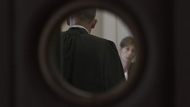
Switching to the confined spaces of the courtrooms, the second section shows judges in action. Two things become apparent. First, the footage appears to be surreptitiously obtained: the judges are often out of focus or obscured by passing figures, and are typically seen through circular portals which remind us of the lens and so suggest the law as a lens on society. Second, the judges are all women, though some of those they appear to be instructing, or keeping waiting, or being bored by, are men. The patriarchal history of the law as a male-dominated profession, emphasised by portraits glimpsed on the walls, has been displaced. Is this an alternative society in which women control the judicial process? We are aware, though, that Young has exercised a different female power: she has constructed this scenario by infiltrating a bastion which we may assume is in practice largely male, then editing what she finds.
That, after three quarters of the running time, might have been point made. But Young adds a coda which avoids the simple replacement of male by female. That might have fitted the assumption that in order to succeed in a man’s world, women need to behave like men (consider the ‘masculine’ style often attributed to Margaret Thatcher). Rather, the last few minutes – recalling that window sill scene – focus on the feminine: a long lens, paparazzi-style, shows fine detail of barristers’ hair, flowing, teased, rearranged. These women are depicted as intellectuals in authority, but they have not lost their softer qualities. Nor has Young excluded the erotic aspect of the cinematic gaze.
I have not mentioned what the judges say. That might seem odd in roles in which language is the primary instrument of power. Yet we hear no words. Far from eavesdropping, the viewer is distanced from the type of case being heard. The soundtrack – produced by hiding microphones on site – is of footsteps, abstracted voices and mechanical movements, as funnelled by the long marble corridors. The result is a low-pitched (male voices carry further) clanking roar which might stand in for the wheels of justice creaking slowly round. The Towner’s installation puts the four speakers emitting this sonic texture high up, above the suitably domineering seven metre wide screen, so that scale and placement both enact echoes in a cavernous space.
The whole film is shot inside, and beyond the white-marbled main concourse all is wood-dark and lamp-lit. That enhances the visual allure, which carries echoes of Hammershoi and Chantal Akerman. It also suggests that the workings of the law are obscured, that proceedings should be more open so that justice is seen to be done. Perhaps the way to achieve that is to move out of what the film discloses as a crumbling 19th century edifice built on colonialism, an intimidatory setting likely to reinforce dated behaviours.
How was this footage obtained? Young shot for three weeks over a period of two years. She has explained (interview in Art Monthly, March 2019) that she was denied permission to film. According to Young ‘it doesn’t work to sneak’, but she hired a lawyer who pointed out that Belgian law made it feasible to film on the basis that the building was out of copyright and the legal professionals in a trial are considered to be public figures revealing themselves in public. Young tried not to draw attention to herself, but she wasn’t hidden. ‘That legal rationale’, she says ‘was enough to get people asking questions to go away’ – the insider power of legal knowledge is thematically folded into the film.
The need to be surreptitious and the style of the building combine to yield footage with a documentary quality consistent with security or surveillance cameras. That reinforces the possibility that, in Young’s words, this might really be a future ‘where there are only female judges’. The men, she says, ‘seem somewhat pathetic in this thought experiment’. Is that an extreme scenario? Context is given by the fact that prior to World War II, all the judges in Belgian, and indeed UK, history had been men.
Beyond the slightly playful possibility of an all-female judiciary, does ‘Palais de Justice’ have a reform agenda? Not explicitly, but the judges come across as empathetic, professional and unpompous; whereas the building in which they operate appears unsympathetic. Perhaps there’s no need to go beyond 50% female, but it would be reasonable to conclude that all judges should act ‘more like women’, and do so in ways made beneficially transparent by modern, light-filled premises.
– reviewed for Photomonitor by Paul Carey-Kent
__________
Carey Young: ‘Palais de Justice’ continues at Towner Art Gallery, Eastbourne until 2 June 2019.
Below: Carey Young, Stills from ‘Palais de Justice’, 2017. Single-channel HD video (from 4K); 16:9, color, quadraphonic sound; 17 mins 58 secs. © Carey Young. Courtesy Paula Cooper Gallery, New York