Reviewed by Caroline Molloy
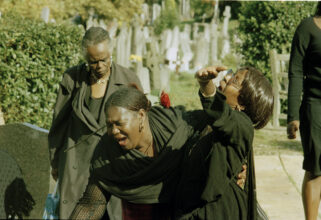
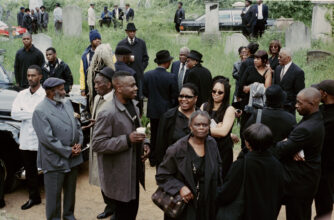
This past Autumn, the Centre for British Photography presented six exhibitions over three floors, including a range of voices, celebrating different communities across generations.This is a complex group of exhibitions to review collectively because, although the work on display is tenuously held together by the theme of ‘Communities’, each of the works in the six spaces interacts with this theme through different photographic registers. This suite of exhibitions embraces historical and contemporary approaches to documentary photography, and sees established photographers exhibited next to new ways of seeing Britain. The main gallery space on the ground floor hosts Charlie Phillips’ body of work How Great Thou Art, which visually documents ritual practices of commemorating the dead in the Afro-Caribbean community of north-west London. It is unusual but insightful to see the focus of a community documented through practices of death, which more frequently are considered a taboo subject to make visible. Through these photographs, that sit alongside family memorial cards, the audience is given insight into an otherwise private ritual.
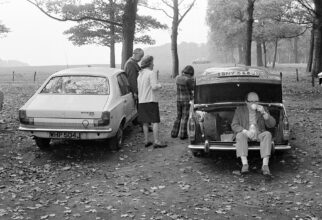
In the basement gallery there is an extended presentation of some of Daniel Meadows’ arresting square format street portraits, drawn from an archive of 958 photographs taken across Britain in 1973, which were then revisited and remade (where possible) some twenty-five years later. The re-presenting of this work marks the fiftieth anniversary of the creation of the original portraits. Being able to view the same person presented in a similar way twenty-five years later, the audience is able to ponder on the lives lived of those in the images. The portraits are exhibited alongside of Meadow’s notes and sketchbooks, which carefully document his journey in a bus across the UK in the early 1970s.
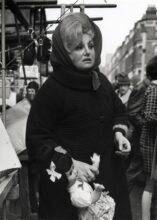
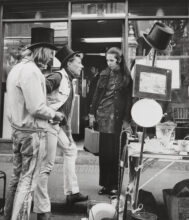
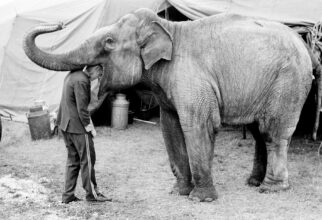
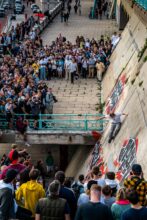
Both Dorothy Bohm’s photographs of London Markets, that commenced in the 1970s, and Caroline Coon’s documentation of the late-70s new wave punk (exhibited November 17- December 17), present London culture of another era. Bohm’s London Markets records the busy working markets of old Covent Garden, Smithfield, Billingsgate, Petticoat Lane and Portobello Road before they became the well-known tourist markets of today. Coon’s unique portraits give us an intimate insight into what was a revolutionary new sub-culture that emerged in the late 1970s in reaction to main-stream British culture. Alongside of this, in the window space, young photographers including Lucas Cannon, Soren Froome-Lewis and Zoe Green respond to the question What does community mean to you?
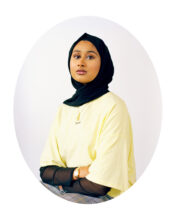
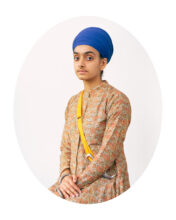
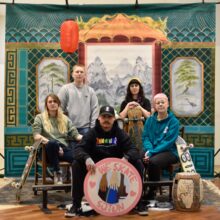
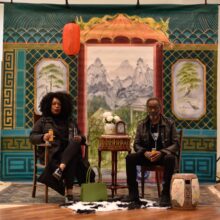
It is refreshing to see the language of studio photography also included in this exhibition. Grace Lau’s pop-up photography studio on the first floor of the gallery builds on her studio portraits of people in Hastings (2005), which were inspired by August Sander’s portraits that documented ‘types’ of people at a given moment in history. Drawing on studio photography to make connections between Victorian Britain and the Chinese photography studio that has its roots in Qing Dinasty China, Lau’s (2005) portraits in Hastings invited people of Hastings to have a studio portrait made. In this reiteration of Lau’s studio portraits, visitors to the gallery are invited to have their portrait made in this contemporary studio mise-en-scène, amongst a fusion of English and Chinese studio props as well as the sitters’ own belongings. Arpita Shah’s Modern Day Muse portrait series also uses the language of the studio portraiture, coupled with reference to Mughal and Indian miniature paintings to diversify ideas of a contemporary aspirational British icon.
This group of contemporaneous exhibitions is a worthwhile visit for anyone interested in thinking about the breadth of approaches to documentary photography. Overall, the absorbing individual installations in the Centre bring together disparate subjects to collectively present multiple ways in which to preserve and contest modern day British culture and community.
__________
‘Arpita Shah. Modern Muse’, ‘Nothing to Lose: The Punk Photographs of Caroline Coon’, ‘Charlie Phillips: How Great Thou Art’, ‘Daniel Meadows: Free Photographic Omnibus, 50th Anniversary’, ‘Dorothy Bohm: London Street Markets’, and ‘Grace Lau: Portraits in a Chinese Studio’ ran at the Centre for British Photography 5th October – 17th December 2023 alongside the themed display: ‘Open Call: Young Photographers Aged 14-21’.
Caroline Molloy is the programme director of Fine Art and Photography at University for the Creative Arts in Farnham, and co-editor of Photomonitor as a residency project between UCA Farnham and Photomonitor. She holds a PhD in Arts and Humanities, from Birkbeck, University of London, in the Centre for Photographic History and Theory, an MA in Photography from the Royal College of Art, an MA in Visual Anthropology from Goldsmiths University of London. Her research interests are focused on the marginalised voice in both gender and post/decolonial colonial contexts. Recent peer reviewed written publications include: (2023) ‘Identity Politics: A study of diasporic identity mediated through family photography’ in Handbook of Research on the Relationship between Autobiographical Memory and Photography. IGI Global and (2020) ‘Rethinking the photographic studio as a politicised space’, in Ashley, T., Weedon, A. (eds.) Developing a Sense of Place: Models for the Arts and Urban Planning. London: UCL.