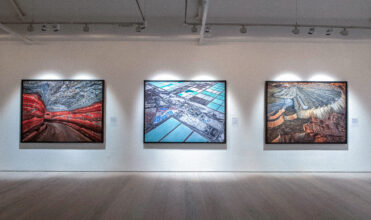



So striking is the aesthetic approach, the physical scale of artefacts, and the pervasiveness of the work of Edward Burtynsky, that he has become synonymous with the documentation of the visual, and predominantly negative, impact human industry and globalisation have inflicted on the planet. Yet despite being demonstrably concerned with ecology and the environment, Burtynsky has repeatedly distanced his practice from ecological activism, something for which he receives significant criticism. Burtynsky’s largest show to date, ‘Extraction/Abstraction’, misses the opportunity to display the true scope of Burtynsky’s four-decades’ worth of photography, and diverts us from meaningful questions about our planet, its resources and how we should represent them.
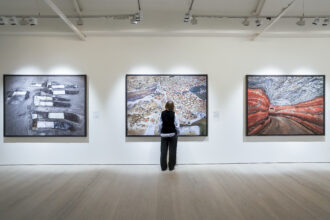
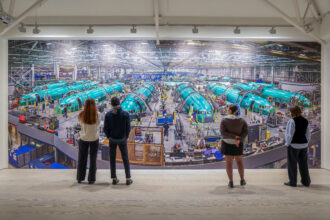
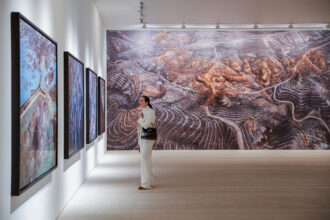
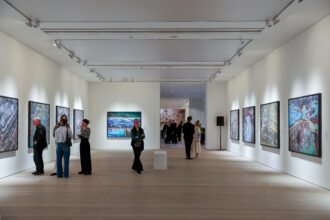
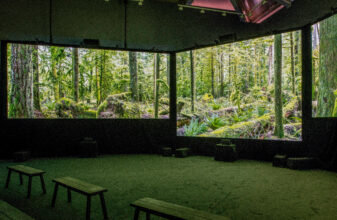
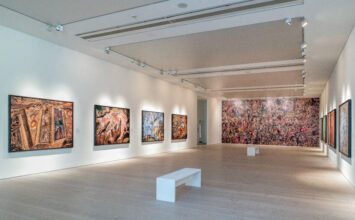
As the title describes, extraction industries – notably petrochemicals, mining and quarrying – have been Burtynsky’s principal subjects, often photographed from helicopters and in recent years making use of drones and digital cameras. The show itself certainly does justice to the scale of Burtynsky’s methods and practices: Room after room across the Saatchi Gallery effortlessly embraces the several squared-metre framed prints, about a dozen murals covering entire walls (plus a floor), multi-media works, and a three-screen video piece titled ‘In the Wake of Progress’. No expense has been spared.
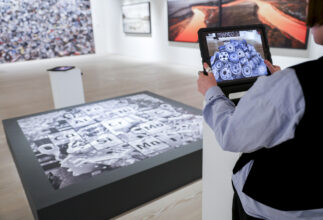
As a retrospective, curator Marc Mayer’s novel approach deconstructs discrete (seminal) bodies of work and arranges the show across three themes, rather than taking a typical chronological approach. (In practice, a photographer’s concerns rarely evolve linearly: projects and ideas overlap, are deferred, re-visited and critical standpoints shift.) As the name suggests, the first part, ‘Abstraction’ proposes – exhaustively – the various ways that Burtynsky’s practice should be likened to abstract expressionism. The galleries devoted to this occupy almost as much as the remaining three themes combined: ‘Agriculture’, ‘Extraction’ and ‘Manufacturing & Infrastructure’. Finally, there is a smaller display, ‘Process Archive’ of production images and a selection of Burtynsky’s cameras and other equipment.
Whilst aerial perspectives have indeed been a hugely important aspect of Burtynsky’s practice, there are a mere handful of photographs that represent land and its inhabitants on a more intimate scale. Such images are of course fundamental to the nuanced cadence of bodies of work such as ‘Oil’ (2009). In reducing Burtynsky’s projects into these themes, we are presented with what are deemed the most distinctive and dominating approaches alone. The effect of one massive view after another is relentless – perhaps that is the point of course. But so preoccupied the show is with the ‘Abstraction’ section that fatigue, of all kinds, sets in for the critically important and challenging later galleries.
Burtynsky’s photographs are indeed dizzying – often eliciting what he describes as a kind of ‘vertigo’[1] . An image that typifies this is ‘Tailings Pond #2, Wesselton Diamond Mine, Kimberley, Northern Cape, South Africa, 2018’ (available from the gallery shop as a postcard). The thick shades of grey almost vibrate like a Bridget Riley painting – shifting between converging to the centre of the frame and sloping away from it. But disorientation, and optical illusion, are quite distinct from abstraction. On the contrary, as well as preoccupations with shape and form, Burtynsky’s appetite for rigid composition, level horizons and verticals, detail, consistent focus and sharp depth-of-field, extend distinctly modernist sensibilities. At 60 x 40 inches, the majority of the subjects in the photographs are discernible when approached up close – and it is precisely the scale of these works that attempts to envelop the viewer. (The postcard, on the other hand, is arguably closer to an abstract representation.) Beyond the aesthetic, elements of chance and spontaneity that were traits of abstract expressionism seem distant from the highly planned and well-resourced productions that bring Burtynsky’s visions to fruition. The ‘Process Archive’ gives a sense of the human and technical machinery that makes Burtynsky’s operations feasible. Whilst it is possible to dismiss this section of the show as a further distraction to the actual subjects that all of this contributes to the representation of, there is a refreshing transparency in seeing the components of a creative practice revealed in a context and institution such as this.
Captions throughout the exhibition oscillate between straight prose describing the subject matter, often contextualizing the specific ecological implications of what we are looking at, and sometime trite or didactic commentary referring to “whimsical patterns” and “this weirdly graphic landscape.” Although the picture captions make various connections between specific photographs and subjects, and abstract artists and their proponents, very little is said in relation to the sublime – an aesthetic principle that is highly pertinent in relation to Burtynsky’s subjects and his choices of how to represent them. The vastness of landscapes; the colour of pollution and toxic waste; the infinite stygian depths of quarries and mines; the power of industries; the terror of the unrelenting deforestation… these are the epitome of Edmund Burke’s Eighteenth-century description of the sublime.[2] Arguably, Burtynsky’s photographs have far more in common with paintings like Philip James de Loutherbourg’s ‘Coalbrookdale by Night’ (1801), which proposed a stark vision of the Industrial Revolution’s impact upon the countryside, than with paintings of an abstract nature.
Heightening sublime subjects with strategies that are themselves manifestly sublime (such as giant, immersive prints – lots of them – as well as hanging out of helicopter to capture the image in the first instance) is problematic in the context of visual representation with any kind of persuasive intent. Writing about Burtynsky’s work a decade ago, Joshua Shuster argued that:
“…the sublime is breathlessness at a distance that stays distant, and thus involves an uneasy relationship with forms of hands-on environmentalist activism.”[3]
Contrary to action the sublime is conducive to a sense powerlessness and inertia – precisely the opposite of affecting the viewer towards constructive individual responses to the climate emergency. But such a critique is perhaps meaningless given how tentatively this exhibition aligns itself with any such aims, and how much more like a show of art photography this feels like, rather than any kind of documentary. Confronted with the scale and art gallery context, it is hard not to find oneself drawing comparisons between Burtynsky’s photographs and those of Andreas Gursky – specifically Burtynsky’s images of a chicken packing factory in China and a Chinese shoe factory in Ethiopia, that chime with Gursky’s ‘Amazon’ (2016), ‘Untitled XVIII’ (2015) and ’99 Cent II’ (2001) in particular. Although quite different preoccupations are in play, both practitioners exploit the potential of our susceptibility for the sublime.
In a recent essay Jörg Colberg included Gursky within his unflinching critique of certain practitioners he believes exhibit a “neoliberal realism” in their photography – what Colberg describes as “a form of visual propaganda whose mechanisms are identical with socialist realism, the Soviet Union’s state-sanctioned visual propaganda.” [4] Gursky’s work, Colberg suggests, deploys the sublime to preserve a belief that there is no viable alternative to neoliberal capitalism:
“[Gursky’s] photographs are always intended to visually overwhelm, which they do physically (prints tend to be very large), in terms of the sheer amount of information depicted, and through reducing human figures into mostly small, irrelevant elements (where they are even present). In a world governed by neoliberal capitalism, Gursky lets us know that resistance is futile, and it’s impossible to come up with any other read[ing] when faced with his photographs. Instead of thinking about resistance, a viewer is ultimately awed by the spectacle presented in front of her or him. Gursky’s photographs are a good example of how the idea of the sublime has its proper place even in neoliberal realism.” [5]
Although there are striking similarities, perhaps it is too simplistic to transpose Colberg’s critique directly to Burtynsky’s environmental photographs. However, the inherent tension between the ‘awe’ and ‘spectacle’ of Burtynsky’s photographs and any meaningful ‘resistance’ to the consumerist-driven ecocide depicted sublimely by Burtynsky – in this particular context at least – fails to be reconciled.
__________
[1] BBC (2024) Free Thinking . https://www.bbc.co.uk/programmes/b07tzytz 15 Sep 2016
[2] BURKE, Edmund 1990. A Philosophical Enquiry into the Origin of our Idea of the Sublime and Beautiful. Oxford: Oxford University Press.
[3] SHUSTER, Joshua. 2013. ‘Between Manufacturing and Landscapes: Edward Burtynsky and the Photography of Ecology’. Photography & Culture. Vol.6 Issue 2. July 2013. p.194
[4] COLBERG, Jörg 2021. Photography’s Neoliberal Realism. London: MACK. p.7
[5] COLBERG, Jörg 2021. Photography’s Neoliberal Realism. London: MACK. p.28
__________
Edward Burtynsky: Extraction/Abstraction was exhibited at Saatchi Gallery, London
(14th February – 6th May 2024) and reviewed for Photomonitor by Jesse Alexander.