__________
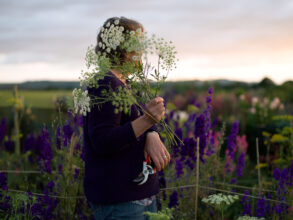
Tessa Bunney has always been interested in how people live with the land. Her work investigates the interdependency of rural communities and the landscape, and encompasses communities as far away as South East Asia and Africa, and as close to home as her native Yorkshire. FarmerFlorist follows in this vein, documenting the small army of independent flower growers in the UK, whose livelihood, along with others, may now be under threat with the advent of Brexit.
Bunney has the facility to photograph people at work as if she were almost invisible, and the documentarian’s skill for making the viewer feel as if they are in the image, not looking at an object on a wall. Her images are clean and clear, mostly concentrating on individuals and their beautiful crop of blooms, and some individual ‘portraits’ of flowers themselves. In this latest exhibition, matt prints are displayed in a simple and traditional way in glassless white frames, arranged in groups and clusters on a charcoal grey wall, a colour which serves to allow the subtleties and colours of the subject to glow from the frames. A variation of size might have brought a greater drama to the exhibition, and certainly the highly detailed imagery would have allowed for some very large prints, but the unfussy presentation serves the subject well.
FarmerFlorist includes – yes, images of beautiful flowers – but it also makes a quiet political point about a mostly-unseen cottage industry which has been growing in strength over the past decade. As consumers have become more concerned about supporting local businesses, driving sustainability and seasonality, the appetite for home-grown, ‘fair-trade’ flowers has had a resurgence, having dwindled considerably since the 1980s when cheaper air transport and large-scale flower production in Africa and South America, and of course Holland, took over the market. This recent movement has allowed small ‘artisanal’ producers to thrive.
However, the intensely seasonal nature of the business means that many are dependent on an influx of labour for harvesting, most of whom come from continental Europe. With the latest events in our politics, Brexit is making the UK a much less attractive place to work, and since 2016 immigration has consistently dropped – which has led to an instability in an already unpredictable industry, dependent as it is like any other agricultural endeavour, on the weather. It may be then, that FarmerFlorist has caught a fleeting time of positivity for these small businesses.
Oriel Colwyn, for those unfamiliar with this small and relatively new gallery, was founded in 2012 by curator and photographer Paul Sampson. It is housed in the oldest theatre in Wales, the historic Theatr Colwyn in the charming seaside town of Colwyn Bay on the North Wales coast, one of only a very few photography galleries in Wales. Sampson’s mission is to bring national and international photography to the community of North Wales, and as some have called him, he has become “the unsung hero of UK photography” as he brings exhibitions otherwise seen only mostly seen in London to a wider audience. His enthusiasm for photography has quickly seen Oriel Colwyn established on the British photography circuit and FarmerFlorist is the latest in a keenly observed and selected series of exhibitions.
– reviewed for Photomonitor by Lottie Davies
__________
FarmerFlorist, An Exhibition by Tessa Bunney was exhibited at Oriel Colwyn (3 May – 29 June 2019)
Tessa Bunney is also a key speaker at the Northern Eye International Photography Festival this October – details can be found here.