

Reviewed by Simon Bowcock
Sprawled across a large hall at the 2015 Rencontres d’Arles festival, the record-sleeve exhibition Total Records: The Great Adventure of Album Cover Photography was a hit. With a few minor variations, this cramped London show is a cut-down version of the Arles exhibition, with a sub-set of the same thematic sections re-presented with a sub-set of the same sleeves. To use a musical analogy, it’s a shortened ‘radio edit’ of the original arrangement with a few new things thrown into the mix.
One of the new things is a subtle but persistent emphasis on London. The exquisite, enigmatic photograph of Joe Jackson’s winklepickers – shot in a shaft of light near Waterloo Station for the cover of his 1979 album Look Sharp! – is rightly given pride of place at the beginning of the show. The image screams of the try-hard overconfidence so typical of the secretly insecure, and is a perfect prelude to many of the lyrics on the record. Jackson hated the picture so much he never worked with photographer Brian Griffin again. Time has told us that Jackson was wrong.
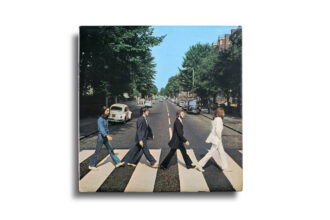
A less successful London inclusion is a near-pointless set of out-takes from the 10-minute session for the iconic cover of The Beatles’ Abbey Road (iconic may be the most overused adjective in photography, but if it’s not applicable to Iain Macmillan’s 1969 picture, then it’s not applicable to any). The only remarkable thing about these rightly seldom-seen rejects is McCartney’s questionable choice of toe-grip sandals to go with his suit that day, a sartorial experiment thankfully so short lived that he was eventually immortalised barefoot. If there is any point to these superfluous shots, perhaps it is to show us mere mortals that even the coolest Beatle could put a foot badly wrong.
Much better is the new section devoted to London label Rough Trade, where the musicians occasionally wear their hearts on their (record) sleeves, especially in the mid-2000s: Roger Sargent successfully captured The Libertines’ complicated and chaotic closeness, the very key to their creativity; and Anthony and Johnsons’ appropriation of Candy Darling on her Deathbed (1973) perfectly packages the beauty and sorrow of the songs on I Am a Bird Now, prefiguring a revival of interest in the late photographer Peter Hujar.
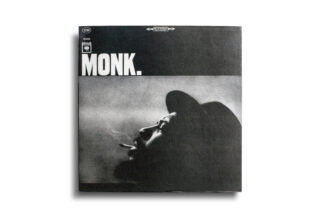
The slightly confusing section ‘Original Creations on Vinyl’ mixes both commissioned and pre-existing photographs, and typifies the whole show: just like the rest of For the Record, it’s a mixed bag. Some of it is monumental, such as Gene Smith’s Monk (1964), which – as a candid portrait of the pianist enraptured in music in the wee-small hours – rings authentic. Some of it just works, such as the Bernd and Hilla Becher-credited giant industrial transformer on the gatefold of 1970’s Kraftwerk, a picture which functions efficiently as both literal and musical metaphor. And some of it is ill judged, such as Roy DeCarava’s cover for Graves and Pullen’s Nommo (1967), a ho-hum, get-the-job-done portrait, seemingly included because it is was taken by one of the all-time great music photographers rather than because the photograph itself has any particular merit.
Suffering from a similar syndrome is the section devoted to Lee Friedlander, whose workaday cover portraits of jazz musicians give no hint of his pioneering prowess as a photographer outside the studio. But even here there are one or two worthy exceptions, such as his loose, hazy and beguiling 1956 portrait of Claire Austin.
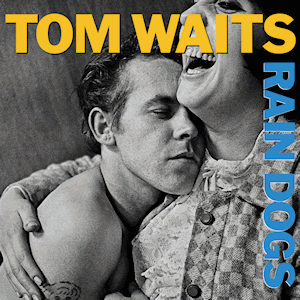
That’s the thing with For the Record: whenever there are bum notes, they are more than made up for by an absolute banger. Whether it’s recycling an existing picture (such as a late 1960s Anders Petersen dive-bar photograph, the overture for Tom Waits’ 1985 ramshackle chorus of deadbeats), or a new shot of a musician (such as Ray Gibson’s kinetic 1966 impression of the eponymous drummer on Sunny Murray, challenging accepted norms of both portraiture and rhythm in a single package), the show repeatedly reminds us that the pleasure of the album in its heyday could sometimes be as much in the looking as in the listening.
__________
For the Record: Photography & the Art of the Album Cover was exhibited at The Photographers’ Gallery, London (08.04.22 – 12.06.22) and reviewed by Simon Bowcock