


With a central focus on sustainability, Horizons (Over Which We May Choose to Disappear) at the University of Hull’s Brynmor Jones Library gallery, assembles work from ten photographers. Curated by photographer Nigel Walker, the exhibition’s origins derive from a 2023 Hothouse event that took place in Hull as part of Hull EcoFest. One of Redeye Photographic Network’s initiatives, the Hothouse event included presentations from a range of practitioners, ten of whom share their work here in Horizons.
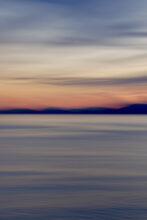
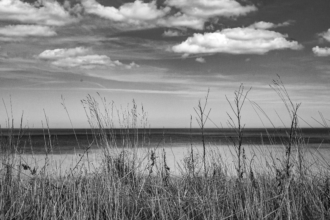
One of the most intimate of the individual displays is that by Fiona Caley. Her ten pieces document aspects of her former family home, a now abandoned farmhouse built in the 1960s on the periphery of the Holderness Plains, East Yorkshire. This flat land, seemingly ideal for arable farming, is also shaped by erosion, specifically the waves of the North Sea that pound the clay coastline rendering it physically precarious. The photographs, through glimpses of exposed plant roots, cracked concrete, tulips in bloom, and the apparent tranquillity of a calm day where the sky meets the sea and the land, are heavy with pathos, both personally for Caley and her family, but also for the wider ecological issues that this one empty farmhouse might represent.
Overlapping subjects, aesthetic approaches and techniques tie together this group exhibition. Indeed, Evelynne Rogers also focuses upon coastal erosion, this time in her home in Sefton, Merseyside. 22 Miles documents the varying boundaries between sea and land, from piers to seawalls and sand dunes, that are present along this stretch. A fold out book of colour photographs, a collection of objects washed up by tidal patterns displayed within a vitrine, and photographic grids of beached sea creatures and sand patterns, detail personal experiences of a changing landscape in macro and micro.
While the subject of sustainability, embedded within the climate crisis and layers of geo-political conflict, is a highly serious one, elements of the exhibition offer a different tone. The wryly composed ‘fake landscapes’ of Evgeniya Strygina are a prominent example. Advertising hoardings, translucent curtains and chance encounters between objects out of context all feature. A glass ceiling light throws shadows that are reminiscent of a snow-covered crevasse; a row of printed birds perch on a wire above a collection of bin bags; a rock on a polythene weed sheet becomes an island. Small gestures transform their surrounding landscapes. Strygina’s interventions bring the humanmade into collision within the natural or more ostensibly ‘real’.
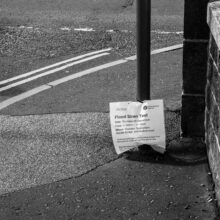
Moments of humour can also be found in a select few of Jim Souper’s black and white Encounters with the Calder, a series which follows the path of the River Calder through West Yorkshire across images titled for their specific individual location. While certain photographs are beautiful, even, dare I say it, picturesque, others are stranger or more melancholic. There is, for instance, a sad beauty and dark sense of irony derived from an empty plastic bag of commercial compost caught in fast moving river water, and in a collection of twenty-or-so footballs stuck splashing against a weir. Souper’s work, in part because of the volume of the collection presented, is expansive and nuanced. From historic bridges and traces of the region’s notable industrial revolution-era architecture to more recent civic-minded developments such as The Hepworth Wakefield (opened in 2011), Souper presents the Calder in many of its changing and interconnected guises.
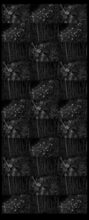
There are relatively few portraits in the exhibition. Ann Hutchinson’s street photographs of Cypriot young people, predominantly vibrant in colour, markedly contrast with her nearby landscapes which are much softer in effect. Hutchinson also includes cyanotypes and a series of black and white foliage studies that emphasise the temporary beauty of shadow and form. Underpinned by research into the impacts of climate change in Greece, upon its natural landscapes, population and economy, this eclectic presentation provides an international perspective.
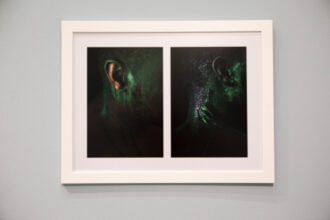
Artist Khandiz Joni’s works combine body painting with photography, giving visualisation to the intimate connections between humanity and the natural world, again on an international scale. In these works by Cape Town-born, London-based Joni, this connection is explored via questions of care. Brightly painted schools of fish, green lungs and rivers of tears are tenderly painted directly upon skin to emphasise the fragile but integral bond between humanity and nature overtly, moving towards the territory and increasingly prevalent discussions, perhaps, of the more-than-human.
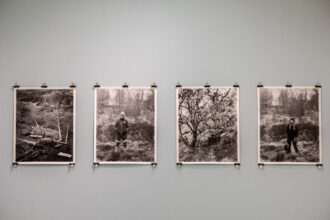
Some of the individual people who work within Hardknott Forest in the Duddon Valley, Cumbria, are featured in work by Chris Routledge. From a long-term project titled Wildwood, Routledge’s works highlight forests as their usage is transformed from farmland to commercial forestry and then, slowly, to native forest planting. The work reveals glimpses of restoration and conservation processes, including the role of Forestry England and the RSPB via portraits of some of the custodians of this specific forest, and portraits of the trees and interconnected ecosystems within.
A series of work by London-based Jacqueline Ennis-Cole invites more direct interaction. Three large scale vinyls and sixteen framed collages explore the socio-economic and environmental impacts of onshore oil mining extraction within Nottingham’s ancient Sherwood Forest. Two vinyls show gridded images from the forest while a third, largely text-based piece invites dialogue by breaking the fourth wall to ask questions of audience perspectives on economic justice. A row of archival images and sources drawn from the archives of BP (British Petroleum) appear along the bottom edge. Ennis-Cole’s smaller collaged works combine multiple animal forms – a moth, toad or snake – with fragments drawn from these military-feeling archives – men working pipes, wearing tin helmets, mending vehicles or, in one instance, standing around with their hands in their pockets. Against green backdrops, the effect is reminiscent of cinematic visual effects, the natural world standing vulnerable, even incongruous, against the violent exploits of men.
Industrial action is explored, too, in works by David Hiney, via its function as a living archive operating among contemporary ecosystems. Manchester-based Hiney’s black and white works explore the decline of the mining industry in Lancashire, a place where industrial buildings and other large structures still figure within the landscape. Bank Hall Colliery, Burnley, like many mines across England and Wales, closed in the 1970s, and the physical, environmental, economic and sociological impacts of this closure are still unfolding across local populations and those further afield. Post-industrial landscapes, some in the midst of re-wilding or other transformation, working class heritage and communities who are still coming to terms with the loss of livelihoods and skills are all familiar stories, but they are nevertheless worth telling.
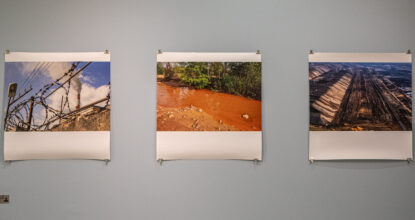
While Hiney’s views of industrial remnants offer a nostalgic perspective, one that might only be afforded through the course of time, Alan Gignoux’s three prints foreground the devastating impact of the fossil fuel industry upon the landscape and its integrated communities in detail and full colour. In the first image, a refinery expels smoke from behind a barbed wire topped perimeter; the next pulls out to vivid river water, stained with pollution and in the third Gignoux’s camera zooms out again to encompass the vastness of a landscape deeply scarred, perhaps irrevocably so, by extraction. While the specifics of these locations are unknown, the wider global resonance of such industries is loud and clear, perhaps the most explicit of the impacts here displayed.
Redeye, the organisation whose Hothouse event was the catalyst for the exhibition, sadly closed in July 2024 following 26 years’ service to the photography community in the UK. Horizons curator, Nigel Walker, emphasises the importance of the network in both a broad sense and the Redeye network more specifically: ‘Nothing ever happens in isolation’ he states. Walker was a member of Redeye prior to its closure and, like many others, especially in the northwest of England, found great value in its capacity to advocate, connect and platform new initiatives across the region. Redeye’s reputation was one of championing photography through its programme and its loyal network of members and supporters. ‘Redeye enabled the ability to share my own ideas and work with others with similar interests or concerns through events and broadcasts. The annual Hothouse days were always a source of both inspiration and personal connection. It was a great loss to me personally when the network folded and was, of course, the inspiration for me in curating Horizons’ Walker explains. ‘Sadly, photography still seems incapable of sourcing the funding and attention given to many branches of the arts.’
Something of Redeye’s loss is mirrored within Horizons. The exhibition, then, not only deals with the subject of environmental sustainability but with the sustainability of photography itself – as a vehicle of expression, as a career and as a sector. While the ecological impacts of material practice, travel and digital technologies within photography are only very lightly touched upon with the Horizons exhibition – perhaps a future second iteration could draw this out overtly – the sustainability of photography as a practice supported by connection and collaboration is underscored. Looking towards the future, more positive is the news that Redeye have reportedly begun conversations with Open Eye Gallery, Impressions Gallery and Arts Council England about developing a new photography network for the north of England. This would undoubtedly be of key importance to the diverse range of photographers practicing across this region and beyond.
__________
Horizons (Over Which We May Choose to Disappear), curated by Nigel Walker, showcased the work of ten photographers at the Brynmor Jones Gallery, University of Hull 16th July – 31th August 2025.
Reviewed for Photomonitor by Anneka French.