
Reviewed by Julian Lass
__________
Mentor, you’re right, we must hold dear
each treasure that’s bestowed on us.
And it is good that we study them close,
but I’m troubled by a murmuring ghost,
asking, ‘Isn’t worship superfluous?’
‘Why not follow the things we want, not fear?’
Like our serpent sang on that day, pre-fall,
his last declaration, ‘You can have it all!’
__________
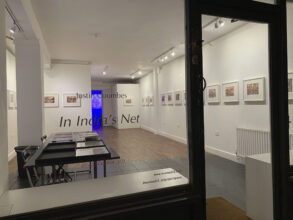
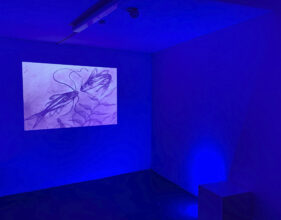
Thus speaks a voice from the distant future, 3222, one of two botanistas, in a six-minute film that forms the centrepiece of artist Justin Coombes’s new solo exhibition at the Hoxton 253 gallery, London. Titled In Indra’s Net, the film hints at a possible global and environmental catastrophe that may, or may not, have happened. Who knows. But the two figures work with a mysterious machine to collect data and make notes along India’s Falgu river, and they speak to each other in rhyme as mentor and mentee. Coomes says that the film is his homage to La Jetée, the 1962 science-fiction film. Like Chris Marker’s film, In Indra’s Net features a sequence of still images with a voiceover as soundtrack. What’s Indra’s net? Maybe Coombes sees it as the infinite net of the god Indra, in some Buddhist and Hindu belief systems. In each eye of Indra’s net there is a jewel, which reflects all the other jewels in the net, limitless in number.
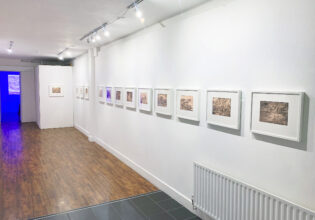
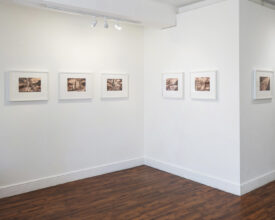
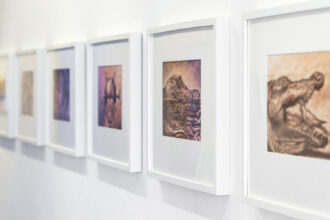
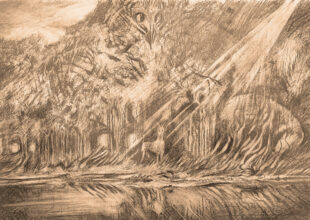
The day I walk into the exhibition space is the day before the show’s opening. Coombes is busy with the finishing touches, with gallery co-curators Zsuzsa Benke and Mirko Boffelli. Benke is lining up the last of 23 framed prints, each at eye level, with dazzling speed. She’s left no explaining through writing on the wall though, and, peering into the room at the back where In Indra’s Net is playing on a loop, I realise it’s up to me to work this out. So I walk around the main room, and soon imagesbegin to form connections with one another. In many, some kind of being faces me, whether botanista, owl, fox, beetle, or elephant. In one drawing, ‘Cerberus’s cousin,’ a deer looks across water at me. A pair of eyes above the deer suggest a giant mouse, while a crouched figure to the right hints at an elephant, head obscured by a shaft of light.
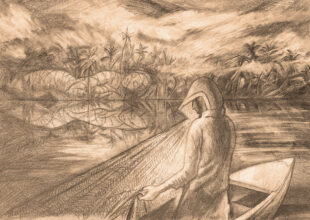
Their gazes do not flicker or pass on, they stop me dead in my tracks, ask me to look back and more closely. These sepia-toned, Giclée prints populate the main room of the exhibition, and are reproductions from pencil drawings, suggesting field notes sketched by the botanistas. Coombes tells me many were sketched from his photographs. The drawings suggest an accompaniment, a melody to the film’s dialogue, which echoes around the room. Myriad eyes, whether actual, or eye-like in pattern, attract my attention. Non-human looks, the many eyes, show a playfulness, yet suggest secrets, Otherness. And love. I shall indeed love this creature as myself when I experience that I am this creature. It’s like plunging your face into jungle undergrowth: fragrant, and surprisingly delicious, a celebration of the senses.
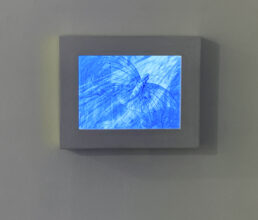
While the botanistas’ limitless voices reverberate around the gallery, there is an additional, one-minute film, titled ‘Preliminary Wisdom,’ which plays out on a small, wall-mounted LCD screen towards the back of the room. It’s a multi-sensory romp. Blue-toned images that the botanistas have recorded with their mysterious machine morph into one another.
The voice of the mentor says,“true kings of the jungle only take what they need: there’s enough for that, but not for their greed.” There is a middle way, a path of interconnection, and the analogy is of Indra’s net. Human beings are dependent on, and connected to, all other forms of life, so that it becomes hard to even say human life. When a dolphin rescues a drowning human, the encounter occurs through the call of one being to another. In the creatures’ non-human looks, which arrest me, in the tenderness of Coombes’s drawings, in the tone of the womens’ voices in the film, I sense an infinity of connections. A simple point of origin, with humankind at the centre of things, becomes untenable. This is a criticism of the burden of Western ‘Enlightenment’ thinking, both in the individual (the myth of the cogito) and species (the privileging of humans over other beings).
Sometimes the burden is a heavy one. The danger of searching for a single meaning, a foothold from which to explain away, is that you remain trapped within the endless recirculation of opinions and concepts. The Buddhist way is to take away, to keep pulling the rug out from beneath until I let go of the need for solid ground. The role of the artist then is as guide, not to manipulate or steer. Rather than releasing a single meaning, the work stretches to show the possibilities (as with Indra’s dazzling net) of different forms of life. This is its lightness.
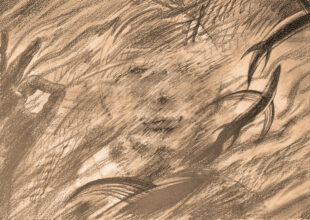
These forms are “unfixed, unsteady,” where thoughts are like uncaught fish and study becomes “a kind of prayer,” because, as the mentor suggests, “the only way we will continue to grow (is) to worship what we do and do not know.” For these botanists of the future are not heavy with interpretation. They seek to live differently. And their relationship, as nameless mentor and mentee, already questions the conviction that I can know everything I need to know and everything that is at stake, that I can somehow ‘possess’ the truth, as I can possess a name. In ‘Junior botanista casting net,’ for example, a face appears blurred by water, fingers in the Buddhist karana gesture, a kind of ‘ok’ sign with index and little finger pointing straight up. In grip: a net. Fish swim at the periphery of vision.
To explain nature by naming it, to suggest a knowing of the world as a collection of objectively existing things (including me), is how the human being acquires a position of mastery over objects. The submission of things, and beings, to the rule of the human cogito, is the origin of so-called ‘calculative’ thinking. Beings are at once subject and object: they are referred to the cogito as master and objectivised as ‘calculable’. Human desire, the will, treats every being as an object and simultaneously compels it to be available for manipulation. All beings are reduced to be used as resources. The world is there to be used up and machined in the service of humanity’s calculating rationality.
Yet a potentially different relation with the world lies with possibilities. With possibilities, life is never already given and presupposed. To abandon desire, the will, even names, is to call for radical ontological revision, for a plurality of forms that can halt the tendency to dominate nature as resource. A nameless form has nothing to define it other than its own expression. And instead of striving to be apprehended by others as exceptional, and exceptionally desiring, which leads to the exploitation of the environment, where freedom appears asfreedom from fear, as a limit to power, the botanistas speak of how to keep on engendering such forms.
A possible form of life that can be glimpsed in the work on display, is one based on fear, not desire. In Buddhism, which obviously influences Coombes’ thought, desire is the cause of suffering. And fear is not a mood that has as its object some particular thing in the world which can be named and removed to make one fearless, the figure of fear as a threat. Instead, fear is a mood that can open one, face to face, to the Other, in vulnerability, tenderness, love. Such change does not follow from exceptional human agency (the will), where man is at the centre of it all; rather, as a philosopher once suggested, what never stops coming are possibilities. The exhibition is a much-needed protest against the kind of ‘calculative’ thinking that may lead to the future the botanistas inhabit.
__________
| Justin Coombes: In Indra’s Net Exhibition runs: 24-31 October 2021 / Mon-Fri 2-8pm, Sat-Sun 11-8pm Hoxton 253 Art Project Space, 253 Hoxton Street, London, N1 5LG |
Julian Lass is a writer and artist and lecturer at the University of Westminster and Solent University. He has a PhD in Fine Art from the Royal College of Art, an MA in Photography from UAL, and an MA in English Literature from the University of Edinburgh. His photography clients include Geographical Magazine, The Guardian, Telegraph Magazine, Times Weekend, Google, BBC, Index on Censorship, and The Radio Times. He has written for the Telegraph Magazine, the British Journal of Photography, Bright Publishing, Photo District News, Photomonitor, and Flash Art, among many others. He has also worked as a Picture Researcher for Taschen. He recently performed his writing at the Whitechapel Gallery as part of the London Art Book Fair, and his art writing has previously been published by the Art Writing Guild. www.julianlass.com