

reviewed by Anneka French
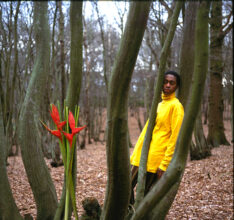
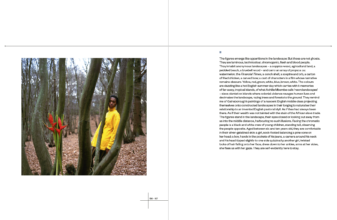
Ingrid Pollard migrated from Guyana to London in 1956 and now lives in rural Northumberland. This ambitious new exhibition, for which Pollard has been nominated for the 2022 Turner Prize, is rooted in portraiture and landscape, being concerned with experiences of racism, representation, nationhood and belonging.
In his catalogue essay, historian and cultural theorist Paul Gilroy summarises Pollard’s approach: ‘Her loving recuperation of England’s landscapes and its insides – wallpapers and curtains, tools and teacups – shows the country’s cultural fibres being unpicked and thoughtfully recycled. This body of work speaks not for hybrids, but for remixes’. Pollard’s multi-media remixing reveals stories and histories that British colonialisation represses.
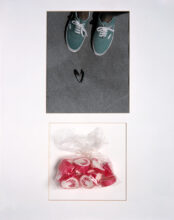
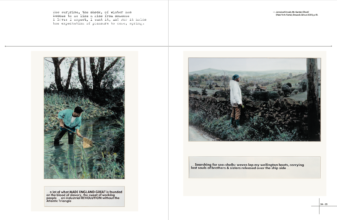
The first room of ‘Carbon Slowly Turning’ opens with water. A flotilla of small ceramic boats and a dual-screen video of a rowing session are accompanied by two photographic series that explore the English coast from differing angles. Pollard’s relation to Hastings is considered in ‘Seaside Series’ (1989), a group of self-portraits framed with fragments of text and typical seaside souvenirs. Views on Sunderland Point, Lancashire, are addressed in ‘The Boy Who Watches Ships Go By’ (2002) through both the artist’s experiences and a historic account of the death of ‘Sambo’, an enslaved Black boy who died at sea and was buried on arrival.
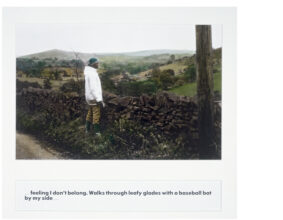
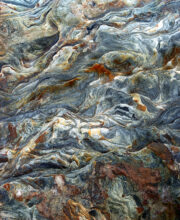
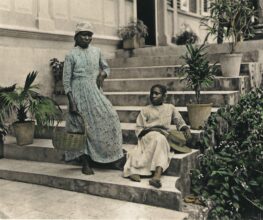
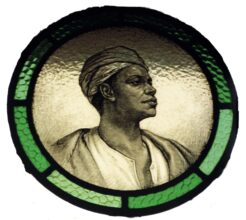
With the exception of the fourth gallery which is a more eclectic display, the remainder of the exhibition’s spaces are tightly curated, with each room a sharply incisive investigation into a particular line of research. ‘The Black Boy’ as a persistent racist symbol found in many British pubs is the subject of one room, bringing together found objects, video, text and photography. This sits adjacent to stories of Windrush-era migration in the video ‘Belonging to Britain’ (2010) with a wallpaper that explores textile histories. A range of impactful work on the rural environment is presented in the penultimate room, a site for exploring and extending the potential sensuality and materiality of Pollard’s practice through artist’s books, hand-tinted photographs such as ‘Pastoral Interlude’ (1987) and four enormous digital photographic prints under the umbrella ‘Landscape Trauma’ (2001), works whose geological or topographical beauty contrasts starkly with their titling.
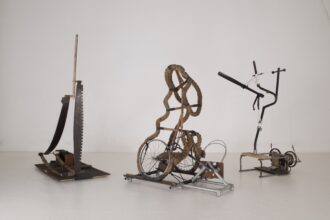
‘Carbon Slowly Turning’ concludes with the most affecting work on display. Three kinetic sculptures are the focal point, their movement dominating the room while their grating and discordant sounds echo throughout the whole exhibition. ‘Bow Down and Very Low – 123’ (2021) is composed of ‘body-ish’ sculptures that swing a baseball bat, raise and lower a wooden baton and threaten a rope: they embody violence. Behind are repeated photographs of a young Black girl, a May Queen isolated from a politically-motivated film titled ‘Springtime in an English Village’ (1944), shown in curtsey.
The exhibition ends with an enlarged photograph of the same girl and here her face is seen more clearly. She smiles confidently and with agency. She sends us back out into the world. Nearby, a quotation on the wall by poet Maya Angelou reads: ‘Now you understand just why my head’s not bowed’.
_________
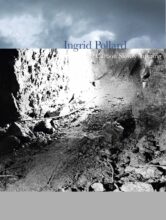
Ingrid Pollard: Carbon Slowly Turning is exhibited at MK Gallery (12.03.22 – 29.05.22) curated by Gilane Tawadros, with the artist.
The catalogue Ingrid Pollard: Carbon Slowly Turning accompanies this exhibition and is edited by Fay Blanchard and Anthony Spira, including essays by Anna Arabindan-Kesson, Cheryl Finley, Paul Gilroy, Mason Leaver-Yap and Gilane Tawadros. (Philip Wilson Publishers, Bloomsbury)
Reviewed for Photomonitor by Anneka French