“I see,” we say so often, meaning “I understand.” And, indeed, seeing is not just believing, but also our best means of comprehending. Light, which makes seeing possible, also makes life possible. The sun is the great creator. And not only does it create and sustain, but, as the late 19th century Danish Nobel laureate Dr Niels Finsen discovered, it can also heal.
With his invention of the Finsen Lamp, Finsen was able to direct the sun’s ultraviolet rays, invisible to the human eye, through a series of crystal prisms, directly on to his patients’ skin, and thus affect a cure for lupus. A recently uncovered archive in Copenhagen contains early documentary photographs of these patients, alongside medical artefacts, and moulages, or wax “life masks,” detailing their before and after states. This groundbreaking medical development might not have been possible, had it not been for the simultaneous advances in photography, exploring and exploiting the properties of light.
For his first solo show in London, Danish photographer Nicolai Howalt (born 1970) presents a celebration of light and the sun, bringing together images from the Finsen archive, which he has rephotographed and turned into appropriately dated looking photogravures, appropriated images of the sun from the NASA website, and a number of abstracted prints, fêting the properties and practical uses of light. Here, on the walls of Edel Assanti, Howalt brings together beauty and ugliness; power and manipulation; the microscopic and the immense; art, medicine and science.
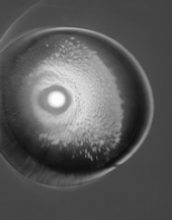
The photogravures taken from Finsen’s work are fascinating, and clearly reflect Howalt’s documentary background. They could be taken straight from a medical textbook. Lupus #4, for example, is harrowing in its clear depiction of the disease’s ravaging of a young woman’s face. The Solar series, from the NASA website, could equally be documentary in basis, but, for me, this row of prints are the highpoint of Howalt’s artistic intervention. Originally blazing reds and yellows, Howalt has rendered the images greyscale, and, without being told, it is by no means obvious that they depict the sun. One might, instead, mistake them for human cells: some healthy, some diseased. The swirling Solar #9 bleeds slightly from its unsteady edge, whilst Solar #8 is “infected” with three small black dots. The darkness of Solar #4 is alluring and beautiful, with an aesthetic quality almost beyond imagination.
For the third strand of the show, Howalt was allowed to borrow one of Finsen’s original lenses from his lamp, and he used it, in his studio, to direct the sun’s rays on to the wall. Again the resulting image, Light Break #1, could be a human cell. Equally, it could be a sun, or a star. The visitor is drawn into a dialogue between the different images and their sources, realising that, when shrunk or magnified to the same size, our life (made up of cells), and our life giver (the sun), apparently look pretty much alike. Is this truth, or is this illusion? With images created by an invisible set of UV rays, who can say? Whilst on some level science does indeed help us to “see”, just how much more is there that we simply do not, or cannot, comprehend?