



reviewed for Photomonitor by Mark Durden
Hélène Binet’s impressive 35-year career retrospective at the Royal Academy of Arts, encompasses responses to diverse architectures from around the world: buildings by twelve architects, including Nicholas Hawksmoor’s London churches, Le Corbusier’s Couvent Sainte-Marie de La Tourette, and signature works by Daniel Libeskind, Zaha Hadid and Peter Zumthor, as well as the Classical Gardens of Suzhou in China and the Jantar Mantar Observatory in Jaipur, India.
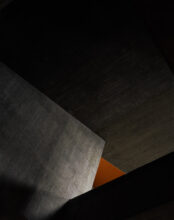
One of Binet’s earlier photographs of John Hejduk’s newly built Kreuzberg Tower and Wings in Berlin pictures the buildings from a distance. Hejduk’s distinctive architecture is viewed from an elevated position from another building and across a carpark. His buildings are put in a context and are, to a certain extent, located in time. Accompanied by photographs giving us close up and fragmentary views of Hejduk’s architecture, this more totalising view points to an approach to architectural photography that she did not pursue. Instead Binet’s reputation has been developed through a formal and abstract pictorial approach to architecture, isolating buildings from context and championing architecture as art— an approach typified by the black and white picture facing us as we enter the exhibition, a dramatic interplay of sharply pointed angular and differently toned shapes drawn from the dynamic structure of Hadid’s Vitra Fire Station.
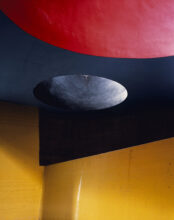
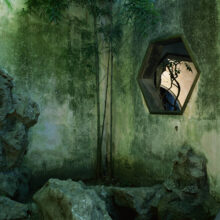
Binet continues to use analogue film processing and printing techniques and there is often a beautiful concordance between this process and the way her photographs accent the materiality of surfaces in architecture or draw out the lyrical qualities of light and dark. She mainly photographs in black and white but on occasion also uses colour to draw attention to the defining elements and qualities of what is pictured— the glistening thin-cut quartzite slabs used in Zumthor’s thermal baths at Vals, Switzerland, the suggestions of landscapes from the mould-stained ancient walls of the Classical Gardens of Suzhou, or Le Corbusier’s dynamic use of primary colours for the skylights of his La Tourettemonastery.
Her photographs do not usually include people because she feels they date the photograph and distract from our absorption with the picture by inviting us “to reflect on the role of that person”. One of her photographs of the astronomical structures of the Jantar Mantar Observatory however does include people because, as she has said, “it’s about marking the presence on earth of people looking at the light.” They serve the more abstract ruminations conjured by this architecture, a reminder of our smallness in relation to the cosmos, mapped by this eighteenth-century architectural wonder.
Some of the most sonorous pictures in the exhibition are Binet’s photographs of Libeskind’s Jewish Museum. The black and white pictures accent the architecture’s brutality, integral to its memorialising function. They distil the tragic metaphorics of the building by concentrating on the cuts of light against the darkness of its bleak concrete interior spaces.
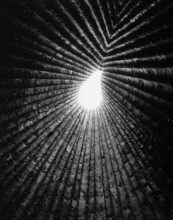
Black and white photographs of Zumthor’s architecture beautifully draw out the distinctive material elements and lyrical forms of his buildings. One picture looking up inside his Bruda Klaus Field Chapel, centres on the light at the top of its extraordinary interior structure formed by the burnt out remains of tree trunks that had been set on fire within its cast concrete walls. Another interior view celebrates the mottled lighting effects created by perforations in the brickwork of his Kolumba Museum.
Binet likens her relation to the architecture she photographs to a musician’s relation to the composer’s score and says she “always has the architect’s score in mind, with its specific period and style”. Her approach is distinct from what she refers to as the feeling among the architecture profession “that photography should do more— wider angles, more colour, more technique, and these days Photoshop.” Against such excesses she has developed a minimalist aesthetic.
Her most minimal pictures are four small square prints showing the same detail, a shallow and hollow concrete cube form, from Le Corbusier’s monastery. Taken from the same viewpoint but at different moments in time, the photographs strip photography back to basic elements, a small geometric form animated by shifts in light and shadows. These photographs also serve as an echo and counterpoint to a suite of photographs of details of the building’s celebrated corridor and the dissonant interplay of light lines thrown across it from its clear glass window with its irregular glazing bars— an architectural feature designed by Iannis Xanakis, who began his career as an architect but became a composer.
In a rather unusual colour photograph of the conical skylights in the monastery’s church the overall pictorial abstraction created by an interplay of their polychromatic shapes and forms includes the detail of what seems to be a small spider web, hanging from the lip of the interior of one of the skylights. Caught by the sunlight from above, it is a beautiful addition to the picture as it brings into this focus on Le Corbusier’s dynamic and colourful architectural feature a subtle fragile form that seems to speak about photography or about what photography does well, its rendition of small and seemingly insignificant details.
Binet’s photographs of Dimitris Pikionis’ pathways from his Landscaping of the Acropolis, completed in 1957, concentrate on their time-worn surfaces. Different natural lighting draws out the texture of the paths, made from stone fragments salvaged from demolished neoclassical buildings in Athens. Binet is attentive and responsive throughout this show to the sensuousness of surfaces, the skin of architecture. Concrete becomes especially beautiful— as in the interior colour photographs celebrating the crazy geometric forms of Gottfried Böhm’s Brutalist churches, further animated by surfaces painted red, and her photographs of the concrete shuttered surfaces of the expressive twisting arches of Sergio Musmeci’s Ponte sul Basento.
Hadid was an admirer of Musmeci and the show fulfils the late architect’s wishes to have Binet’s photographs of her own buildings shown alongside pictures of his bridge. With Hadid’s renown for her curvilinear architecture one can understand the interest. But at the same time the two represent very distinct approaches, with Hadid one of the early adopters of a fully digitised 3D design process, while Musmeci apparently used handwritten calculations and handmade models to design the structure of his bridge. In Binet’s photographs, sunlight reveals the traces of production of the concrete arches and they have an almost handmade sculptural presence. This is in contrast to the slick surfaces of Hadid’s architecture, evident in her photograph of the undulating forms of the Zinc-clad roofing of Glasgow’s Riverside Museum. Set beneath a dramatic cloudy sky and animated by shadows, Binet pictures the rooftop like a landscape.
Hélène Binet’s career as an architectural photographer has been centred on the aesthetic value of architecture which has necessarily involved an abstraction, separating and detaching architecture from the life-world. Her aesthetic nevertheless offers an important counter to the culture of consumerism and spectacle, which now surrounds much architecture and is part of much architectural photography. Through a detailing of surfaces and fragmentary views, and an understanding of light’s importance to architecture, she draws attention to the sensorial qualities of architecture and at the same time revitalises our pleasure in photography itself as a rich sensorial form.
__________
Light Lines: The Architectural Photographs of Hélène Binet was exhibited at Royal Academy of Arts, London (23 October 2021 – 23 January 2022).
Mark Durden is an artist, writer and academic. He is currently Professor of Photography and Director of the European Centre for Documentary Research at the University of South Wales, Cardiff.