![[Detail] The Magician © Stella Baraklianou, GLOAM gallery, 2020-21](https://photomonitor.co.uk/wp-content/uploads/2022/07/Clear_v_detail-147x220.jpg)

reviewed by Zak Dimitrov
Photography and the occult have been closely intertwined since the medium’s inception. As Clément Chéroux argues in his eponymous book, photography is “the perfect medium” to capture the occult and it was widely believed that “the camera would prove more efficient than the human eye in capturing the unseen”. This perhaps stems from the belief that humans are flawed and biased, whereas the camera is a machine with no feelings and therefore superior at recording. Examples of pictures of, purportedly, fairies, ghosts, auras and levitations abound in historical archives.
Magicians are, above all, performers and manipulators. They are adept at distraction, capturing their audience’s attention, and moving their own bodies in such ways as to create the illusion of magic – making people disappear, slicing them in half, or, in a familiar story going back millennia, turning water into wine. We all know that magic is trickery, yet trusting what we see has been so deeply ingrained in our culture (“seeing is believing”, or even using “I see” interchangeably with “I understand”) that we want to believe.
The idea that Tarot cards predict the future is a similar misconception as they have almost become synonymous with reading someone’s fate. They don’t, but an interesting concept circulates, namely that the cards show what would happen if we continue acting the way we presently do. As soon as we see the reading, however, we change our ways – sometimes subtly, sometimes not – but most of the time without us realising or meaning it.
The Magician in Tarot is card number one of the Major Arcana following The Fool, who is zero. Numerically, the card is related to The Wheel of Fortune (X) and The Sun (XIX), the common denominator being awareness of realms and dimensions other than the earthly and tangible. The Magician stands for creativity, action and success, but also new beginnings and adventures. He is the conduit between the Gods, with his right hand pointing high up, and Earth, left hand to the ground, thus linking the two together. On the table in front of him lie the symbols of all four Minor Arcana – cups, pentacles, swords and wands. He is urging us to manifest our desires, but also explore the occult and not be afraid to let a little wonder and mysticism in our lives – after all, not everything can be explained using pure reason.
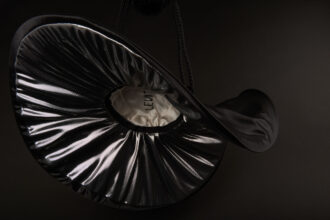
The Magician is a messenger and so is the medium of photography – a tool devised to capture, translate and relay information by one human to another. Stella Baraklianou, a photographic artist and educator, is passionate about exploring all things ephemeral, poetic and unstable as well as challenging the common perception of photography as simply a print on the wall. Her solo show, The Magician at Gloam Gallery in Sheffield, presents the viewers with a multi-sensory experience that demands their undivided attention. It utilises a plethora of materials, from velvet to acrylic, fabric, tassels, and various reflective surfaces.
One of Baraklianou’s interests is the colour black and the fact that, strictly speaking, according to colour theory, black is not a colour, but rather a surface or material which absorbs light instead of reflecting it. As she mentions, black has multiple connotations and interpretations, which date back centuries, but one of its most common mutually agreed-upon meanings is impending doom and cult activities – think of black cats (bad luck), ravens (symbol of death), or the black death, which was the common name for the plague. Her fascination with black is clearly manifested in the works she has exhibited here. A metaphor that struck me as particularly fascinating was the comparison between The Magician’s tools and the tools in Photoshop, as pointed out by Charlie Gere in the text accompanying the exhibition. Some of the tools even share the same name and implied purpose, such as the magic wand. As The Magician directs you to manifest all your desires and creativity by utilising your skills and talents, it’s easy to see why Photoshop is mentioned in the same breath.
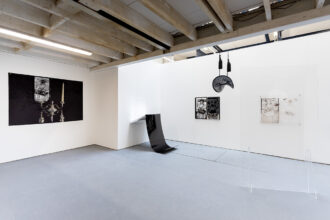
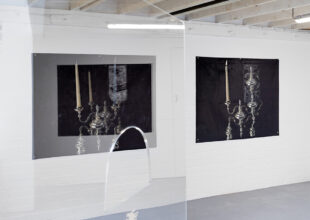
Baraklianou and the team working on the exhibition have avoided a common pitfall and one which I would argue would have risked diminishing the impact of the work, namely painting the walls black. The white walls, as cliché as they may be, provide the perfect contrast for the rich velvety blacks in her prints and sculptures to stand out and gain life of their own. They possess the space rather than being engulfed in an ocean of blackness, which arguably would have made the images and materials struggle for dominance and perhaps drown.
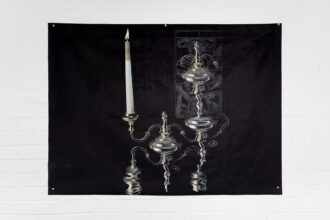
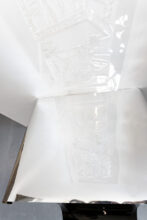
Reflection, as well as negative and positive imagery, form part of the backbone of the exhibition. The images of the candlesticks are partly reflected in what seems to be water or some other liquid with similar physical qualities; Black Magician, White Magician, the laser-cut acrylic pieces, resemble a negative and positive image, mirroring the photographic negative or even the matrix for linocut prints or etchings; even the words on the reflective Mylar above the visitors’ heads are a mirror image conjuring the idea of reversibility. I am particularly drawn to the mirrored surfaces – they demand that we once again consider the age-old debate whether photographs are windows or mirrors. Some of them do more than simply reflect – they distort and skew the reality in front of them. The acrylic semi-reflective screens, nowadays ever-present and even expected in the world of Covid, are a strong symbol of the spiritual invisible forces that gently guide us throughout our lives, albeit barely perceptible.
The Magician exemplifies how art, craft and photography are not mutually exclusive; in fact, they can cohabit in perfect balance and symbiosis. Stella Baraklianou has combined photographic prints with velvet, paint, hand-stitches and laser-cut material in a way which feels harmonious and carefully considered, far from idiosyncratic or gimmicky. This rich cornucopia and three-dimensionality of the work overall makes it perfectly suited to the gallery wall – it’s a textbook example of what the physical space can achieve that would be near impossible to translate onto the printed page with the same effect.
__________
Stella Baraklianou : The Magician was exhibited at the Gloam Gallery, Sheffield (17.06 – 04.07.21) and reviewed by Zak Dimitrov. Documentation photography: Jules Lister
For further viewing: Stella Baraklianou