


Reviewed by Caroline Molloy
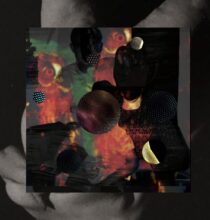
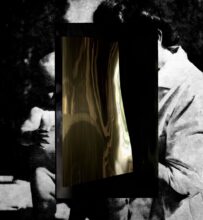
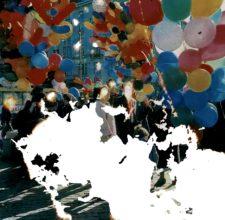
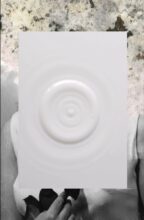
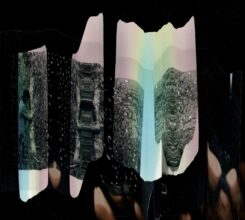
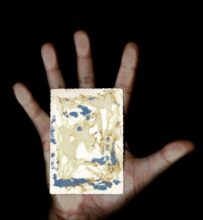
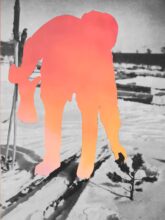
Slips and Burns is a series of experimental photographic collages by Maria Ahmed that combines both traditional photographic and digital techniques. Using images from her personal familial archive as a starting point, together with found images of her mother’s native Finland, and additional vernacular images, Ahmed’s work uses the language of photography to suggest absences, gaps and silences to blur truth and fiction. The title of the work locates its name in the history of black and white photographic darkroom printing. The terms ‘dodge’ and ‘burn’ refer to creative techniques used in the darkroom when printing black and white photographs. We see these terms then translated into Photoshop tools and together with ‘slips’, it is partially appropriated into the title of Ahmed’s work Slips and Burns, suggesting the movement between past and present. In framing the work with this title, it immediately locates the work within an historical framework of the material culture of photography.
For Ahmed the images are catalysts for new narratives, and whilst we may never get to know more about the mnemonic relationship Ahmed has with her familial images and her connection to her Finnish heritage, they are innovative in their reworking as a creative networked and expanded archive. If we understand the foundation of Ahmed’s work to be the raw archival materials through which ideas are instinctively mined, extended, and expanded, Ahmed’s images can be understood as David Bate (2023) describes them, in his accompanying essay, as rhizomic responses to the original archival material which can be accessed at multiple points. Situated memories become opaque or perhaps never existed as we are encouraged to ponder the painterly feel of the still images presented in the gallery. The moving images expand beyond conventional collage techniques, forming a part of a constructed iconoclastic archive that transcends any original use of the photographs.
Here, imaginative images spring out of the raw material, the personal meanings of which may only be accessible to an audience through oral narration; the images become a porthole through which information is revealed and concealed, and new narratives are created.
Within this exhibition, it is impossible not to be confronted by the material culture of the work on show. Careful attention has been paid to the curatorial decisions made about how to present the work both in and outside of the Photofusion gallery. Within the gallery space, the audience is not confronted by glaring white walls, instead the work sits within an air force blue palette. Within this physical setting, what could be seen as fragmented imaginative investigations feel cohesive as an experimental body of work. In addition to the work exhibited in the gallery, further works are accessible outside in public spaces as a series of weather-ready poster images. What is refreshing about this body of work, is that it has developed beyond an established convention of re-activated archives as image-inspired memory texts. The images creatively layer the present and the future to the past, thus offering innovative ways to read these archival images.
__________
Maria Ahmed: Slips & Burns was exhibited at Photofusion 17th March – 2nd June 2023.
Caroline Molloy is the programme director of Fine Art and Photography at University for the Creative Arts in Farnham, and co-editor of Photomonitor as a residency project between UCA Farnham and Photomonitor. She holds a PhD in Arts and Humanities, from Birkbeck, University of London, in the Centre for Photographic History and Theory, an MA in Photography from the Royal College of Art, an MA in Visual Anthropology from Goldsmiths University of London. Her research interests are focused on the marginalised voice in both gender and post/decolonial colonial contexts. Recent peer reviewed written publications include: (2023) ‘Identity Politics: A study of diasporic identity mediated through family photography’ in Handbook of Research on the Relationship between Autobiographical Memory and Photography. IGI Global and (2020) ‘Rethinking the photographic studio as a politicised space’, in Ashley, T., Weedon, A. (eds.) Developing a Sense of Place: Models for the Arts and Urban Planning. London: UCL.