

Reviewed by Haley Drolet
Maud Sulter (1960-2008) knew first hand what it meant to be excluded from the art world and she would spend her life fighting for inclusion of the erased. She sought not only to recentre marginalized experiences through her creative work but also to promote them in cultural institutions. In addition to being a visual artist and poet, Maud Sulter was also a talented curator who founded a gallery in London which promoted the art of Black women.
She once said, “This whole notion of the disappeared, I think, is something that runs through my work. I’m very interested in absence and presence in the way that particularly black women’s experience and black women’s contribution to culture is so often erased and marginalized.”
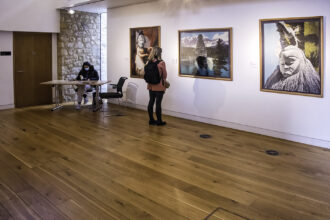
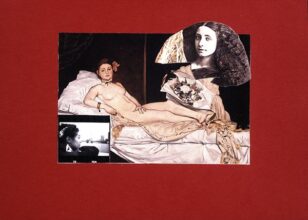
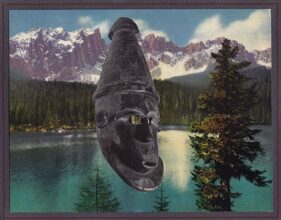
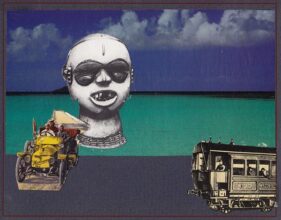
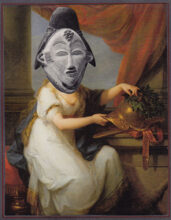
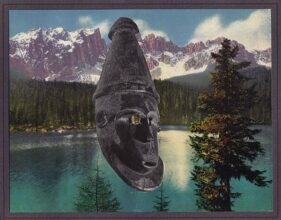
In ‘Maud Sulter: Remaking the Past’, curator Katy Barron juxtaposes selections from two of the artist’s photomontage series – ‘Jeanne Duval: A Melodrama’ (first exhibited in 2003) and ‘Syrcas’ (first exhibited in 1994). They have never been displayed simultaneously and the result is striking. Both utilize collage and each demonstrates Sulter’s commitment to recovering the disappeared. An obvious and powerful pairing.
In each series Sulter interrogates the treatment of Black bodies in European visual narratives. She reclaims – or, as the show’s title suggests, remakes – historical moments which either exploit or wholly ignore Black presence.
‘Syrcas’ drags you into the room from the doorstep. The pieces in this series are monumental and dominate the space. By fixing African artefacts onto Western paintings and idyllic postcards of the European countryside, Sulter challenged the exclusion of Black people in traditional historiography, emphasising in this particular series the way collective memory has shunned the experience of Black Germans during the Holocaust.
Having circled the room your eye finally falls on ‘Jeanne Duval: A Melodrama’. These images are small in size compared to Syrcas but the character they explore is larger than life. A Haitian actor, Jeanne Duval was historically dismissed as a white man’s muse. Baudelaire called her his “Black Venus” and she modelled for various artists including Manet and, potentially, Nadar. Sulter rescues Jeanne Duval from both the male and the white gaze, allowing her instead to stand in defiance of fetishization.
Although compact, the space dedicated to this exhibition is neither underwhelming nor overcrowded. The curator’s choice to hang the two series together instead of in the available adjoining corridors enables the visitor to compare them more readily. Barron invites a twenty-first century viewer to look again at Maud Sulter’s enduring legacy and to question the motivation behind our own cultural representations.
This is the first time Sulter’s work has appeared in Oxford. It arrives in a city still divided over its willingness to interrogate its own history. Student and community activists continue to challenge harmful representations in Oxford’s built environment; like Sulter, they seek to upend an imbalanced canon. Sulter reminds us to give voice to those excluded from this canon. She would no doubt ask us who was (and is) among the disappeared so that figures like Christopher Codrington and Cecil Rhodes can stand.
___________
Maud Sulter: Remaking the Past has been exhibited at Barn Gallery, St John’s College, Oxford (15.10.21 – 14.11.21) as part of Photo Oxford 2021 and reviewed for Photomonitor by Haley Drolet, Research Assistant for the Oxford and Empire Network.