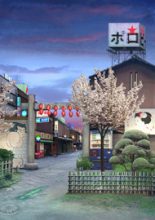


Emily Allchurch: In the Footsteps of a Master is an augmented version of an exhibition previously held at Manchester Art Gallery. The centre piece is a series of work titled Tokyo Story in which the artist revisits woodcut prints made by Utagawa Hiroshige between 1856 and 1858 titled A hundred famous views of Edo. A number of the woodcuts are displayed in glass cases in the centre of the gallery space with Allchurch’s work mounted on the walls, mainly on light boxes but also as prints. In two other gallery spaces we see work based on other artists such as Pieter Bruegel the Elder, Giovanni Battista Piranesi and Adolphe Valette.
It is hard to discuss any of Allchurch’s work without mentioning her working process. In the show there is a short video documentary that portrays her developing a series of work and also a text panel in which she talks about how she constructs her images. It is an intriguing and thoroughly modern process. The first step is a visit to the city or place where in a relatively short and intensive period of time the artist takes a lot of photographs. She is able to do this quickly due to her using digital cameras, including her mobile phone camera. The sheer volume of material and images that can be collated with more recent technologies is at times overwhelming. In less experienced hands it can be a negative aspect, as the enforced restraints imposed by the analogue process, not least due to the cost of printing work, required artists to be more discerning. Today with this huge abundance of images a much more rigorous editing process is required.
This is where the second part of the process comes in for Allchurch but interestingly rather than editing out or down the number of photographs, she embarks on a process of collaging and layering images over each other.
“I digitally collaged dozens, if not hundreds, of photographic fragments over the framework of the original image, blending the images to create a seamless new space. The tools I use to create these subtle effects – erasing and blending layers, modulating colours, contrast, perspective, focus, highlight and shadow – require a painter’s eye and skill, except that for me the traditional canvas is replaced by a computer screen.” [Allchurch taken from exhibition wall text]
In the exhibition we get the chance to see Allchurch’s creations alongside or close to the original prints or paintings. Whilst we can admire how closely the composition, light, colour and look of the works compare we can also see the changes and alterations the artist has made, updating the images to provide a contemporary perspective.
Francis Hodgson points out in his essay in the accompanying catalogue that Van Gogh was heavily influenced by Hiroshige’s work. This seems one of many connections between Allchurch’s work and Impressionism. Artists like Van Gogh were famed for their insistence of being in the landscape they were depicting to capture the atmosphere and to be immersed in the elements. Their quick working process seems redolent of Allchurch’s fieldwork where she snaps, moves and absorbs a location. However her working process then gets taken back to her contemporary studio, where the works themselves take shape. No hand touches these works, and no brush strokes are left on the surface. If this is like a contemporary form of Impressionist painting, and certainly it looks similar, then it is one that shows no sign of the author’s hand, although it is clearly shaped by the artist’s eye.
Hiroshige of course was not a painter but an artist using print making and the woodcut process. There are parallels between print making and photography in terms of how both opened up new markets and forms of distribution of artists’ work. Formally however there is a big jump between the visual impact of a Hiroshige woodcut and an Allchurch photograph. This is particularly around the sense of perspective created. Hiroshige uses a traditional and Western form of perspective, which developed during the Italian Renaissance era, in which he creates an illusion of depth in his work. Using one point perspective he blurs objects in the foreground, keeping the details in the background to lead our eye into the centre of his image. Digital photography, more than analogue, has a habit of rendering everything in high detail. All across the surface of the print, or in this case light box, every area of the image is in almost heightened detail. There is a flattening over the surface of Allchurch’s images that can create a visual cacophony across the work.
This quality to Allchurch’s work makes it so much more than simply a contemporary reconstruction of a previous master’s work. Her practice uses digital photography in a really challenging and exciting way. She creates a fundamentally contemporary new type of visual language for us. Equally her work, which really needs to be experienced first hand and in a gallery space, successfully achieves something that much photography struggles to do when exhibited, which is to demand our time to view it. With the wealth of detail and the interesting symbols across the work, we need to contemplate and absorb the work.
Allchurch’s work needs to be read carefully as there is so much story telling in each image. Everything, as with Hiroshige’s work, has a meaning, nothing is incidental. Although both artists are rooted in chronicling contemporary everyday life there is also a sense of the work offering a form of modern moral tale. One cannot look at a cherry blossom in a Japanese artwork, or a Westerner’s version of it, without thinking of the symbolism assigned to this flower. Allchurch’s contemporary updates are fascinating and revealing. We see a homeless man in the midst of a landscape, a branded neon sign instead of a woodcut printers mark, the inclusion of vending machines amongst paper lanterns. There is a strange consistency with some objects recurring between Hiroshige’s time and today, whilst other elements of the landscape have been transformed. These works become a contemporary moral fable about life in society today, which also reflects on our relationship with the past.
– review by Camilla Brown
For more information on the artist’s work visit www.emilyallchurch.com