
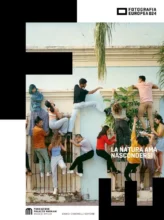
Heraclitus (enigmatic Greek philosopher, c. 500 BC) has been credited with the saying ‘nature loves to hide’. The curators’ choice of this phrase (‘la natura ama nascondersi’) as the unifying idea for the 19th Fotografia Europea Festival in Reggio Emilia earlier this year enabled the creation of a wide range of engaging cultural conversations between man, the environment, and the transformations wrought by human interaction with the planet, by an impressive group of international and geographically-local artists who expanded on this overarching theme and even brought it all the way home to Emilia Romagna. The curators of Fotografia Europea – Tim Clark, Walter Guadagnini and Luce Lebart – delivered a thought-provoking and immersive festival which can best be described as both ‘of its time’ and timeless, just like Heraclitus’ thoughts themselves. The impressions made by the works and their curation endure, and keep inspiring.
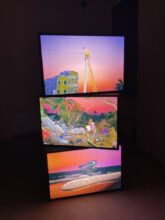
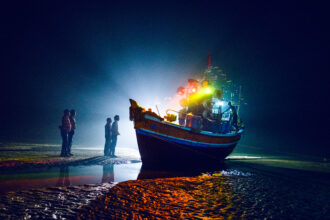
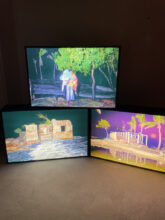
Nature has always had to adapt to the presence and interference of man; perhaps in the current alarming state of the global ecology it is somewhat comforting to think that we have been pondering this for centuries. However, the women on the beach in Arko Datto’s work ‘Where do we go when the final wave hits, Bakkali, India’ (2019) implore the audience to think and act differently, to change something in this lifetime because nature is struggling to cope with mankind, in this instance, including rising sea levels, storm activity and erosion of ecosystems threatening communities across India and Bangladesh. Part of the installation of Datto’s project ‘The Shunyo Raja Monographies’ in this curation drew the viewer close to several colourful, stacked lightbox sculptures, each presenting highly saturated tableaux of storm-ravaged coastal communities. In this festival, Datto’s works were exhibited in cool, cavernous rooms of the beautiful Chiostro di San Pietro; viewers took selfies in front of the light boxes, smiling and circling like moths attracted to the light; the curators’ inclusion of this project set the tone for considering the unfolding climate crisis and our responsibility for its creation and mitigation.
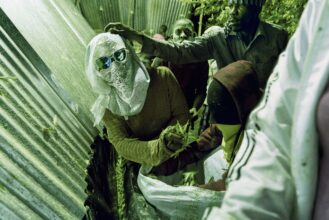
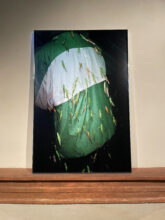
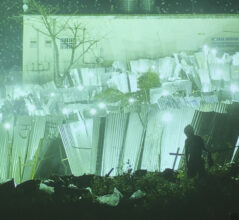
In a nearby room, Michele Sibiloni’s ‘Nsenene’ actually does involve light and swarms of insects, in still and moving image works exploring communities in Uganda who harvest grasshoppers at night, using lights to attract and trap them, to be used as an important food source. Rather than a swam of insects depicting nature going awry and damaging crops, here the focus is on man benefitting from these ubiquitous pests, in the short term; in fact, we learn in the exhibition text that the longer term outlook for these grasshopper species is also threatened by reduced and unpredictable African rainfall. The installation activated Sibiloni’s deft interplay between documentary and cinematic visual treatment, where video work and still images echoed living shades of green that saturated the space and viewers’ afterimage.
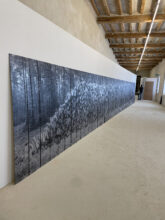
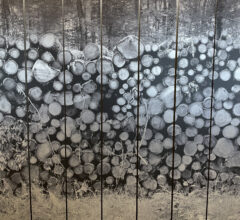
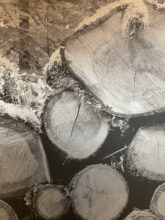
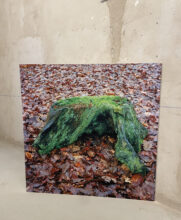
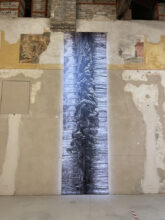
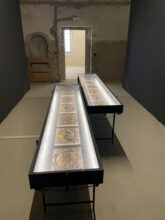
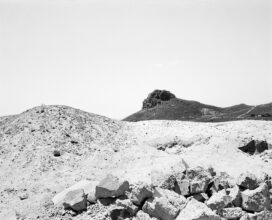
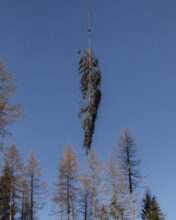
What will happen in the long term? Helen Sear’s installation ‘Within Sight’ suggests a different horizon of duration and vision, that of the forest and all that slowly grows, dies and renews itself outside of anthropocentric fixed point perspective and experience of time. In Sear’s work spaced across multiple rooms the invitation for multi-sensory enquiry included haptic contemplation of the vast 14-metre installation of more than fifty vertical images of a pile of cut trees in ‘Stack 2’, a poetic test of the limits of vision and perception as well as physical interaction with this giant photographic object.This installation cleverly interacted with nearby ‘Anatomy of a Tree’ (2024) a long photographic scroll suspended from the high ceiling of the cloister, seemingly unfolding one tree but upon closer inspection revealing secrets of its creation from more than 100 photographs taken while walking around a fallen tree in the forest, a true artifact of duration questioning the act of looking and forming a memory of this object as well as an homage to its once vertical form. Placement of these works by images of grown-over tree stumps ‘Base 2’ on floor level and waist high vitrines of ‘Phantom Amber’ tree slices introduced an element of the sublime on human scale, an appreciation of a slower timeframe and way of looking as if through forest sightlines and on the lifecycle of a tree. For me this sentiment was echoed nearby in Jo Ractliffe’s ‘Landscaping’ presenting views of nature in the longer term, where land takes back in the aftermath of destruction from extractive enterprise. Around the corner in Matteo de Mayda’s exhibition ‘There’s no calm after the storm’, a topographical investigation of changes to forest health and composition was poetically chronicled to include closeups of insect damage, studies of tree health, and documentation of those working to study and save this particular forest (in nearby Emilia Romagna), an example of the curatorial theme looking to local experience, here in reference to storm ‘Vaia’ in north-Eastern Italy in October 2018 and de Mayda’s documentary exploration. Photographic tales of landscape elude an easy reading; nature may reveal itself on a longer scale than we can appreciate in our human experience.
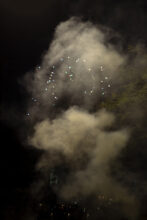
An exploration of ‘150 Years of Capturing Clouds’ saw a magnificent presentation of 200 diverse images in ‘Sky Album’, conceived and created with Archive of Modern Conflict and Fotografia Europea, taking the elusive image of clouds from early photography into the present, in a dance between the vernacular, art, science, and the unescapable shadow of atomic Anthropocene, all within the heritage cloister, itself resplendent with frescos and putti in the clouds. Elsewhere, ethereal works of Terri Weifenbach explored the interplay between cloud particles and existence – the importance of atmospheric phenomena on the basic foundations of biological life. Weifenbach has stated that ‘Cloud Physics’ is ‘about what can be measured and what cannot, what can be seen outright and what cannot be seen. It is about science and climate. It is about the intersection of reason and sensibility.’ [1]
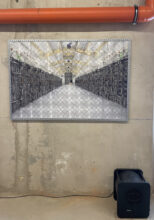
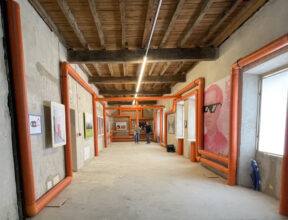
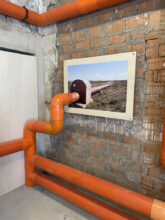
A nearby encounter with the installation of Lisa Barnard’s project ‘An Act of Faith: Bitcoin and the Speculative Bubble’ flowed along similar lines of seen and unseen. From afar, the hum of a motor permeated the air, emanating from a type of crypto-mining rig in the gallery; entering Barnard’s space the walls were alive with large orange pipes arranged around and into artworks, as if part of a giant geothermal power installation activating the space, images and sound. Barnard’s project investigating cryptocurrency and the mining of Bitcoin included still and moving images created in Tokyo and Iceland, highlighting the natural resources engaged in the creation of, as well as the precarity and illusory appeal of this high-risk speculative asset. Here the unexpectedly three dimensional and multi-sensory physical curation added an unforgettable dimension to this important photographic project.
Elsewhere in the curated festival exhibitions, installations of projects by Yvonne Venegas, Natalya Saprunova, Bruno Serralongue, Marta Bogdańska and Karim El-Maktafi shared further ideas on the delicate balance between man and nature, sometimes with reclamation, sometimes subjugation, or mapping the history of communities on our changing planet, for example. In the Palazzo Magnani, an immersive exhibition of works from Susan Meiselas’ long career ‘Mediations’ highlighted her working practice engaging with subjects on a personal and geopolitical level, and in this curatorial iteration, in collaboration with Magnum Photos, Meiselas’ ongoing ‘storymap’ created by contributors from the global Kurdish diaspora continues the experience into the present. Further afield in the Collezione Maramotti compound, Silvia Rosi’s commissioned series ‘Disintegrata’ presented a multilayered view of Afro-Italian community, told with collaborative archival dialogues on identity in contemporary Italy and centred around local Emilia Romagna, in this first solo show for the artist in an Italian art institution.
Alongside the more literal interpretation of Heraclitus’ famous enigmatic phrase, ‘nature loves to hide’ can also be interpreted to mean that life’s profound truths, much like the secrets that nature holds, may not be immediately evident but may unfold over time. Attending the festival and later reading the extensive exhibition catalogue continues this idea, building a past-present-future continuum memory of this festival, punctuated by the experience of seeing the works in person. The curators of FE have delivered many memorable and unexpectedly physical encounters with photography in this festival, sometimes playing beyond the traditional binocular vision on flat surfaces. Discussed here are only a part of the exhibitions programmed in this year’s festival. The catalogue included many voices in its expository texts, alongside large image reproductions, to make a publication that will continue to engage over time. These facets underscore the depth of resources and curatorial support that has been brought to these projects at FE, a feeling brought home after speaking with Helen Sear about her experience of being part of this year’s festival:
“Making the exhibition ‘Within Sight’ for Fotografia Europea has been the highlight of my year so far for several reasons. Firstly, the overarching theme ‘Nature Loves to Hide’ was a dream, and not having a fixed ‘project’ at the start enabled really enjoyable conversations with curator Tim Clark. The final works selected were from different times and locations and brought together with the architecture of the spaces at the forefront of the decision-making process. The on-site team Francesco Colombelli and Francesca Tagliavini steered the design and fabrication seamlessly.
I encountered the physical presence of the 14-metre-long ‘Stack 2’ for the first time, made to measure for the long corridor in the Chiostro di San Pietro, having been confined to data for the last 10 years, a reminder that without support and good curatorial advice some works would never be made.”[2]
Fotografia Europea’s curation, selection of projects and written texts have elevated the combined understanding of these artists’ themes surrounding nature, environment and human existence to an impactful experience that is both entirely personal and shared with the thousands of other festival attendees. Nature loves to hide, and she is now resident in collective photographic memory.
__________
[1] Terri Weifenbach, ‘Cloud Physics’, by Mike Slack. Fotografia Europea 2024 Catalogue, Dario Cimorelli Editore, p. 130.
[2] Author’s email correspondence with Helen Sear, July 2024.
Fotografia Europea 2024 ‘La Natura Ama Nascondersi’ was presented in Reggio Emilia, Italy (26.04 – 09.06.24) and its exhibitions and events were attended by more than 75,700 visitors.
Christiane Monarchi is the founding editor of Photomonitor, which has published more than 1,400 features since 2011. In 2020 she co-founded Hapax Magazine, a bi-annual print publication commissioning new photographic ideas. She mentors artists, writes for other art publications, serves on boards of not-for-profit art institutions and charities and regularly reviews artists’ portfolios, including taking part in Fotografia Europea’s portfolio reviews in 2024.