
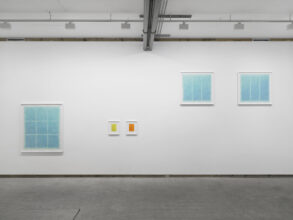
At first glance, the title of Anna Barriball’s recent exhibition at Frith Street Gallery might seem surprising. The works resemble photographic images with painterly qualities rather than drawings, however they form part of the artist’s ongoing engagement with mark-making on paper, following her previous rubbings of windows, fireplaces, walls and other thresholds or in between places. In ‘New Drawings’, windows are not rubbed, but their image appears to materialise more independently from the direct effect of light on light-sensitive surfaces. The colours also lead these images to resemble sugar paper which has faded in the light, only retaining the original colour where the paper has been obscured. These works are like early cyanotypes or photograms, reminding us that the etymological origin of the word photography is ‘drawing with light’. The images seem to have been ‘impressed by Nature’s hand’, to quote William Henry Fox Talbot’s description in The Pencil of Nature of his own early photographs. In fact, the works on display are very much the product of Barriball’s own hand. In a complex process, the artist begins by dusting rectangles of paper with coloured pastel, carefully ensuring that the whole surface is evenly covered or creating a gradation of colour. Very hot wax is applied, which permeates the paper, rendering it and its soft colour semi-translucent. The resulting works are both flat drawings and thinly-layered, sculptural objects.
These large-scale drawings are based on windows in Barriball’s south London studio building, and are to scale, granting them a level of realness or literalness which offsets their handmade, creative qualities. At the same time, the magicality of the photographic-like process transforms these fixtures into subjects worthy of our prolonged consideration. As windows, their usual function is hindered by the opacity of the paper and of the colour; we cannot see through them. Nor can light pass through them, however the wax causes them to emanate light which reflects off the soft surface, and their colour is blue, like the sky beyond. This tension between open and closed or inward-looking spaces threads through the show, subtly underpinning the range of inter-related images resulting from similar but slightly different techniques.
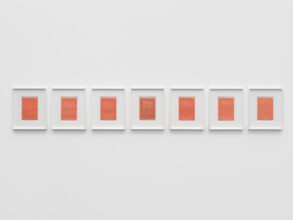
Barriball describes the small-scale works as ‘handheld drawings’ akin to Polaroid images that gradually develop in one’s hands, highlighting their tactile and intimate quality. In the rose-coloured series Afterimage (2021), the sun appears to project through a window an image of flickering leaves on a wall. The central image in the series of seven is the strongest. The leaves are just there, while they are less clearly recognisable in the other images, as the light gradually intensifies and fades. The artist’s finger or thumbprint can be seen at the top of each image, reminding the viewer of the handmade process from which the images derive.
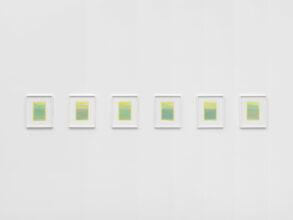
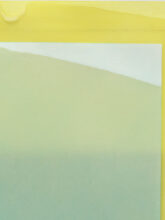
In Afterimage the artist layered a drawing in graphite powder beneath a sheet of paper which had been dusted with ground down pastel and then dipped into hot wax. A slightly different method evolved for the series Seascape I-VI (2022-23) in which an even block of graphite powder forms a horizon beneath two layers of yellow and blue wax-dipped, pastel-dusted paper. The original paper can be seen at the top edge of the blue sheet, recalling the way in which the edges are often visible of the light-sensitive emulsion which was painted onto paper to produce early photographs.
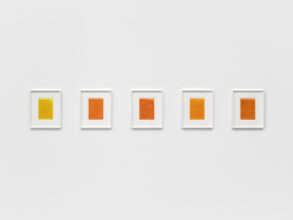
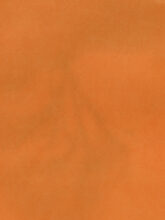
These and the series of five works, Amber (tree shadow) I-V (2023), are suggestive of duration with each image akin to a film still. In tandem is the silent digital video, of just under ten minutes, The sun (Rosa’s room) (2024), the starting point for which was the play of shadows on the wall of Barriball’s daughter’s room, whereas Afterimage derived from images on the wall of the artist’s childhood bedroom. The colours of these two works are related too, with the peachy rose of Afterimage a lighter version of the deeper tone of The sun (Rosa’s room). The room of each work becomes a camera obscura, in which intangible images are captured and preserved on film. In the video, the light flickers as the shadows of trees projected onto the wall are akin to memories fading in and out. The window acts like a lens, while the wall enables the fragile images to be held and seen. The memories are unstable, like the wax which, at the same time, preserves the images, just as amber preserves insects and plant forms over millennia. The video was filmed in black and white before colour was added.
Colour is a significant component of the exhibition as it is throughout Barriball’s practice. Bright, light, but rich and soft at the same time, the colours seem both natural and artificial. Perfectly co-ordinated across the gallery space, they draws the works together making the exhibition into a coherent whole into which the viewer enters. The window works are hung at the same height as those in the studio building on which they are based, their literalness thereby reiterated. As in previous shows, the concrete of Frith Street Gallery’s Golden Square interior complements the images of nature and the artificial undertones of the colours. Within this space, the viewer feels compelled to slow down and tune into the artist’s sensitive studies of the world around her.
I was reminded of the recent Wim Wenders film, Perfect Days (2023), in which the main character is similarly attentive to often overlooked details in the world around us, like the transient play of light and shadow through trees which he photographs daily. Each image he produces is similar but subtly different.
__________
Anna Barriball: New Drawings was exhibited from 2nd February to 14 March, 2024 at Frith Street Gallery, London. Reviewed for Photomonitor by Dr Deborah Schultz.
Deborah Schultz is a Senior Lecturer in Art History at Regent’s University London. Her research focuses on historiography, photography, and the representation of memory in twentieth-century and contemporary art. She is currently completing an edited volume with Geraldine Johnson on Photo Archives and the Place of Photography, to be published by Routledge in 2024. She is also co-edited a volume with Andrew Chesher on Changing the Décor: Essays on the Late Marcel Broodthaers. Deborah has published widely and is a regular contributor to Art Monthly and other contemporary art journals.