A North Eastern Wonderland
Sunderland has a grand Victorian museum that brings together all sorts of cultural delights for visitors to explore under one roof including a small gallery space that provides walls for contemporary exhibitions. Photography leads me everywhere; up the stairs past Anglo Saxon relics and through modern corridors that lead readers to books in the library and coffee-seekers to a café to sup with a view of the tropical winter garden.
Observe, Experiment, Archive are big words that boldly declare the curatorial intention of the exhibition and the style of practice that was chosen to hang together. Arranging a group show can be a little like arranging a group portrait. Making sure that everything can be seen equally and that the overall grouping is appealing for the expected viewer. There are eight artists in this exhibition whose various projects deserve more space to breathe and more freedom from curatorial expression than a group show can offer – but from a visitor perspective it is a pleasure to find so much in one place. This show provides an enticing smorgasbord of the breadth of contemporary photographic practice, it opens dialogues between approaches and aesthetics by making immediate comparison and the choosing of favourites easier.
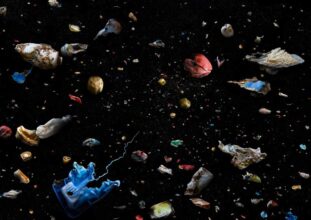
A mathematician friend who visited the show with me was drawn to SOUP – the work of Mandy Barker – whose fascinating, controlled images reveal the horror and reality of plastic pollution firstly as engaging patterns from a distance and secondly on closer inspection tiny objects are revealed and isolated on a bed of blackness. Each object is forensically presented and arranged precisely to form a bleak yet beautiful picture of the pickings from ocean depths and scatter paths of littoral zones across the world. The work insists that the viewer engages with a reality and knits together a conceptual approach to documenting this serious and topical issue. Quite uniquely.
The gallery is crammed with photographic work that looks closely to inspect something. The work of Sophie Ingleby portrays the triangle of human fertility treatment as scientist, Mother and cell cluster. Helen McGhie indexes the kit of the wandering stargazer in Northumberland’s Kielder forest for fascinated viewers to see the stuff carried by the nighthawk obsessive. And Robert Zhao Renhui employs the language of museum cataloguing to isolate objects and encourage thoughts into narratives. Penelope Umbrico captures the zeitgeist with ‘Everyone’s Moon’ and flicks moon-image after moon-image at each passing viewer to encourage contemplation of high speed searching and common picture searches on the internet. Tessa Bunney combines a variety of documentary techniques from portrait to object to tell a story of flower pickers and picked flowers. Elsewhere in the gallery scientific fact is presented conceptually. In Sire Maria McKinney shows Stubbs-like cows on huge prints that dominate the gallery and are accompanied by twisted sculptures made of multicoloured insemination straws that adorn the cattle in the photographs and are evidenced in the gallery; reverberating the impact of scale and the size of the beast.
Overall, the viewer has to believe in each artist’s ability to present fact and utilise science for the purpose of viewing these observations through photographs; here words are essential and captions importantly add useful information to all of these projects.
Perhaps my favourite work is by Liza Dracup who returns my thoughts to aesthetics and photographic process. The fundamentals of photography (perspective, colour, lighting, composition) and the process of looking are challenged and the viewer is encouraged to dwell and question what is seen. I stand back and lose myself in photography’s ability to share colour and reveal form by the way she teases the viewer.
This exhibition is a rich and rewarding journey into the practice of eight contemporary photographers who have been wonderful specimens to examine and deserve more than these few words.
– reviewed for Photomonitor by Helen James
__________
Image: SOUP Burnt, 2011, Mandy Barker