Reviewed for Photomonitor by Anneka French
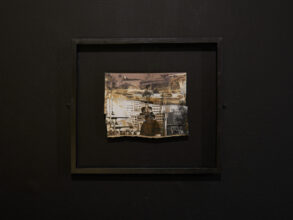
Cradled in the blacked-out gallery space of Grand Union are a series of silver gelatin prints, digital prints and digitised Super8mm films. The works, by New York-born Phyllis Christopher, are concerned with the beauty and the power of queer lesbian sexuality, love and expression, with each intricately connected to Christopher’s autobiographical experiences in San Francisco from 1988-2007.
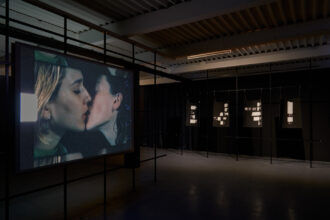
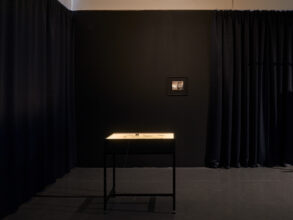
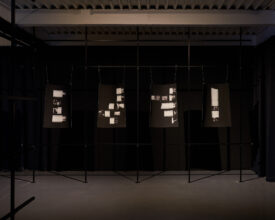
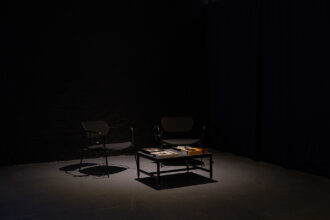
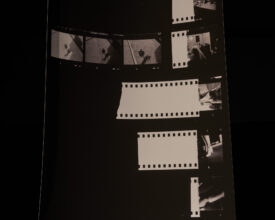
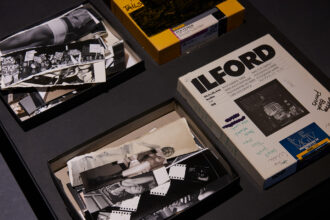
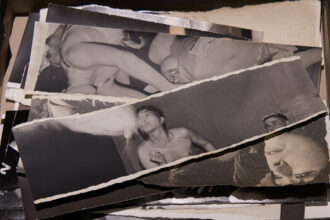
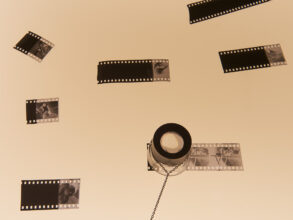
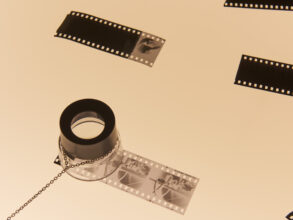
The exhibition’s design mimics a photographic dark room – a space of safety and seclusion, of freedom, concealing and revealing. It is also a space of making, of making a stand and therefore of occupying space. The breadth of Christopher’s subjects and the differing modes of display used here ask questions not only of what is public and what is private but also of consumption, value, access and process. The Super8 films Skin (1988-90) and Kiss-In (1990), showing bodily close-ups and tender kisses between two women respectively, for instance, are shown here for the first time and projected on a large double-sided screen. These are placed alongside Heads and Tails (1994-2003), enlarged black and white proofs assembling the domestic, the technical and the personal in new configurations. Seats at a low table containing small boxes of ripped prints of protest and portrait invite intimate, gentle rifling, with more thorough examination via a lightbox and magnifying lens nearby. Both make implicit reference to the physical contact called into question by the Covid-19 pandemic.
In audio that accompanies the exhibition, Christopher, who was photo editor of lesbian erotica magazine On Our Backs from 1991-94, offers reflections on the making of the images. Personal photographs top and tail many of the film rolls Christopher used in commercial shoots in the 1980s and 1990s. These bookending images experiment with subject and style and co-exist with those driven, for instance, by the magazine’s visual and political content. “A photoshoot in those days was a 24-hour ordeal” Christopher noted in a recent interview. “It was much slower and more thoughtful than you can be with digital … [and] the reason I shot in black and white was partially … [because] I wouldn’t have to send it to a lab, which might object to something. I had total control.”
Analogue film holds ‘traces of life’ in a way that the digital cannot. Christopher, who is now based in Gateshead, comments in the audio that these photographs ‘appear now as mysterious clues’; to her own personal history, yes, but also to the close communities and individual lives of queer people during the height of the AIDS crisis. We might also say the same for this retrospective. It coincides with another solo exhibition, Contacts, at BALTIC that further expands visibility of Christopher’s documentary and more overtly political work and an expansive monograph, Dark Room: San Francisco Sex and Protest, 1988-2003 published by Book Works in 2022 that follows the same themes. These projects offer significant records. Sometimes the photographs are fleeting and ordinary but more often they are sensual, electric and steadfastly solid portrayals of the lives that Christopher and her friends, lovers and contemporaries have lived and continue to live today.
__________
Phyllis Christopher / Heads and Tails continues until 4 March, 2022 at Grand Union, Birmingham.
With thanks to Anneka French for this review.