

Reviewed for Photomonitor by Bronwen Colquhoun
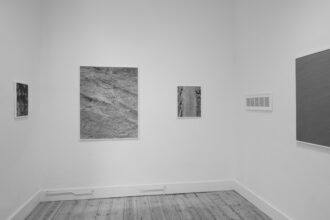
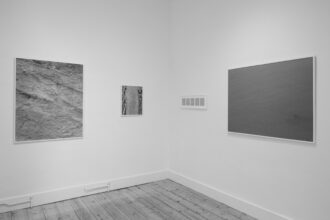
Sam Laughlin’s latest exhibition, Ripples in the Surface of Things, is a meditation on nature, time, relationships, and the states of consciousness that underpin our understanding (or lack thereof) of our everyday surroundings. Presented in Serchia Gallery’s unique, semi-domestic space, the exhibition presents Laughlin’s recent works, some of which are being shown for the first time.
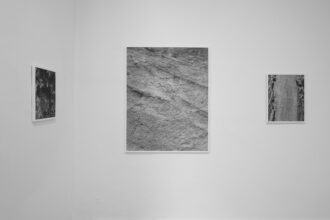
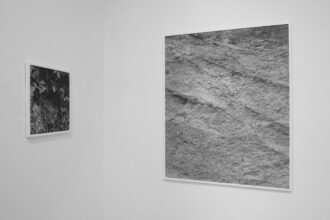
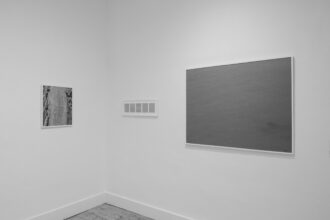
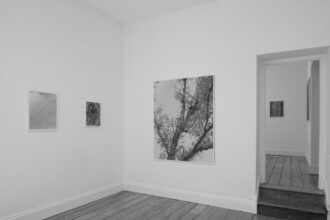
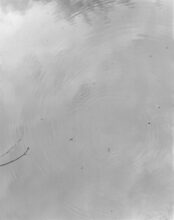
Spread across two rooms, the works vary in scale and composition. Individual large-format photographs are interspersed with sequences of smaller images to create both a fluidity and changeability that encourages the viewer to spend time with each work, to look closely, and to contemplate exactly what it is we are seeing.
Laughlin’s work is inspired by the natural world itself and writings on it. He cites Annie Dillard’s Pilgrim at Tinker Creek as formative in first developing his mindset and, consequently, his approach to making work. Walking plays a huge part in this process; sometimes to experience chance encounters, and sometimes to encounter known subjects. In some instances, this leads to the creation of a single image. In others it generates a sequence of images over a sustained period.
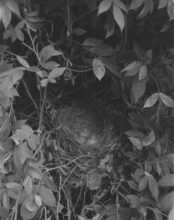
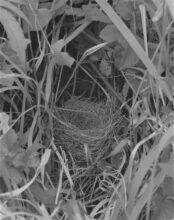
The son of a zoologist, Laughlin began his implicit relationship with the natural world as a child. He was given field guides by his father which resulted in hours spent in the garden looking for insects. His fascination with birds began later and Laughlin describes himself as ‘obsessed’ with birdwatching. This is particularly evident in the works presented in the exhibition, the majority of which focus on birds. What is not evident at first glance is the level of knowledge and expertise Laughlin has developed over a prolonged period to facilitate the creation of this work. His innate understanding of and sensitivity to different species, their environments, their movements, their life cycles, is at the heart of his images. It is this subtlety that makes the work so powerful.
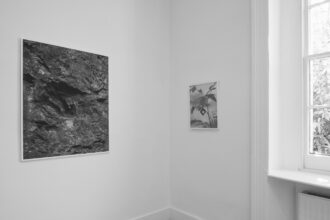
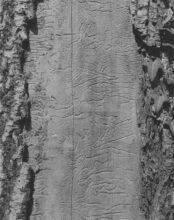
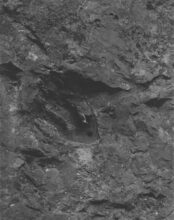
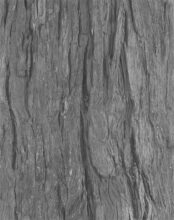
For example, ‘Nuthatch at Nest (Sitta Europaea)’ is a striking image that depicts the complex relationship between animals and their environment. Traditionally nesting in trees, the nuthatch that Laughlin observes and captures is adapting to its surrounding habitat of the rockface. Similarly, ‘Borer Beetle Larvae (Oak)’ beautifully captures the traces of a complete life cycle, from the point at which a Borer beetle burrows into the bark of an oak tree, to the patterns created as the larvae hatches and feeds on the wood.
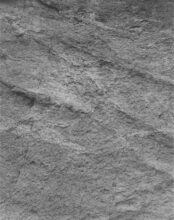
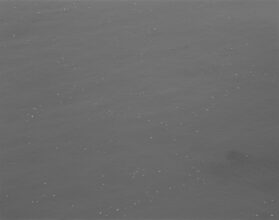
The knowledge embedded within each work is further emphasised by its presentation. Scale is carefully considered in relation to subject matter. For example, ‘Mining Bee Colony (Colletes)’ appears large format, the focus being the tiny holes burrowed on the surface of the soft stone. Laughlin draws attention to the movements and patterns created by the bees, generating an abstract image decontextualised from its wider surroundings. I later learnt that the bees burrow on a particular kind of stone which Laughlin had located in Dorset.
What is evident when speaking to Laughlin is his curiosity and desire to learn more about the natural environment on our own doorstep. His images make visible what is largely unseen and embody subtle markers of time. Furthermore, his gentle approach to looking, and his generosity in encouraging us to do the same, creates a unique sensation which is both revelatory and melancholic in equal measure; a feeling of having had our eyes opened.
Adam Nicholson’s poetic reflection on Laughlin’s work, from which the exhibition title derives, emphasises nature’s cyclical character and its partial invisibility. Describing traces of animal activity as ‘an invitation to look for what we cannot see’ encapsulates the act of experiencing Laughlin’s photographs. Within this gentle act lies a subtle message to slow down, observe, and reflect.
__________
Sam Laughlin‘s artistic practice is concerned with a variety of forms and processes both natural and man-made. Much of his recent work is characterised by its slowness, focussing on natural processes, eco-systems and animal behaviour. Laughlin has exhibited widely both in the UK and internationally, including at the Brighton Photo Fringe where he received the Danny Wilson Memorial Award, and more recently at Jerwood Space and Impressions Gallery. In 2017 he was awarded the Jerwood/Photoworks award. He works mainly on personal work, which sometimes takes the form of commissions, most recently for John Hansard Gallery, Towner Gallery and GRAIN Projects.
Dr. Bronwen Colquhoun is Senior Curator of Photography at Amgueddfa Cymru – National Museum Wales. She curates the exhibition programme for the Museum’s permanent photography gallery as well as contributing to temporary exhibition programmes. She previously worked as Assistant Curator of Photographs at the Victoria and Albert Museum and holds a PhD from Newcastle University. At Amgueddfa Cymru Bronwen has curated photography exhibitions including Swaps: Photographs from the David Hurn Collection, Women in Focus, ARTIST ROOMS: August Sander, Bernd and Hilla Becher: Industrial Visions and Martin Parr in Wales.
Ripples in the Surface of Things: Recent Works on Nature by Sam Laughlin was exhibited recently at Serchia Gallery, Bristol.