Reviewed by Mitchell Moreno
2021 marks a grim anniversary. Forty years ago medics in the United States began to identify clusters of gay men suffering from severe and sometimes fatal immunodeficiency – the first reported cases of what would soon become known as AIDS.
From the outset, one of the defining clinical conditions of the AIDS epidemic was Kaposi’s sarcoma – a form of cancer characterised by purple lesions on the limbs, face and torso.
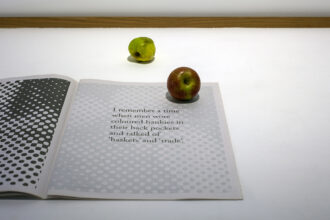
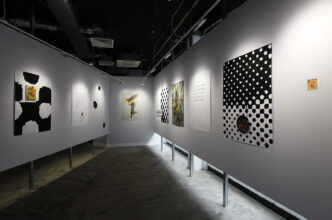
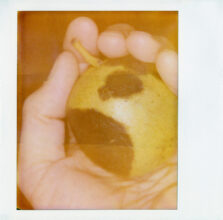
In The Spots That Never Went, Roelof Bakker takes these lesions as the starting point for a deeply personal and poetic meditation on loss, memory, and the lived experience of HIV and AIDS. In its first iteration the project was an artist’s book in which an image of a spotted, rotting apple held in a hand is transformed into a series of abstracted halftone patterns. Opposite these patterns, on each double-page-spread, sit short fragments of text, narrating a journey from a heyday out on the ’80’s London gay scene (“I remember a time of coloured lights, naked flesh and thick clouds of cigarette smoke”) through to the unfolding devastation of the AIDS crisis (“I remember a time when I was young and other young men got ill and soon after they died”).
The book takes the form of a tabloid newspaper, reclaiming and queering a medium conspicuously used as a vehicle for homophobic hatred and alarmism throughout the first decade of the crisis. Bakker’s magnified halftone creates effects of obfuscation and disorientation, of having to try to piece together a whole from fragments. Here, as throughout the exhibition, form is dynamically put to the service of concept. By way of a coda, a pocket at the back of the tabloid houses a single broadsheet which, unfolded, yields up the entire legible image of the cupped apple.
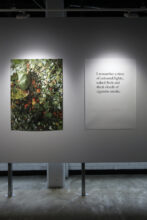
Had Bakker pinned the pages of his book onto the gallery walls and stopped there it would have been work worth seeing. But he has gone beyond that, expanding his visual enquiries and references to create a nuanced mise-en-scène. The halftone forms are a recurrent leitmotif. When enlarged in black and white, or stuck to the walls as digitally fuzzy perspex sculptures, they suggest the binaries of (HIV-) positive and negative, of presence and absence, of life and death. When rendered very finely in colour, and viewed right up close, they echo medical photomicrography.
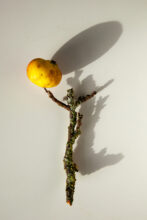
The apple is another recurring theme – a symbol of prelapsarian innocence and utopia, now fallen and turned bad. For the artist the fruit also acts as a proxy for his English lovers, as in “Some Are Here And Some Are Missing”, where apples lay on top of a copy of Van Gogh’s “Sunflowers” – symbolising Bakker’s Dutch body. Susan Sontag argues that “All photographs are memento mori. To take a photograph is to participate in another person’s […] mortality, vulnerability, mutability.” Nowhere is this truer than when looking at photographs of those who died young. It would be emotive and perhaps an easy reach for Bakker to draw on the archive for this project; to show us a photograph of a now-dead lover in his arms, instead of an apple on a sunflower. But his process consistently resists the expositional and instead strives for metonymy, analogy and metaphor.
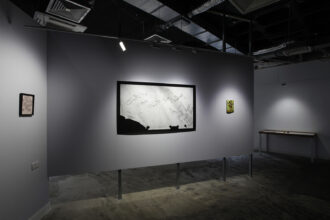
The largest image in the exhibition is a scan of a love note to Bakker from his boyfriend, A., who subsequently died of an AIDS-related illness. The page has been torn out of a Filofax, and is time stamped 1985.
Either side of the scanned note are two works based on Van Gogh’s “Sunflowers”. In one, the artist has cut out the centres of the flowers, leaving circular holes. In the other he has used these centres to create a lumen print, reinstating the ‘holes’ as shadowy ‘wholes’ which may recall lesions, apples, microscopic pathogens, or even the flashing lights of an ’80’s gay disco. This is a show that benefits from deep looking; time spent with the images reveals a web of intertextuality and layering of ideas.
Van Gogh intended to use his sunflower paintings as the left and right flanks to a portrait of Augustine Roulin. In this exhibition, Bakker has hung his reworked sunflowers so as to create his own loose triptych, referencing not only Van Gogh but also traditions of Christian devotional art and three-part Buddhist shrines. At its centre is A.’s love note. Enlarged far beyond its familiar scale, a fine dotted halftone-like pattern emerges on the paper – the invisible rendered visible. The page is photographed against a black background. Printed digitally using commercial vegetable inks – in common with most of the works in this exhibition – the black is voluptuous in its depth and matteness. Yet in places it is scratched – presumably from ordinary transit and handling – and the thin paper stock is lightly creased. These are artefacts which, like our own fragile bodies, are not made to last long.
There is no national AIDS memorial in the UK. We must remember our own dead, process our own grief, and share our own histories – both personal and collective. The Spots That Never Went is a moving and eloquent contribution to this imperative.
_______
Mitchell Moreno is an artist from Leicester, UK. Their work explores the queer gaze, the construction of gender, and creative practice as therapy.
For further viewing: Roelof Bakker: The Spots That Never Went is exhibited at Photofusion, London (21.10.21 – 3.12.21)
Roelof Bakker’s website: rbakker.com