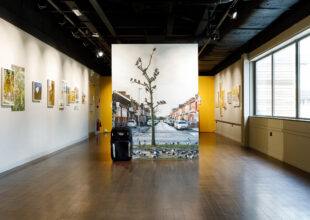
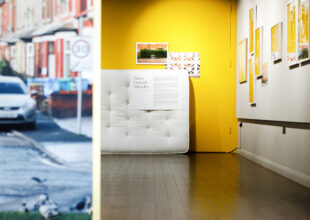
An unattended suitcase stands proud in the centre of the Lauriston Gallery, watched over by a flock of pigeons in Roxana Allison’s Longsight streetscape. This unlikely installation is the first hook of Hope, Despair, Miracles, an exhibition celebrating life’s little wins, in the face of ostensible hopelessness.
This is the culmination of a five-year project by Roxana Allison exploring her adopted home, and the communities that make it, in the north-west of England. Though born in Manchester, Allison was raised in Mexico, only returning to the UK in 2008. Hope, Despair, Miracles is an attempt to make sense of contemporary Britain, its complex sociocultural make up, its raw, and sometimes ugly features, and its enduring communities.
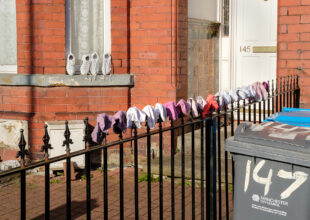
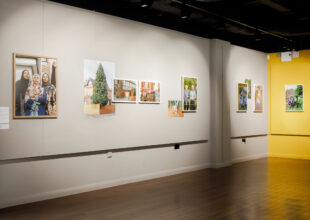
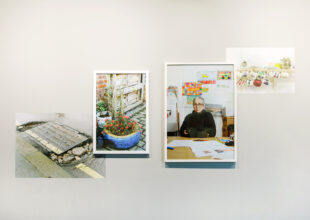
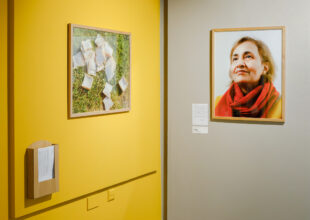
The exhibition is comprised of a series of portraits, street scenes, and still lives, which collectively craft a multi-layered visual illustration of Longsight, an area three miles south-east of central Manchester. Presented in different formats, with images of pavements and pathways pasted onto walls, and framed works overlaid, there is a sophisticated visual coherence to the exhibition. Neutral walls are disrupted with dandelion yellow interludes, and the semi-sculptural suitcase is joined to the rear of the gallery with a similarly discarded, lightly-stained mattress, from which a text panel is suspended.
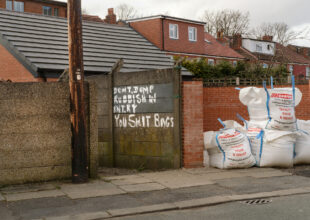
The project comes from a refreshing standpoint. This is not a marketing campaign for resilient Northern communities with halcyon images of residents at play and inspirational words peppered throughout. Rather, we can sense Allison’s frustration with her home town. Images of fly-tipped rubbish, grey skies, and irate notices on parked cars and walls all attest to underlying dissatisfaction, yet there is a quiet sunshine here too.
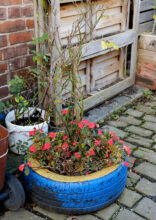
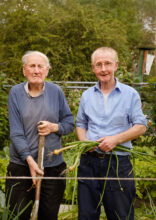
Made against the backdrop of Covid-19, in a post-Brexit Britain, under the shadow of wider international and economic unease, Allison finds light within her community. These moments of joy come in various forms, a display board packed with colourful drawings at the TLC Art Drop-in Project, striking red flowers growing from a painted tyre, recycled as a planter, and onions freshly dug from the community vegetable patch on Clitheroe Road.
Longsight is one of the most diverse areas in the UK, with 77% of residents identifying in the 2021 census as being from non-white backgrounds [1], and 48% of residents born outside of the UK. In getting to know her community, the artist identified cross-cultural traits and values, including the importance of food and celebration, and the inherent inclusivity found within a tendency towards collective thought and action.
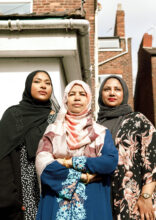
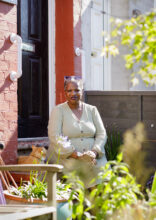
It is this spirit which underpins the entire body of work. Through a series of captivating portraits, Allison introduces us to pivotal people within the Longsight community. Nasima Begum, Shireen Sobhani and Safina Islam, who provide support for survivors of domestic abuse with Manchester Bangladeshi Women’s Organisation, hold our gaze in their Portrait of Britain prize-winning image; Pauline Omoboye, of New Longsight Housing Cooperative, is photographed at her front door, her agapanthus-purple glasses matching the flowers outside her doorway; meanwhile Mohammad Khairuzzaman, founder of Work for Smile, an organisation providing advice for refugees and community foodbanks, is pictured beside stacked donations. These are just a few of the individuals highlighted by Allison, the artist has worked with a broad spectrum of residents, turned organisers, who are driven to rectify inequality, ensuring that their community has access to basic needs of food, shelter and safety from violence.
There is a sense of authenticity, trust and collaboration throughout the exhibition. Participants’ voices can be heard, with reproductions of handwritten notes appearing alongside several portraits, and an accompanying newspaper publication, with text in both English and Urdu. Escaping the contemporary convention of flat portraiture, Allison has created a thoughtfully authored photographic series, placing participants centre stage, whilst alluding to more broadly-recognisable societal concerns replicated in towns and cities across modern Britain.
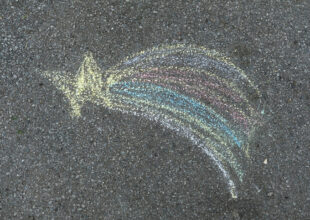
Like a shooting star chalked onto a pot-holed pavement, Roxana Allison reminds us to look beyond surface struggles and preconceived conclusions. Ultimately, the work attests to the miracle of human spirit and collective action, demonstrating the moments of brightness that can still be found, if you look close enough, in the most unlikely of places.
__________
[1] Of this percentage, 54% of census respondents identified as Asian, Asian British or Asian Welsh, 14.9% as Black, Black British, Black Welsh, Caribbean or African, and 8% as mixed, multiple or other ethnic groups. Source: Census 2021, Office for National Statistics, ons.gov.uk
__________
Hope, Despair, Miracles was on show at the Lauriston Gallery at Waterside Arts, Sale, between 27 January and 13 April 2024. The project and its accompanying publication are available to view on the artist’s website www.roxanaallison.co.uk
Reviewed for Photomonitor by Angela Sheard, a creative project producer and writer. Between 2018 and 2021, she was Associate Curator at Impressions Gallery, one of the UK’s leading venues for photography, and currently assists in the delivery of the creative programme at Chatsworth, including working with contemporary artists to respond to Chatsworth’s history and collection. With a passion for good storytelling, Angela pursues projects which have a social focus, encouraging new perspectives, and rethinking historic spaces, knowledge bases and their legacies.