
Reviewed by Simon Bowcock for Photomonitor
Presented across two separate locations, this rich selection of work in multiple media by five female artists has much to say about art, society and culture, both past and present. Two broad themes manifest: mystery and erasure.
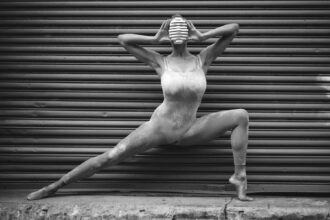
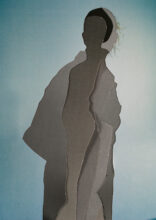
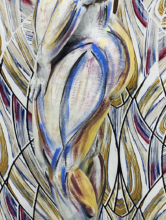
First, the mystery. Pinar Yolaçan’s painted photographs could be a softer, more feminine 21st Century update of Futurism or Vorticism. They depict a female figure barely discernible from the world around her, conveying a sense of wider connectedness and whispering about the timeless spiritual mysteries of her relationship with the universe. A traditional spirituality also imbues Delphine Diallo’s portraits, which suggest mysterious transformations: in one, via body paint, (a) woman becomes the cosmos, absorbing planets, stars and moons which both obscure and reveal her.
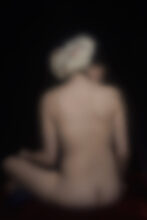
By contrast, the mystery in Céline Bodin’s defocused portraits-from-behind is firmly grounded in the subjects themselves, whom we glimpse rather than see. Suffused with the history of painting, these small but complex photographs have a spectral quality at least as alluring as Richard Learoyd’s hyper-large-format portraits, and all the painterly mystery of Gerhard Richter’s famous photorealist rendering of his daughter turning away from him. Even in an image reminiscent of Ingres’s Odalisque lying on her side, Bodin’s sublime lack of clarity evokes fascination rather than exploitation, upending outmoded notions of the male gaze.
Such subversion is also evident in Drape, where Eva Stenram takes old found portraits – which might once have been called (to use outdated terminology) ‘girly pictures’ – and deftly amends them to ‘protect the modesty’ of their subjects. This certainly says much about changing attitudes to the portrayal/ objectification of women: what used to be considered ‘a bit of harmless fun’ is now taboo. Perhaps ironically rather than deliberately, however, the newly ‘cleaned-up’ images aren’t necessarily less titillating than the unseen originals, because covering up can add to the sexualised mystery. It is no accident that in Oscar Wilde’s play Salome “dances the dance of the seven veils”. The young doctor in Salman Rushdie’s The Perforated Sheet is filled with desire for his patient because (and not despite the fact) he can only see her bit by bit. Less is often more – just ask my Uncle Ray.
Compare this with Parts, where Stenram takes similar found ‘pin-up’ photographs and skilfully obliterates the ‘saucy’ subject save for a single stockinged leg. Despite resembling a lingerie mannequin, each newly dismembered limb has an air of the prosthetic. Unlike the residual captivating mystery of Drape, the surgical erasure in Parts leaves no lingering eroticism. And just as the surreal sexualized horror of Hans Bellmer’s Doll series was in tune with the creeping menace of the 1930s, Stenram’s desexualised limbs have a macabre sterility which chimes perfectly with our oppressively medicalised times.
The erasure in Sarah Eyre’s collages and GIFs is even more comprehensive. While the female form is always discernible, it is at the same time almost entirely obscured by the artist’s adroit interventions. She’s there but she isn’t. Covered up and masked over, Eyre leaves us with only the faintest trace of the photographed women, supplanting them with inventive and beguiling composite images which simultaneously serve as tabulae rasae for us to try (in vain) to reconstruct the originals.
Now you see her, now you don’t.
Thinking outside the gallery walls, such erasures have indirect correspondences in the wider sociocultural world, such as the partial or complete expurgation of women from marketing images in some societies, a phenomenon which has itself become the subject material or inspiration for other artist-photographers. Parallels can also be drawn with new inclusive linguistic trends, where we increasingly see the word ‘woman’ and traditional female gender pronouns (literally) disappearing from contemporary and even altered historical speech. While the worldviews, motivations and intentions in each of these contexts may be very different, the outcomes can have a singular similarity: she appears to vanish.
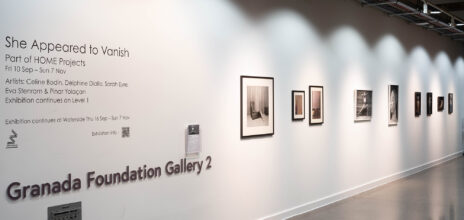
Even ignoring these tangential questions, She Appeared to Vanish succeeds on its own terms, with its thoughtful curation of some top-drawer work provoking deeper thinking about female representation and advancing the associated art-historical discourse. The fact the show is germane to the broader social and cultural Zeitgeist only elevates its importance.
__________
10th September – 7th November at Home, 2 Tony Wilson Place, Manchester M15 4FN
17th September – 6th November at Waterside, 1 Waterside Plaza, Sale M33 7ZF
Simon Bowcock’s writing has appeared in The Guardian, V&A Magazine, Harper’s Bazaar Art, Frieze, Photomonitor, Eikon and 1000 Words, amongst other places. He is also a photographer.
All images courtesy of exhibition curator Mario Popham. All images of individual works © the artists (Pinar Yolaçan, Delphine Diallo, Céline Bodin, Eva Stenram and Sarah Eyre). Installation image © Mario Popham