After visiting Sylvia Grace Borda’s solo exhibition ‘Camera Histories’, I was curious to research the etymology of the word ‘camera’. Its historical origins are in fact architectural and can be traced back to the Latin for ‘vaulted chamber’, the addition of the word ‘obscura’ or ‘dark’ was added to describe the act of projecting an inverted image of exterior surroundings into a darkened room and hence the term ‘camera’ is now associated with the recording of images.
In Borda’s ever expanding body of work the camera becomes the focal point of her photographic compositions as opposed to a mere means of production, and in doing so invites the viewer to engage in a curious study of the camera as an object, to see it through a newly polished lens; even, as it turns out, to trace back its literary meaning.
The exhibition at Street Level is in essence a collection of camera portraits, collated under titles that allude to visual art terms such as ‘still life’ and ‘memento mori’, where the traditional symbols and subjects associated with these art forms are replaced with photography ephemera. It is roughly an exhibition of two halves, the left side black and white, and the right in colour, offering a visual chronology of the progression of photography from monochrome into full colour.
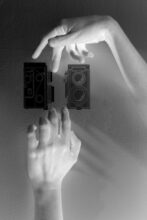
To echo Borda’s visual timescale, it seems appropriate to begin with Seeing Technologies, a series of carefully composed black and white prints featuring cameras framed delicately by gesturing human hands. These negative prints possess a great luminosity spreading from the fingertips, bringing to mind a sense of power and energy in our ability to harness images from the world into tangible prints and drawing attention to the use of the hands as a tool in the photographic and developing processes. The stark monochrome and simple unframed presentation of these prints belie their intricacies. There is a complex layering of light and dark, the addition of spidery diagrams and geometric shapes which calibrate certain details of the negative forms.
This intricacy is continued through Interrogations of a Camera, framed x-rays of camera bodies that reveal their inner mechanisms. Initially they appear as abstract shapes that at once become blueprint drawings for futuristic buildings or delicate architectural floor plans (an interesting observation considering the architectural origins of ‘camera’) before coming back into focus as ethereal alternative representations of these machines that feel so universally familiar.
The colour images in Camera Still Life – A Memento Mori are appropriated from online auction sites. The vintage camera equipment, now redundant in the digital age, possesses the warmth and aesthetically pleasing quality of antiques, yet the title (Latin meaning ‘a reminder of death’) hints at something darker, not just the short lifespan of much technological equipment but also our own mortality, and the notion of ‘immortalising’ a subject through film.
Through delicate alternative ways of seeing the camera as a compositional subject, Camera Histories encourages a re-evaluation of this technology that has seamlessly become ingrained in our daily existence. The works, simply presented, take in many traditions of the medium, from darkroom experiments to ocular mechanisms, cliché sunsets to Google Earth, exploring its position historically, commercially and aesthetically.
As cameras become increasingly covert, assimilated into other technologies and apps, Camera Histories draws our gaze back to the physicality of photography, the alchemy and process of photo creation, and most importantly seeks a consideration towards the objects that enable the images which flood our daily vision.
– reviewed by Rebecca Travis