reviewed by Elizabeth Woodger
The Great British Summer Holiday: a curious dichotomy of fantasy and reality. The fantasy being hot sunny days spent playing games on the beach and paddling in the sea. The reality being wind and rain, and families huddled together eating their ice creams. It’s a formative experience that my parents can remember well and that my own children now participate in.
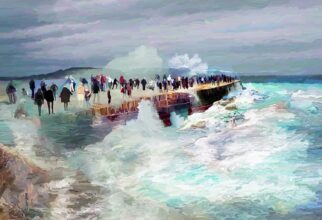
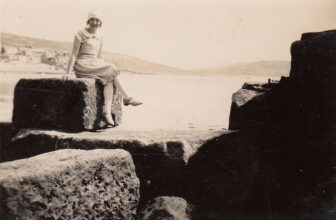
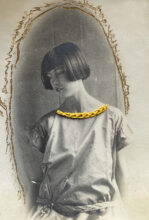
In her current solo exhibition Not many people here yet, Teresa Williams explores this idea of shared experiences using found photographs, digital montage and physical manipulation. The artist’s journey started when she acquired a century-old photo album featuring two young women, Milly and Lily, as they travelled together on the cusp of adulthood. Among the many places they were photographed was the Cobb at Lyme Regis – a Grade I listed, curved stone breakwater – a place that Milly, Lily and the artist each have in common, as do countless other British holiday makers (myself included). For Williams, Lyme Regis was the setting of her first holiday romance. For me it was a place to study geology and examine fossils. For Milly and Lily, we can only guess. At the Cobb, each of us was separated by time and intent, and yet we are all inexorably connected by having stood in that one place.
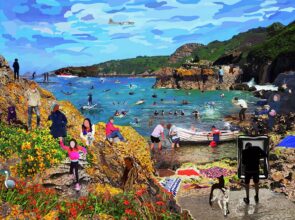
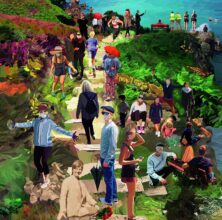
In response to these connections, Williams set out to visit and re-photograph the images contained within Milly and Lily’s photo album. Or rather she would have done, had the global travel situation not changed so dramatically. A new approach was clearly needed and to that end the artist started collecting screenshots of Lyme Regis, and later, of Bouley Bay in Jersey. Hundreds of photographic elements – fragments of sea, sky, rocks, individual flowers and people – were meticulously and painstakingly reassembled in order to create the illusion of crowds occupying these beauty spots. There’s something ostensibly obsessive about the process of collecting and contriving these crowds but by hybridising and abstracting the photographic process, Williams creates new visual associations, which successfully allude to the multi-layered narratives of a century’s worth of visitors.
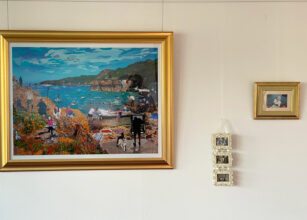
At first glance, the extensive photographic assemblages could be traditional oil paintings; rich and vibrant landscapes framed in ornate gold. In reality, the painterly aesthetic perceived on the surface is a subtle deception that harbours a surreal duality. It doesn’t take long for the viewer to start noticing incongruities in the images. Heavy winter coats and umbrellas are juxtaposed with flip flops and sunglasses, in essence blending time within space. Surreal props also make an appearance – a birthday balloon, a picture frame and a zebra – as the artist stages a performance inspired by her lockdown surroundings and embellished by an assortment of old postcards that she purchased online. Of course, the tell-tale signs of the Covid-19 pandemic are inextricably woven into the making of these tableaux. They’re there in the irony of constructing tightly packed crowds at a time when congregating was prohibited. They’re there in the obscured faces and the fragments of newspaper articles. And they’re there in the figure of the artist herself, asleep under a cliffside lamp and effectively eluding her present reality.
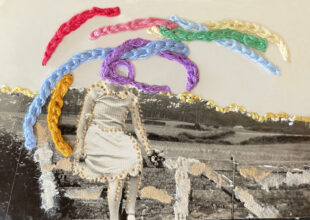
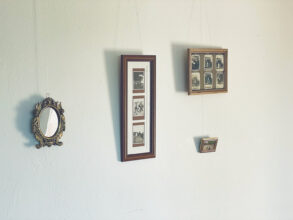
The expansive and intricate digital composites that form the core of this exhibition sit comfortably alongside small clusters of archival memorabilia. Found photographs, postcards and portraits – some physically altered by Williams using paint, collage, crochet and embroidery – are displayed in the gallery in much the same way that they might be displayed in a family home. Together, these images serve as an effective reminder that certain experiences are universal. What’s more, it’s remarkable that an exhibition conceived out of frustration and confinement resonates not with sorrow or isolation, but with humour, optimism and ultimately, a sense of the enduring interconnectedness of humanity.
__________
Teresa Williams ‘Not many people here yet’ is shown at Wolfson College, Oxford, as part of PHOTO OXFORD 2021 (11.10.21 – 10.12.21)
For further viewing: teresawilliamsphotography.com Photo Oxford 2021
Elizabeth Woodger is a photographic artist based in Somerset. She has a PhD in palaeoclimatology and a background in geological research. Her artistic practice experiments with alternative photographic representations of the landscape, and it draws heavily on the duality of science and art. Her work has been exhibited both nationally and internationally. It has also been shortlisted, or selected, for several photographic awards. elizabethwoodger.com