

Reviewed by Bronwen Colquhoun
Gareth Phillips’s new exhibition, ‘The Abysm’, focuses on the intimate relationship between a father and son following the diagnosis to the latter of a life-threatening illness. This central theme is interwoven and contextualized with additional narratives that focus on relationships between other family members (most notably between Phillips’s mother and father), the domestic, and notions of identity and belonging as embodied through landscape.
‘The Abysm’ began seven years ago as a project entitled ‘Ligatures of Ivy’ in which Phillips walked the entire coastal path of Wales, processing and understanding his relationship with his father. Phillips camped and lived off the land whilst engaging with local people he encountered along the way. The landscape played a formative role in the development of this body of work, alongside others created as a result of the walk. Since then, ‘The Abysm’ has seen many iterations, all in book format, the focus shifting from landscape, to family, from father to mother, and back again. The endpoint is the culmination of all of this work into a final presentation that chronicles the journey that he and his family have endured to get to this point, and simultaneously challenges the mode through which one experiences and understands this journey.
Phillips has spoken of his burgeoning desire to photograph his father following the diagnosis and, likewise, his father’s willingness to collaborate in this process. He lays bare the shared emotional and physical trauma of coming to terms with and living through a disease that is unpredictable, immoral and defiant. His father’s experience is the subject of documentation, yet Phillips’s own emotional wellbeing is palpable; his photographs seemingly an act of reconciliation.
Phillips has also spoken about this project as a defining moment for his practice, where his fascination with the materiality of ‘the book’ was truly activated. The project offered the opportunity to experiment with different book concepts and formats, and the visibility of this creative process is critical to the project as a whole.
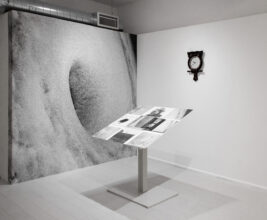
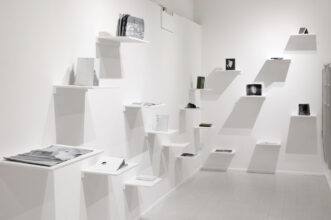
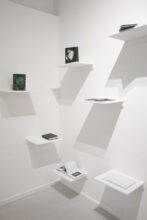
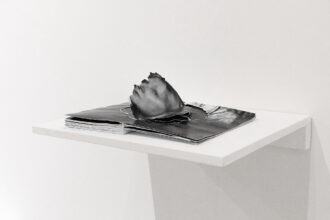
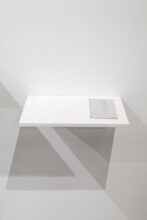
‘The Abysm’ is presented against a backdrop of a black hole-like image, enlarged to fill the back wall from floor to ceiling, and emblematic of the abyss from which the name of the exhibition derives. The exhibition comprises three elements; the first is a collection of nineteen book dummies, each one portraying a subtle, disparate narrative that metamorphoses as Phillips embarks on his journey to reach the endpoint of the project. The book dummies vary in size, format and subject matter. For example, one of modest size in a slim, portrait orientation focuses entirely on Phillips’s mother. Another has a recurring blackbird motif, believed by some to be a symbol of death. The dummies are displayed as a library, each with their own shelf situated at varying heights on the wall and each positioned on the shelf differently. Visitors are invited to spend time looking at the books individually, handling them, experiencing their nuances, and then replacing them, perhaps with a different page visible, or repositioned for the next visitor to discover.
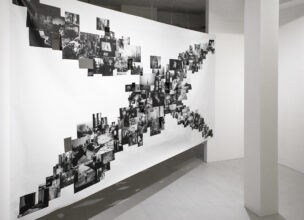
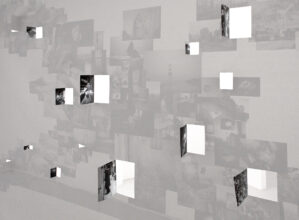
The second element is a single montage book, comprising all of the photographs taken for ‘The Abysm’ and printed on a four-metre-wide page suspended from the ceiling. Selected images have been cut out and folded back within the montage, creating new pages behind the surface of the work and illuminating the negative space with distorted shapes of light. The sheer quantity of images is representative of Phillips’s and his father’s anxiety-afflicted experience, the scale of the printed page reinforcing this notion.
The third element combines the previous two elements into a final edition of ‘The Abysm’. The image of the large-scale abyss frames a standing plinth which holds the book itself. A clock from Phillips’s father’s living room hangs directly opposite, reminding us of our collective mortality. The book is designed to be opened into a grid of 3 x 3 pages. For the purposes of the exhibition, it is fixed to the plinth in a fully opened format however, one would ordinarily be able to fold the book in multiple ways and interact with the sequencing and assembly of image and narrative.
Phillips’s practice expands and transforms conventional understandings of the photobook as an object. From structure to scale, content, function and interactivity, his experimentation with the materiality of the book is situated at the core of his practice and breaks new ground. He has dedicated the last five years to obsessively exploring this concept and ‘The Abysm’ is evidence of his ambition to rethink the role of the photobook from object-based to experience-based.
__________
The Abysm, an exhibition by Gareth Phillips, was presented at Elysium Gallery, Swansea (26 November – 14 December 2021) and reviewed here by Bronwen Colquhoun.
Gareth Phillips is an established photographer working predominately in the medium of photo books, maquette and installation. He is based between Wales and Spain and has an extensive international exhibition history. Phillips has been recognised in numerous awards and continues to be commissioned by clients internationally. A selection of his work resides in the David Hurn Collection at the Amgueddfa Cymru – National Museum Wales.
Dr. Bronwen Colquhoun is Senior Curator of Photography at Amgueddfa Cymru – National Museum Wales. She curates the exhibition programme for the Museum’s permanent photography gallery as well as contributing to temporary exhibition programmes. She previously worked as Assistant Curator of Photographs at the Victoria and Albert Museum and holds a PhD from Newcastle University. At Amgueddfa Cymru Bronwen has curated photography exhibitions including Swaps: Photographs from the David Hurn Collection, Women in Focus, ARTIST ROOMS: August Sander, Bernd and Hilla Becher: Industrial Visions and Martin Parr in Wales.