Most British civilians never encounter the tangible reality of war. Yet they regularly consume it as a leisure activity: through films, fashion, computer games, parades or air-shows. These civilians are more than spectators; they are actors whose endorsement of militarism, however tacit, has consequences.
Such is the focus of The Home Front, an exhibition of three related series by Melanie Friend, shot predominantly at UK air-shows between 2008 and 2012. Air-shows are seen as a jolly day out by the families and military enthusiasts in attendance, a chance to see historic aircraft up close, watch impressive air displays and commemorate victories past. And, as demonstrations of military might, they also have a PR value in attracting young recruits and promoting the armed forces as a brand.
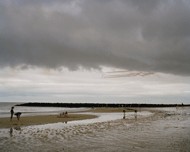
That discord between civilian experience and military intent is where the power of Friend’s work resides. A set of mostly seaside landscapes, shot during flypasts in medium format, opens the show. Although the sky is a weighty presence, often taking up half or more of the frame, the planes themselves can be hard to spot. Indeed, in some, the holidaymakers seem almost oblivious to them. A shot of a girl with her hands clamped over her ears, however, reminds us of their considerable aural impact. In these familiar beach scenes, in which kids build sandcastles or paddle in the shallows, the sense of military jets above jars.
As we move through the exhibition, we see civilians as increasingly active participants. The next section takes us into the thick of the air-show. These pictures, freer, more photojournalistic in manner, are displayed in clusters. In them we see children dress up in uniforms and pose with weapons – their exploits snapped on camera phones by proud parents. With its ice cream vans and tank rides, the air-show resembles something between a fairground and an immersive performance.
By the time we reach the final images, taken at arms fairs, it’s not simply the idea of war being sold, but actual weapons. Like the beaches earlier, the exhibition centres where the fairs are held are otherwise civilian spaces temporarily transformed for military ends. Anyone is free to attend an air-show; few see what goes on behind these normally closed doors. It is a surreal, sanitised environment, far removed from war’s physical effects, where sharp-suited men wander about sizing up missiles and ogling gold-plated pistols.
The arms fair pictures, which don’t feature in the accompanying book, published by Dewi Lewis, draw our attention to the global economic forces underpinning militarism. But while the international arms industry undoubtedly benefits from the repackaging of war as entertainment, it is also part of it. For here too we find elements of fantasy and theatre at play. Friend’s work doesn’t propose a straightforward conclusion. Instead, it leaves the viewer questioning their role in militarism as both a cultural and a commercial practice and, crucially, how the two connect.