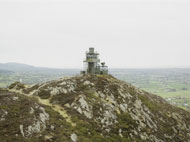
At the Imperial War Museum (Southwark), Magnum photographer Donovan Wylie explores the theme of surveillance, its significance and its impact on landscape, in the exhibition Vision and Power. The large-scale digital photographs of landscapes are documentary in style. But the long views into a hazy distance are ambiguously attractive, because they stem from these wartime observation decks and represent armies’ predatory gaze.
Observing observation is an interesting take on the representation of war. Far from showing action or soldiers, Wylie proposes to look at the long and slow process of scrutinizing a field of vision. The link between “vision” and “power” is an obvious one: the sacred position afforded by an elevated observation post is that of a god upon its subjects. Foucault has theorised this in Discipline and Punish (1975), using the example of the Panopticon: not only does unimpeached vision allow control and therefore power, the consciousness of being observed is also the first step to self-discipline. Therefore, while the relationship between vision and power is the backbone of this show, I found that other underlying themes were of equal interest.
The juxtaposition of images from different geographical locations creates striking colour-blocks: green for Ireland, sand colour for Afghanistan, white for the Arctic, etc. This functioned like a statement about colour: geography, as a subject, plays upon colour codes; camouflage is about mingling into the local colour; architecture’s colours are meaningful. Surveillance from these vantage points is an exercise with and against an all-embracing monochromatic scale of tones. Similarly, looking at Wylie’s works is like diving into one colour and deciphering its many nuances.
The wall text clearly points to Wylie’s technique as a digital photographer, which includes retouching images in post-production, and in particular removing some details. This remark points to the liminal position that this kind of photography holds between documentary and art, truth and fiction, observation and construction. However, there is not much further to go in this direction of investigation for the casual visitor, as it is not made clear where the artist has retouched and where he has not. As a consequence, the visitor’s suspicion is aroused throughout, but questions remain unanswered.
Another underlying strand of reflection in Wylie’s projects, however, seemed to revolve around the process of decay. Many of the depicted watchtowers were either not in use or about to be taken down. Most were located in a desert, be it of sand or snow, or a human-enforced no man’s land. And while the purpose of these architectural beasts is to spot life and movement, the watchtowers themselves appear to be unmanned and abandoned. In any case, no human beings are to be seen in the photographs. In that sense, these images were not only about the power that the observation posts give, but rather pointed to a historical commentary on the transfers of power taking place in war zones over time.
———-
Donovan Wylie: Vision as Power continues at IWM London until 21 April 2014