Letters on Photography by Kim Beil and Annebella Pollen
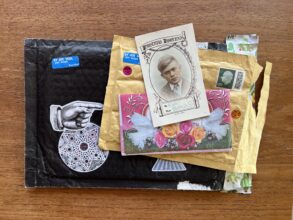
Correspondence Course began as a creative adventure during the confinement of Covid lockdowns. While the doors to many museums and archives were still locked, two historians of visual culture, Annebella Pollen and Kim Beil, sent each other, by post, photographic curiosities and ephemera as gifts and as writing prompts. The resulting eight essays are written as personal letters. They are informal, reflective takes on photographic history and collecting, with research folded into autobiographical stories. The project takes its name from the first item sent out across the sea: a guide for a 1960s educational course on camera technique taught remotely, via post. Below, Pollen and Beil present these Correspondences as an evolving series of Photomonitor Experiments.
__________
Correspondence Course 2
From Kim Beil to Annebella Pollen:
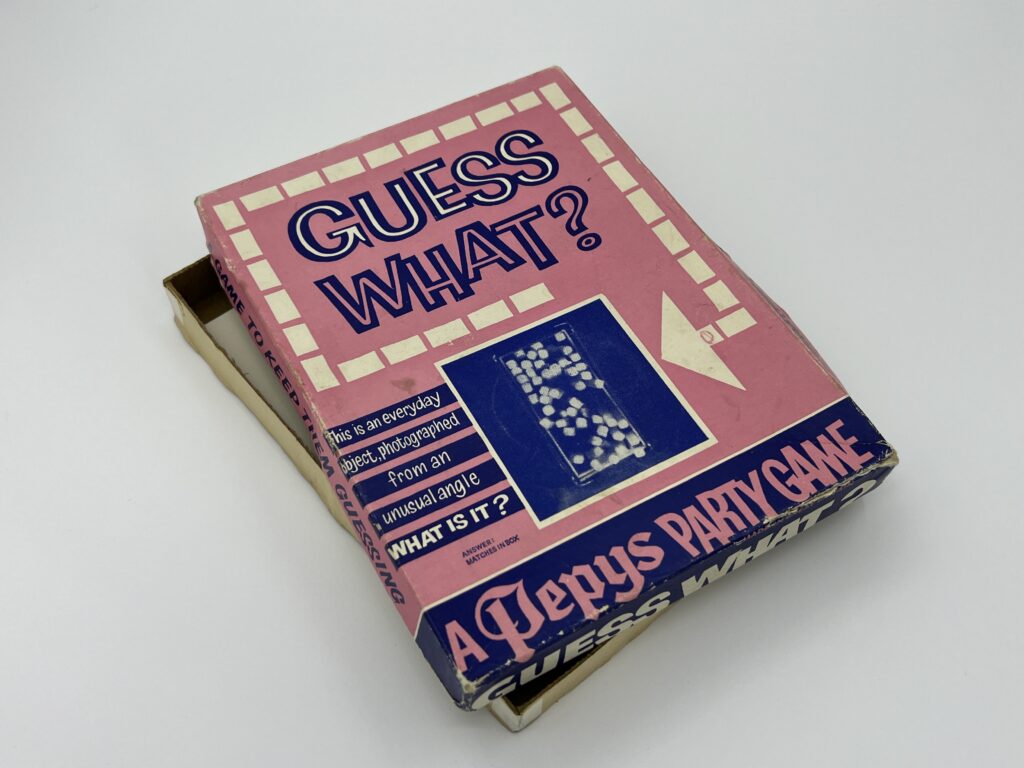
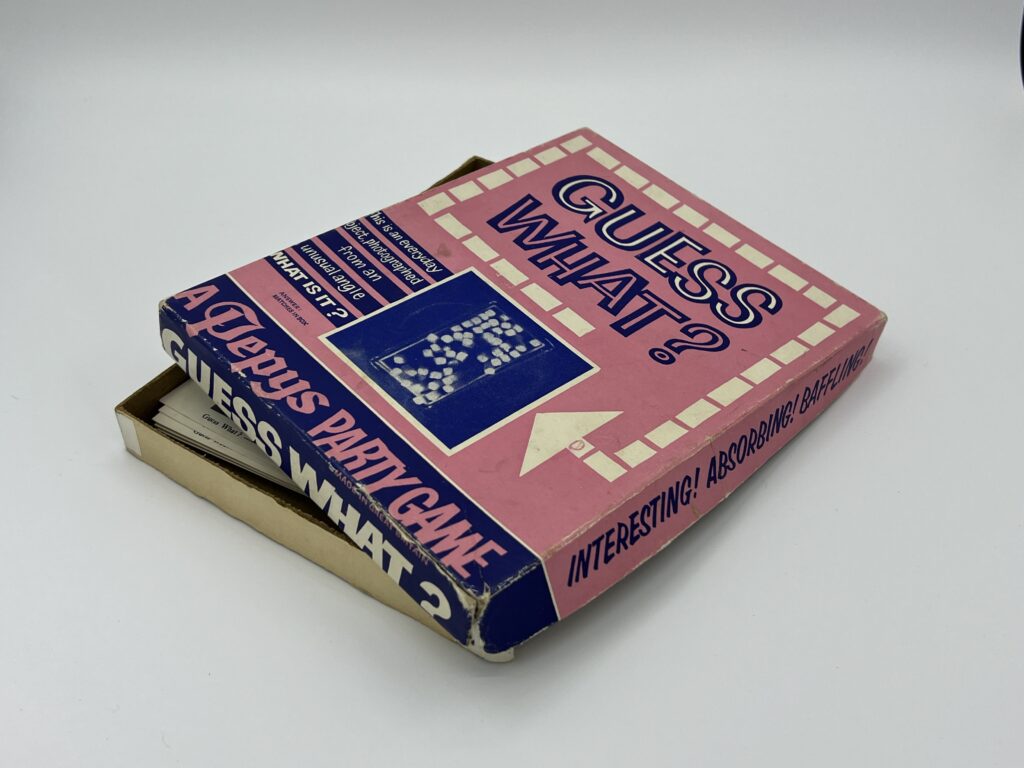
At first I thought the promises of this “party game” were pure marketing hyperbole: “Interesting! Absorbing! Baffling!” Its Pepti-pink box suggests that the party involved too much absorption of intoxicants other than good cheer.
Then I got a new iPhone and spent an entire morning making macro pictures of rocks, marbles, coins, postcards and the pages of well-worn books. Also: blankets, shells, shards of pottery, stuffed toys, and even my hand when I ran out of other Lilliputian treasures. I remembered, while looking through the lens, that this was my favorite kind of picture as a child. The back page of National Geographic World, a children’s magazine, presented a grid of nine macro photographs each month. They were close-up views of everyday things, both natural and manmade. Birds and bugs, machines and melons posed side-by-side for their class picture.
Children are usually powerless to understand the workings of the world. It’s a wilderness of ‘why’? These pictures promised answers. And, crucially, they were answers that a child could identify, even identify with. Maybe children are better suited to seeing things close-up, with their perfect vision and their low vantage point.
Only belatedly do I realize that these pictures I loved were abstractions. And at first it seems strange that a child would gravitate towards abstraction. In teaching art history, I’ve noticed that an appreciation for abstraction often comes later, only after students have grown tired of figuration. But, actually, most children’s art begins in abstraction. Before they learn the rules, children’s art is all about color and form. It doesn’t have to represent anything except itself. Modern artists took it as their task to return to this untutored state. As Monet put it: “I wish I had been born blind and then suddenly gained my sight so that I could begin to paint without knowing what the objects were that I could see before me.”
Children don’t realize that the world around them is strange. They recognize things as they are. I recall only one instance of being aware of the size difference between me and adults. I remember clearly standing in line at the grocery store staring at the backs of legs. Otherwise, it felt normal; there were magazines displayed at exactly my height. Some part of the world always seems to be made for us, even if some shelves are too high, spoons are too big, and scissors don’t work right. Perhaps the world seems inexplicable or unjust for a child, but it doesn’t seem too large. Only when Alice falls into the rabbit hole was I startled by a sense of recognition, by the realization that other people thought this perspective was strange.
Adults need abstraction, especially photographic abstractions, for a different reason. It’s Viktor Shklovsky’s old trick of defamiliarization. The macro-photograph promises the real world (true because it is a photograph), but runs amok. It reveals the strangeness of the world before we organize it into a picture, like a landscape perfected by the Claude glass.
Even in the nineteenth century, when photographs made through microscopes first became popular, there was an emphasis on how they revealed the extraordinary aspects of ordinary things. Photomicrographs featured flowers and bugs and mud. The American photographer Marcus Aurelius Root raved about his close-up visions of “glacial ice” and “gnats’ eyes.” The comprehensive and catholic lists emphasize the fact that these things are present to us all the time, but we just can’t see them. These are everyday things, magnified beyond our own powers of observation.
Close-up pictures rekindle the prospects for wonder in the visual world. Like a conspiracy theory, the world hides its atoms just out of sight. Macro photographs promise revelation. They reignite the possibilities for photography at large. In an obituary of the fashion photographer Hiro, the New York Times cites this mantra: “If you look into the camera and you see something you recognize, don’t click the shutter.” The best photography, as the ad copy on the Guess What box promises, is “a game to keep them guessing.”
I’m already guessing at what you’ll send next—and how it’ll prompt me to see photography and my love of it anew.
__________
With thanks to Annebella Pollen and Kim Beil for their text and images.
Annebella Pollen has been writing about photographic archives and lesser-known visual histories for over twenty years. She is the author of five books: Mass Photography (2015); The Kindred of the Kibbo Kift (2015); Nudism in a Cold Climate (2021); More Than a Snapshot (2023) and Art without Frontiers (2023). She is Professor of Visual and Material Culture at University of Brighton.
Kim Beil is an art historian who teaches at Stanford University. She is the author of two books: Good Pictures: A History of Popular Photography (Stanford, 2020) and Anonymous Objects: Inscrutable Photographs and the Unknown (MACK, 2023). Her writing on photography and visual culture also appears in the New York Times, the Atlantic, the Believer, and Cabinet magazines, among many other publications.