Letters on Photography by Kim Beil and Annebella Pollen
Correspondence Course began as a creative adventure during the confinement of Covid lockdowns. While the doors to many museums and archives were still locked, two historians of visual culture, Annebella Pollen and Kim Beil, sent each other, by post, photographic curiosities and ephemera as gifts and as writing prompts. The resulting eight essays are written as personal letters. They are informal, reflective takes on photographic history and collecting, with research folded into autobiographical stories. The project takes its name from the first item sent out across the sea: a guide for a 1960s educational course on camera technique taught remotely, via post. Below, Pollen and Beil present these Correspondences as an evolving series of Photomonitor Experiments.
Correspondence Course 3
From Annebella Pollen to Kim Beil:

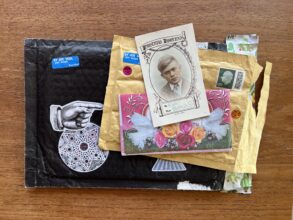
Your package arrived in pieces. A plastic bag from Royal Mail, printed with apologies for the parcel’s parlous state, contained your airmail envelope, fine and fragile, addressed in delicate pencil, but torn down one side. It suited the contents it contained. Alongside your postcard greeting, I found another envelope, spotted by time, containing historic postcard pieces and plastic sleeves.
A delicate device was layered between brittle polythene and yellowed sheets: “a calibrated transparent photographic wedge for measuring the speed, contrast, exposure factor and tonal range of photographic papers, and the relative actinic strength of printing lights and enlargers”.
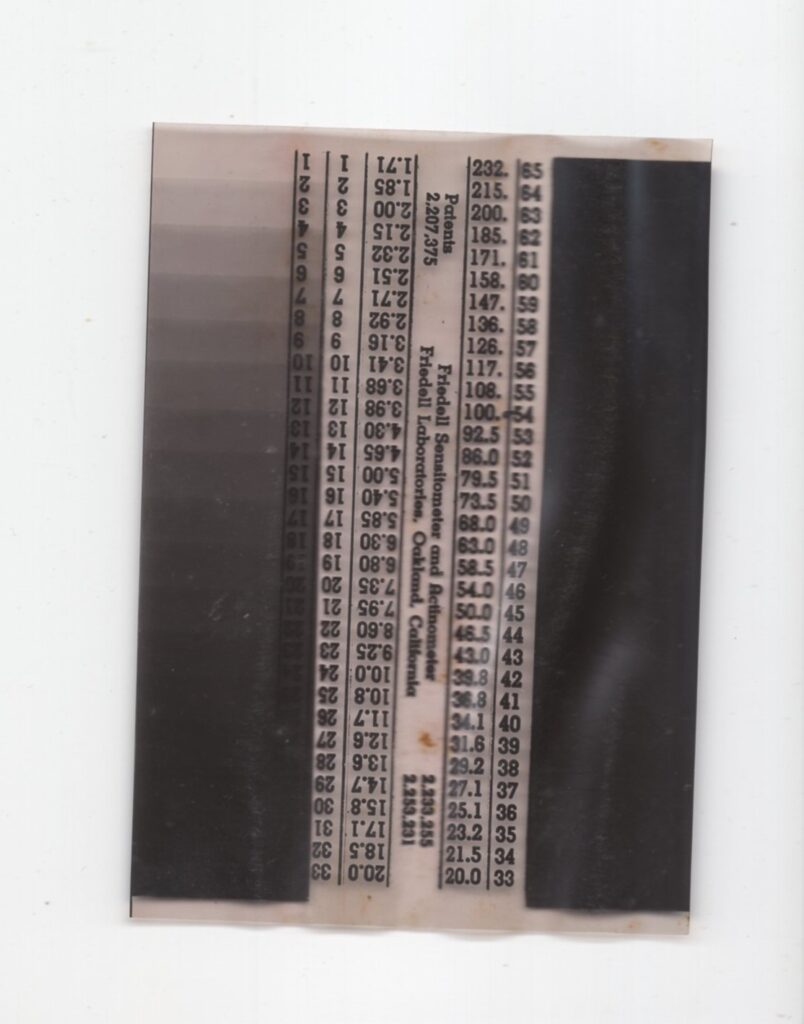
This gadget, a “Sensitometer and Actinometer”, was effectively a sheet of film, around the size of a credit card, through which 65 shades of grey could be reproduced on a test print, and from which an ideal setting for photographic contrast could be identified. Via a formidable computational method, printed in tiny instructions and requiring significant mathematical mastery, the device promised freedom from guesswork and the happy union of paper print to light exposure.
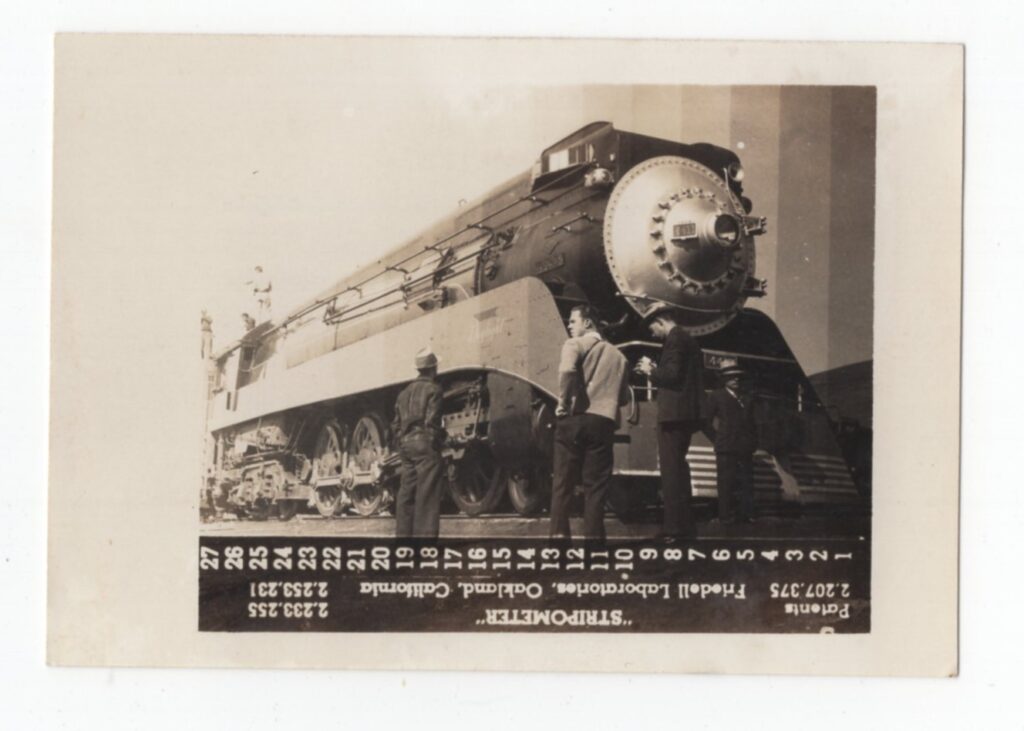
The “Stripometer”, another patented tool from Friedell Laboratories, at the same Californian location, was much simpler and promised the achievement of “the most perfect prints” emphasising, with two delighted exclamation marks, that no calculations were needed at all.
A small example photograph, of a streamlined locomotive admired by a group of four men, lined in vertical gradations of light and shade, revealed not only the possible tonal outcomes but also the meter’s suitable subject matter: American masculinity, speed and engineering.
These “sensitometric aids” were discussed in Popular Photography in October 1942, where they were promoted as innovative items for the amateur darkroom alongside a range of other must-haves, from a transparent apron designed to be “impervious to ordinary photographic chemicals” to Superflash and Superflood lamps. Despite some small-print acknowledgements that commodities may not be available due to wartime supply issues, the magazine was packed with abundant advertisements for technical novelties, each emphasising simplicity and labour-saving credentials, while at the same time demonstrating how complex and laborious mid-century darkroom photography could be, and how much it was rooted in chemistry and optics, at least among those readers who considered themselves photographers-cum-scientists. Instruments for measuring, enhancing and improving photography, often with suggestive portmanteau brand names from Kin-O-Lux to Developix, demonstrated the expanding market for proprietary products for affluent American hobbyists by mail order. The Stripometer and its compatriots were among them.
The same issue, however, contains a tellingly satirical story by John Adam Knight, Camera Editor of the New York Post, lampooning those who emphasise “too-modern” and “ultra-scientific photography” over other aspects of image production. A bespectacled stock figure, Horace Dogsbody, is mocked for his enthusiasm for photographic contraptions, exaggerated for comic effect, such as the “argon-mercury-vapor lamp screened with a Corning 986 filter to transmit only ultra-violet rays of 2537 Angstrom”. The cautionary tale comes to a bitter end when the protagonist’s pride in his latest apparatus, the “Inspectoscope” that reveals prints otherwise invisible to the naked eye, spectacularly fails to show a single picture in a denouement worthy of the Emperor’s New Clothes.
Once described as “indispensable” and “easy to use and easy to understand”, the inventions you sent have become examples of the photographic ephemera with which the second-hand market is overpopulated. Full of mid-century promises of efficiency, precision and modernity, but now consigned to obscurity, their function will be largely incomprehensible to many users of twenty-first century cameras where measuring systems are mostly built-in and self-correcting. Their forgotten technical names are also-rans in a photographic history littered with commercial gizmos, each claiming to be scientific necessities capable of delivering ever-elusive photographic perfection.
__________
With thanks to Annebella Pollen and Kim Beil for their text and images.
Annebella Pollen has been writing about photographic archives and lesser-known visual histories for over twenty years. She is the author of five books: Mass Photography (2015); The Kindred of the Kibbo Kift (2015); Nudism in a Cold Climate (2021); More Than a Snapshot (2023) and Art without Frontiers (2023). She is Professor of Visual and Material Culture at University of Brighton.
Kim Beil is an art historian who teaches at Stanford University. She is the author of two books: Good Pictures: A History of Popular Photography (Stanford, 2020) and Anonymous Objects: Inscrutable Photographs and the Unknown (MACK, 2023). Her writing on photography and visual culture also appears in the New York Times, the Atlantic, the Believer, and Cabinet magazines, among many other publications.