Letters on Photography by Kim Beil and Annebella Pollen
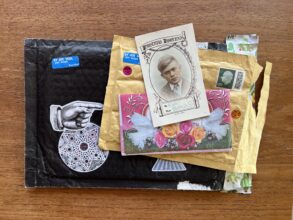
Correspondence Course began as a creative adventure during the confinement of Covid lockdowns. While the doors to many museums and archives were still locked, two historians of visual culture, Annebella Pollen and Kim Beil, sent each other, by post, photographic curiosities and ephemera as gifts and as writing prompts. The resulting eight essays are written as personal letters. They are informal, reflective takes on photographic history and collecting, with research folded into autobiographical stories. The project takes its name from the first item sent out across the sea: a guide for a 1960s educational course on camera technique taught remotely, via post. Below, Pollen and Beil present these Correspondences as an evolving series of Photomonitor Experiments.
__________
Correspondence Course #4
From Kim Beil to Annebella Pollen
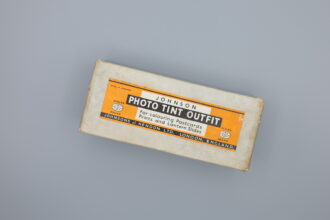
The Johnson’s Photo Tint pamphlet claims, “Ever since photography was first invented men have sought means of reproducing in colour the scenes of everyday life which the camera will record so faithfully in black and white.” Mostly, men sought out women to color photographs by hand with oil or watercolor paints.
Virginia Penny’s 1863 book, The Employments of Women, devotes a long passage to the possibilities in photographic coloring. Penny conducted interviews with studio proprietors and women workers, chiefly in the Northeastern United States. Mr. F., a studio owner in Philadelphia, told her he “would employ good lady artists” if only he could get them. But, then he continued “ladies do not succeed so well, because they do not have such an efficient course of training.”
Several photographers suggested that “English ladies color best.” One noted that his firm could not “get their coloring done in New York, so [they] have most of it done in London; and as work is cheaper, it costs them no more with the addition of transportation.” Another Philadelphia photographer took care to advertise that his colorist was “the daughter of an English painter.”
Penny extended her interviews over the Atlantic. She reports: “Mr. B., a photographist, writes: ‘Women are employed in my branch of art in England. I would like to find competent assistance, but have been unable to do so. The work is not unhealthy, but it is very trying to the eyes. I should think that in many respects the work would be well adapted to females, but think, from trials that I have made, that the mathematical precision of the work is a feature unfavorable to the feminine mind. Were I to find such assistance as I would be satisfied with, I would pay according to capacity and work. Thorough artistic education and natural talents are essential. In point of taste, as regards color and elegance, I think women might be superior; as regards precision and firmness of minute work, I am uncertain. It would require considerable time and patience to learn the art.’”
The businessmen whom Penny interviewed insisted, like this one, that photographic coloring could be taught to women, but since it hadn’t been, there were no good women photo colorists. Why have there been no great women artists?
Linda Nochlin disparages the feminist response in the late sixties and early seventies, which, she says, was to “dig up examples of worthy or insufficiently appreciated women artists throughout history; to rehabilitate rather modest, if interesting and productive careers; to ‘rediscover’ forgotten flower painters or David followers.” By engaging with the question, Nochlin argues, these efforts of recuperation accept its premise: there were no greats.
Reading Virginia Penny’s guidebook to employments for women, it’s no mystery where this premise came from. The studio owners bemoan the lack of training for women, some even offer lessons to women at $10 per series, then insist that women can only be good at some aspects of the art. And, therefore, though they employ women artists, they can only pay them a fraction of what they pay men. Sometimes the imbalance is couched in Taylorist principles: women can only produce two-thirds of the work that men accomplish, therefore they are paid less (but less than two-thirds of men’s wages). Other studio owners insist that training women is a waste of time, because after marriage, women will become workers devoted only to their husbands (where they will be paid one-hundred percent less).
Here, then, is the answer. A small pamphlet, a box of nine paints, and two well-worn brushes. As correspondence courses changed education for women, as well as rural and working class men, the do-it-yourself kit makes way for training, at one’s own pace and on one’s own schedule. It is a studio and a classroom of one’s own.
There is no promise in this neat gray box that the colorist will go on to professional acclaim or artistic success. But, it does promise that the practice is open to anyone, even “without previous experience.”
Johnson’s, a twentieth-century supplier of photographic and cinematographic chemicals, moved to the Hendon location in 1927. This kit is likely from the 1930s. The pamphlet also advertises a larger set of twelve colors, which included mixing trays, and another still that featured gold and silver powders. Nearly a century after the invention of photography, the history seems to collapse in on itself: hand-coloring procedures were among the first processes to be patented in the 1840s in the United States. The most frequently added colors were blush and daubs of gold on jewelry.
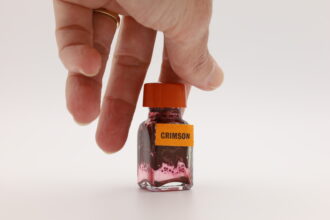
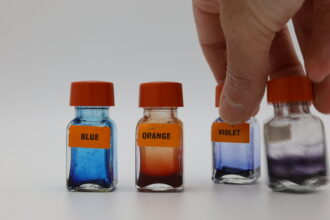
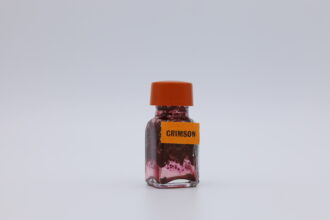
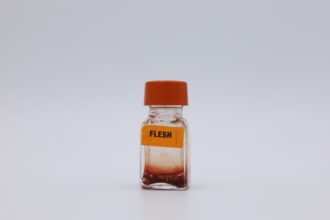
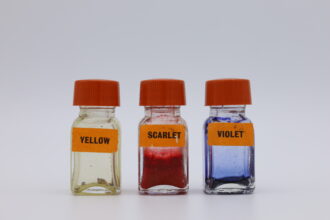
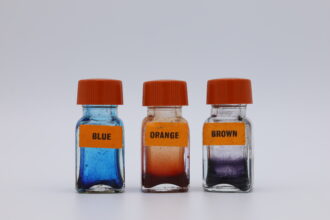
The colors remaining in the Johnson’s set corroborate this. The so-called ‘flesh’ tone bottle contains nothing but a narrow band of dried blood-orange sludge. Other bottles—violet, green, and scarlet—bear higher high-water marks. The instructional booklet cautions: “Colour, to be effective, needs to be used sparingly. A picture having patches of every colour in the box will not give the brilliant effect that one might expect. Use your colour to emphasize the most interesting portion of the picture.”
The kit advertises itself as suitable for “Colouring postcards, Prints, and Lantern Slides.” Through an analysis of these kits, could the pictures they colored be deduced? The empty flesh tint bottle certainly suggests which faces featured in these postcards, prints, and lantern slides. And, although the pamphlet describes how to mix the pure pigments to make other colors, such as purple, pale green, and brick red, one suspects that “Air Force blue” and khaki drew down the blue and yellow bottles over the years.
Since the 1860s when Virginia Penny was interviewing ‘photographists,’ how many women learned the art? Did one of their relatives learn from this set of photo tints, this “efficient course of training,” neatly packaged in a box? The user of these pigments has left behind two extra paintbrushes, bent like a mop in the box top, but no other clues as to whether she was a forgotten flower painter, a David follower, or any other genre of good lady artist. She has evaporated, leaving only a ghostly cloud of blue pigment and a thick ring of scarlet.
__________
With thanks to Annebella Pollen and Kim Beil for their text and images.
Annebella Pollen has been writing about photographic archives and lesser-known visual histories for over twenty years. She is the author of five books: Mass Photography (2015); The Kindred of the Kibbo Kift (2015); Nudism in a Cold Climate (2021); More Than a Snapshot (2023) and Art without Frontiers (2023). She is Professor of Visual and Material Culture at University of Brighton.
Kim Beil is an art historian who teaches at Stanford University. She is the author of two books: Good Pictures: A History of Popular Photography (Stanford, 2020) and Anonymous Objects: Inscrutable Photographs and the Unknown (MACK, 2023). Her writing on photography and visual culture also appears in the New York Times, the Atlantic, the Believer, and Cabinet magazines, among many other publications.